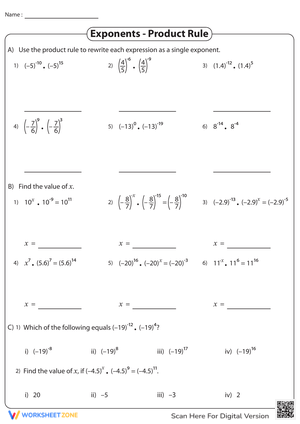
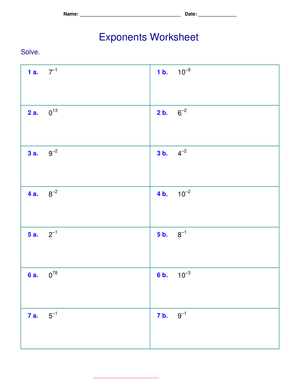
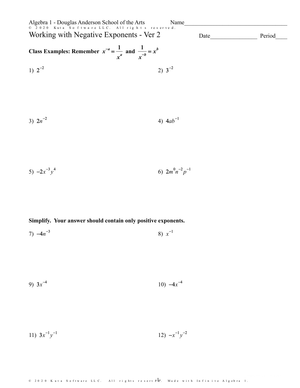
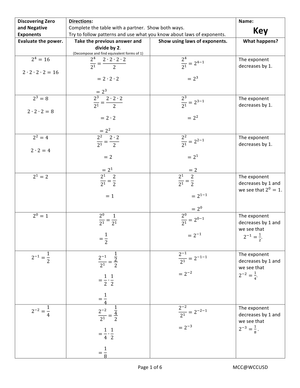
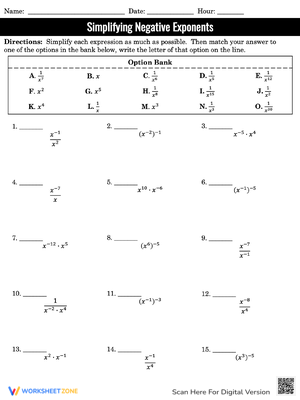
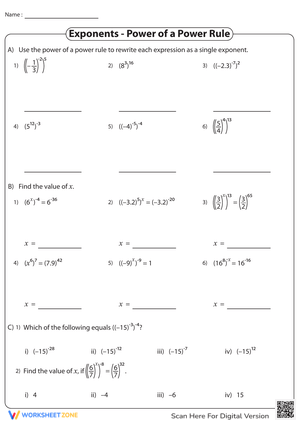
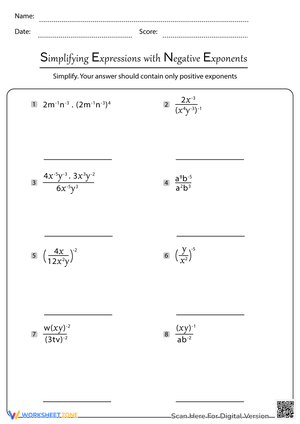
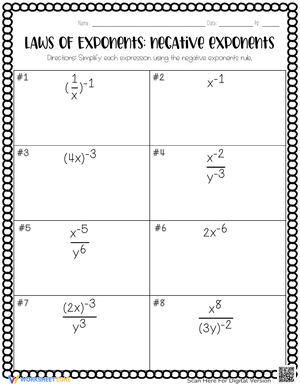
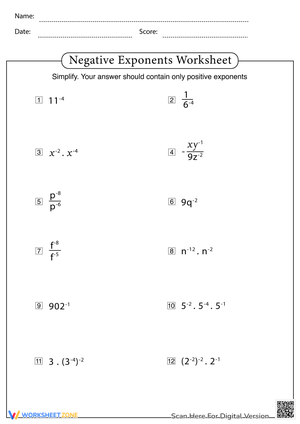
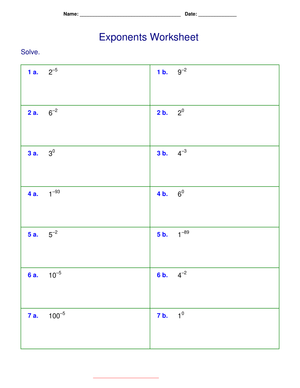
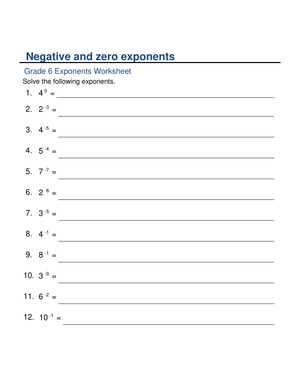
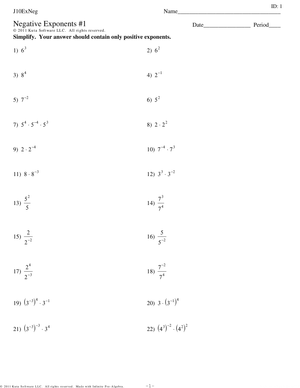
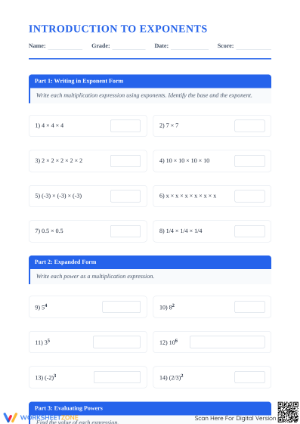
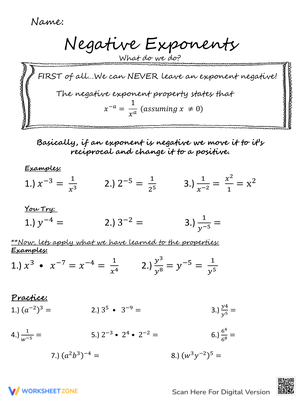
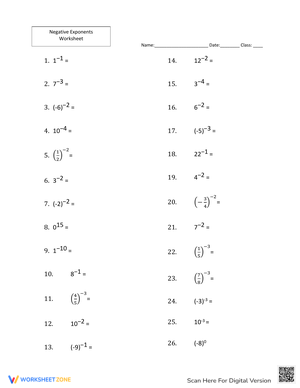
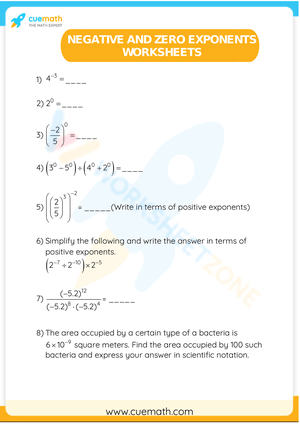
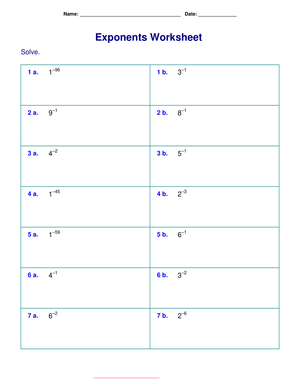
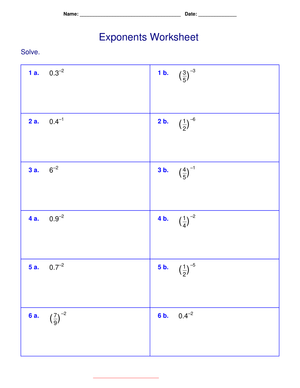
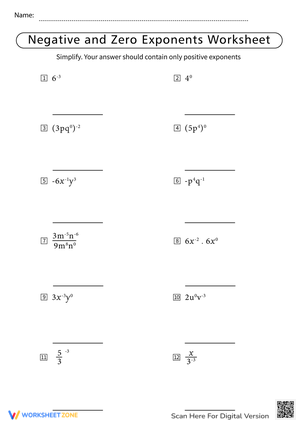
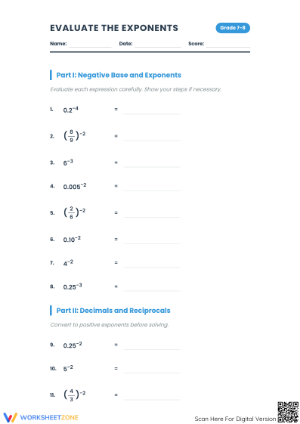
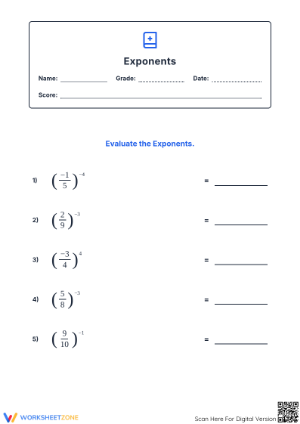
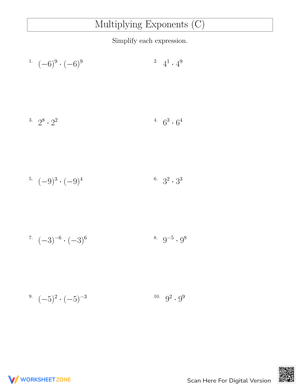
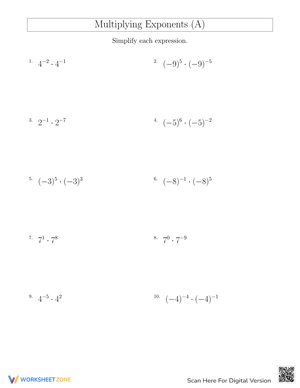
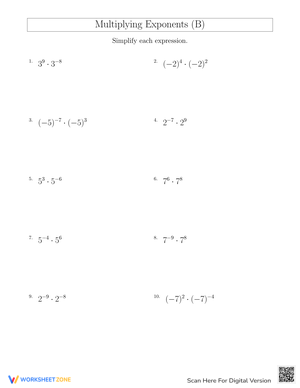
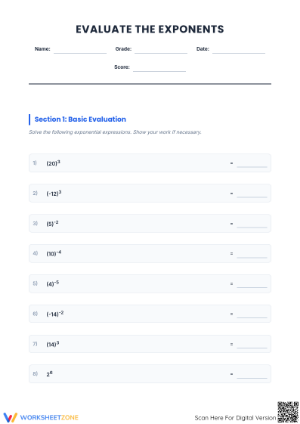
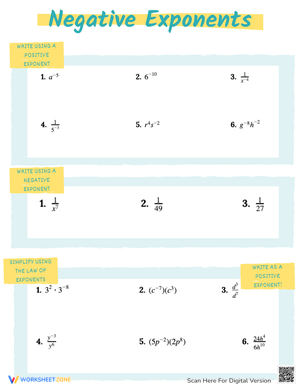
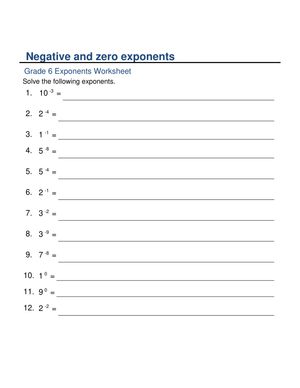
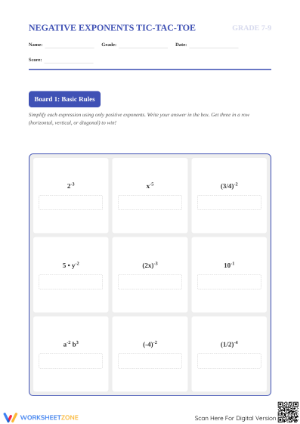
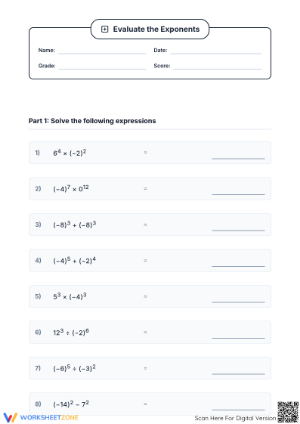
These negative exponents worksheets for 8th grade target one of the most reliably misunderstood moves in 8.EE instruction: shifting a factor across the fraction bar and changing the sign of its exponent. Each worksheet stands alone — printable, focused, and built around the specific error patterns that surface in actual student work. Teachers get a set that fits multiple classroom routines without needing to adapt the content every time the purpose changes.
The Specific Skills Targeted
The worksheets cover the full arc that 8.EE.A.1 demands at the level of negative exponents. Students rewrite expressions so every exponent in the final answer is positive, evaluate numerical expressions after applying the reciprocal rule, simplify fractions where factors carry negative exponents in the numerator, denominator, or both, and work through mixed problems that combine the product rule, quotient rule, and power rule with negative exponents in the same expression.
Problems increase in complexity across the set. Early items isolate the core move: one factor, one negative exponent, one step. Later items introduce multiple variables, integer bases, and expressions where students must determine which rule applies before rewriting anything. That range makes individual worksheets useful for a first-day mini-lesson and for a review session two weeks later — without changing the topic or lowering the mathematical demand.
Common Misconceptions to Watch For and Correct
The most consistent mistake is treating a negative exponent as a negative sign on the answer. A student who sees 3 raised to the negative second power will write negative 9 rather than one-ninth. This is not a careless slip — it reflects a genuine confusion between the sign of the exponent and the sign of the resulting value. Worksheets that pair the rewrite step with numerical evaluation expose this quickly: students check their rewritten expression against a calculated result and see the discrepancy before it hardens into a fixed habit.
Two other errors appear regularly across classes. First, students move the entire term across the fraction bar when only one factor carries the negative exponent. A student working with a numerator of 4 times x raised to a negative second power will sometimes shift the 4 as well, leaving nothing above the bar. Second, in mixed-rule expressions, students apply the wrong operation — multiplying exponents when the problem calls for adding, or subtracting when the bases are not the same. These mistakes are hard to catch through routine simplification practice because correct-looking intermediate steps can mask the error. The error-analysis items in the set ask students to locate and correct a worked example, which gives teachers more diagnostic information than routine simplification alone.
Standard Alignment
Common Core State Standards 8.EE.A.1 directs students to know and apply the properties of integer exponents to generate equivalent numerical expressions. Negative exponents are not a peripheral extension of that standard — they are the case that forces students to move beyond pattern recognition with positive exponents into genuinely new reasoning. The worksheets address 8.EE.A.1 directly: students rewrite, evaluate, and simplify rather than copy a definition from a notes section. The standard also connects forward to 8.EE.A.3 and 8.EE.A.4, where negative exponents appear in scientific notation values smaller than one. Students who are solid on the reciprocal relationship reach scientific notation with far less confusion about what a negative exponent on 10 actually means.
Making These Worksheets Work Across the Instructional Week
A reliable sequence runs three to four days. On day one, model the reciprocal move explicitly using a fraction bar drawn on the board — move the factor, flip the sign on the exponent, keep everything else in place. Follow that immediately with four to six rewrite problems from the first worksheet. Students should do these with pencil because the physical act of writing the fraction bar and moving the factor reinforces the spatial logic faster than clicking through a screen. On day two, add numerical evaluation so students can verify whether their rewrite produces the correct value. By day three, move to the mixed-rule worksheets. This order produces cleaner student work and fewer procedural guesses because each step builds on demonstrated success, not assumed readiness.
These negative exponents worksheets for 8th grade also hold up as sub plans when accompanied by a clear answer key. The directions are explicit enough for students to work independently, and the grader can move through a stack quickly because correct answers are fractions or integers — nothing ambiguous. For the ten minutes before a class transition, two or three rewrite items work as a verbal pair-check: students solve independently, then explain each reciprocal step aloud to a partner before comparing. Exit tickets pull cleanly from the numerical evaluation items since each answer is a single value, which makes next-day grouping fast.
Adjusting the Work for Students at Different Points of Readiness
For students still building fluency with positive exponent rules, assign items that keep the base as a positive integer and limit the expression to a single factor with one negative exponent. This holds the cognitive demand on the new concept rather than on fraction arithmetic. Once students rewrite accurately and consistently, move them to numerical evaluation — they develop the symbolic skill and the numerical check together, which is a more durable combination than symbolic fluency alone.
Students ready for more challenge can work with expressions that place variables in both the numerator and denominator with different negative exponents on each. Adding the requirement that answers contain no negative exponents and no fractions within fractions pushes the reasoning further without leaving 8.EE territory. For these students, the mixed-rule worksheets become most valuable when you ask them to name which property they applied and explain why — that requirement surfaces reasoning gaps that correct answers alone do not reveal.
One honest limitation: students with significant gaps in fraction fluency sometimes stall at the rewrite step because the fraction bar itself is unfamiliar ground. A five-minute fraction warm-up before the worksheet removes that barrier without changing the exponent work. The negative exponents worksheets for 8th grade assume students can read and write basic fractions — if that assumption doesn't hold for a particular group, the warm-up is worth the time.
Frequently Asked Questions
What should students know before working independently on these worksheets?
Students need to read exponent notation fluently and understand that a negative exponent does not make the base negative. They should also be comfortable writing and reading simple fractions. A three-minute teacher model before independent work is usually enough to make the first worksheet productive rather than frustrating.
How do the worksheets handle expressions starting in the numerator versus the denominator?
Problem types are organized so students see both positions. A factor with a negative exponent in the numerator moves to the denominator; a factor already in the denominator with a negative exponent moves up. Students practice both directions before mixed problems combine them. This prevents the shortcut thinking where students simply erase the negative sign without considering where the factor sits in the expression.
Do these worksheets connect to scientific notation?
The set stays within the 8.EE.A.1 focus on properties of integer exponents, but evaluating expressions like 10 raised to the negative third power connects naturally to values students encounter in scientific notation. Teachers building a unit that moves from negative exponents into scientific notation can use those items as a bridge without separate instruction on the connection.
Can a student use these worksheets to catch up after missing the unit?
These negative exponents worksheets for 8th grade work well for independent catch-up when paired with a short reference card showing the reciprocal rule and worked examples. The progression from single-step rewrite items to mixed-rule problems lets a student re-enter the concept at the right level without requiring a full teacher re-teach.













 Interactive Worksheet Maker
 Quiz Maker
 Word Search Maker
 Crossword Puzzle Maker
 Word Scramble Generator
 Sentence Scramble Generator
 Handwriting Worksheet Generator
 Name Tracing Generator
 Fill In The Blank Generator