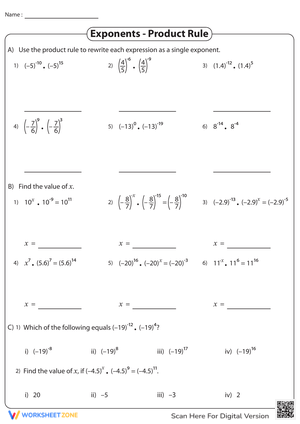
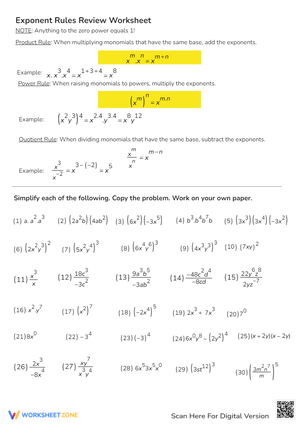
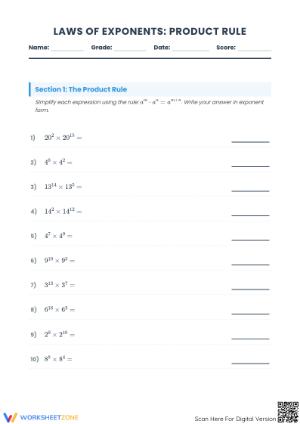
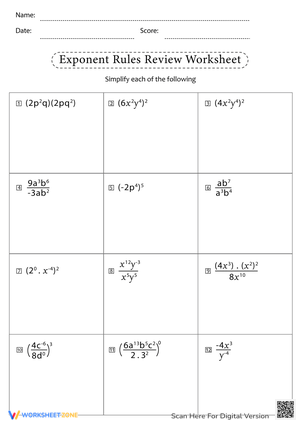
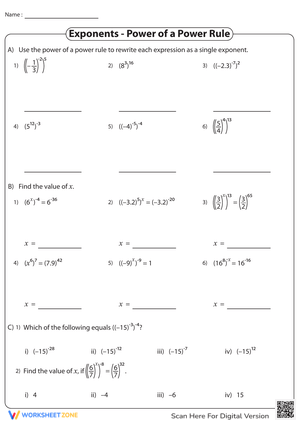
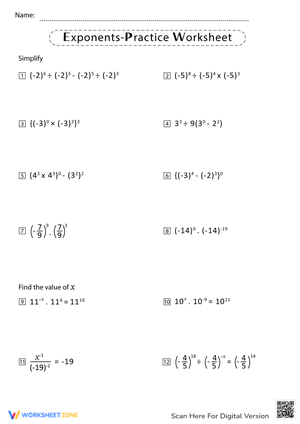
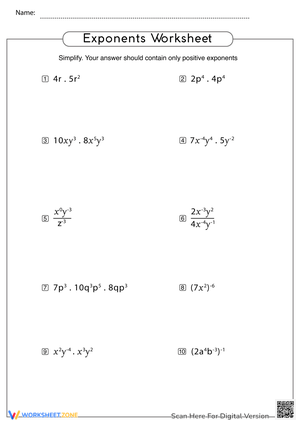
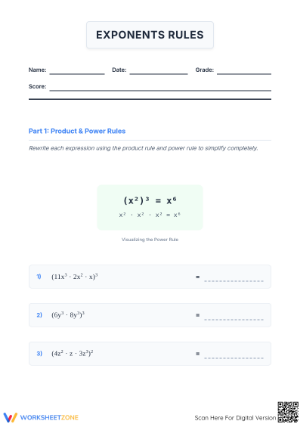
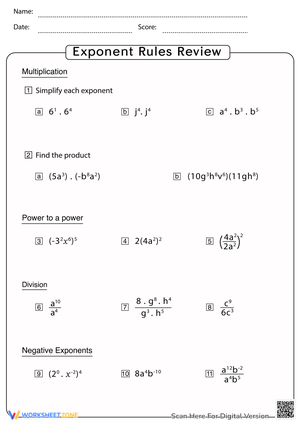
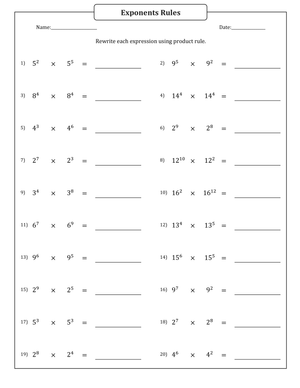
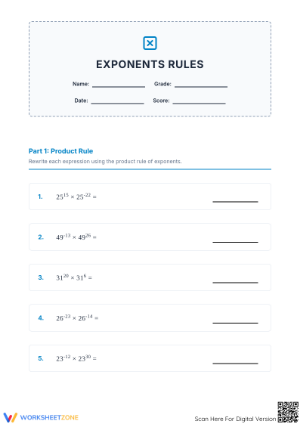
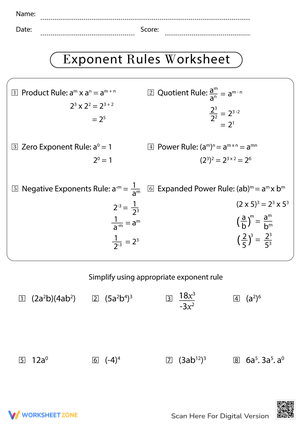
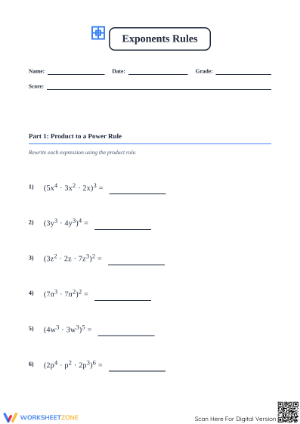
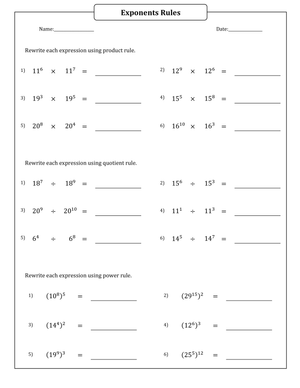
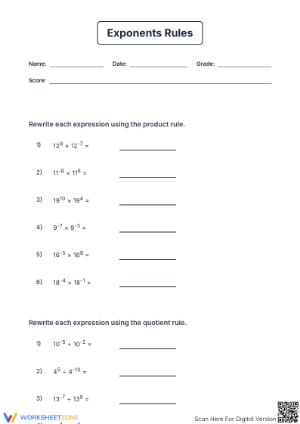
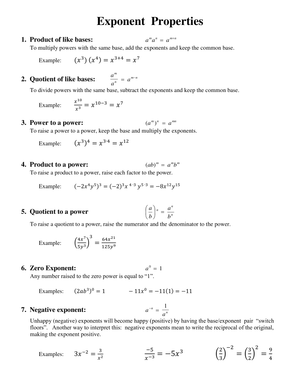
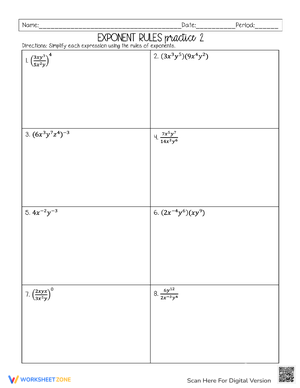
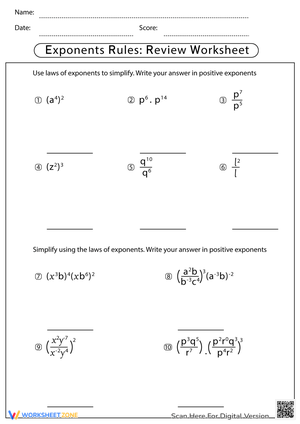
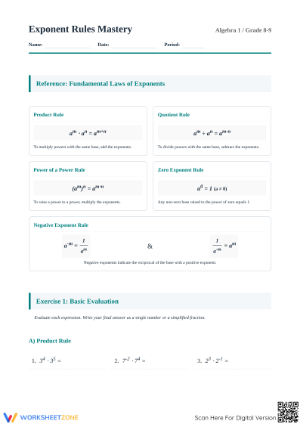
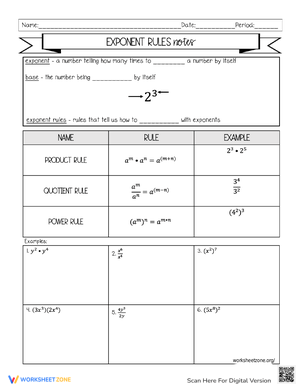
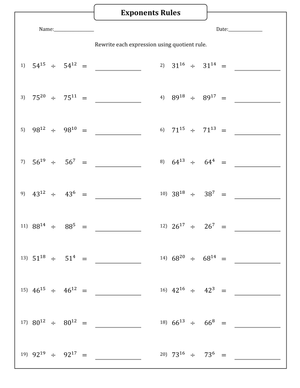
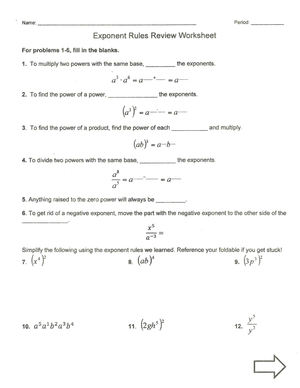
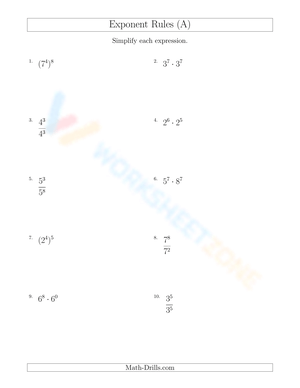
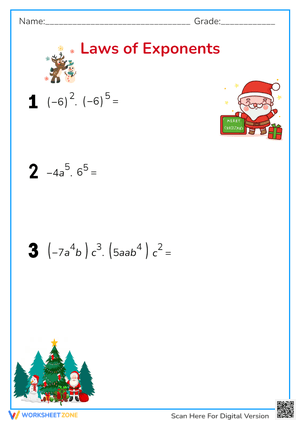
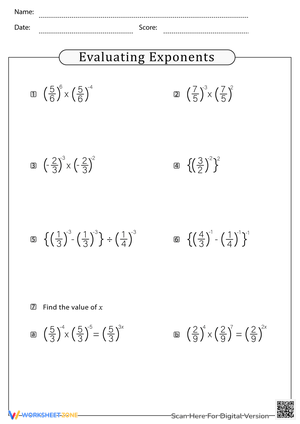
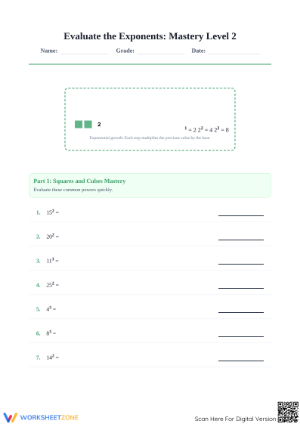
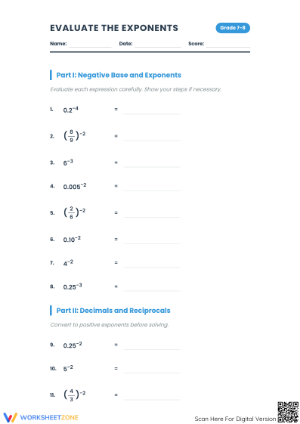
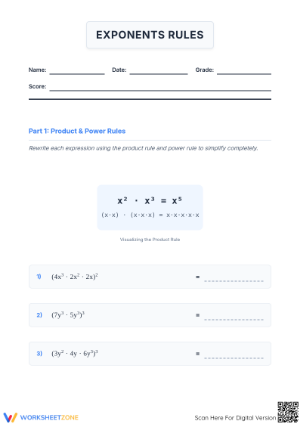
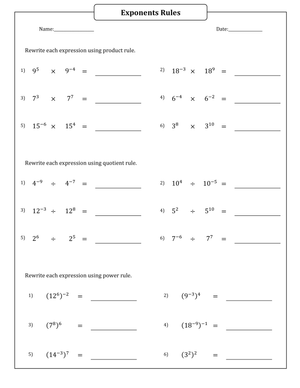
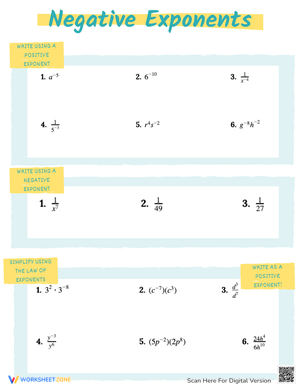
These exponent rules review worksheets for 8th grade solve a specific problem that shows up in almost every middle school math classroom: students who can recite a rule in isolation but freeze or guess when several rules appear on the same worksheet. The set covers product of powers, quotient of powers, power of a power, zero exponents, and negative exponents in a mixed format — which is exactly the kind of practice that builds the rule-selection skill Algebra 1 will demand.
At this grade level, most students have already seen each property at least once. The gap isn't exposure; it's consolidation. When x³ · x⁴ sits next to (x³)⁴ in the same exercise, students have to notice structural differences and choose accordingly. That's a harder cognitive task than a set of identical-format problems, and these worksheets build that selection skill directly.
The Specific Skills Targeted
Each worksheet addresses one or more of the following:
- Product of powers: students add exponents when multiplying expressions that share the same base
- Quotient of powers: students subtract exponents when dividing — the step that generates the most arithmetic errors in 8th grade exponent work
- Power of a power: students multiply exponents when a power is raised to another power, a rule they routinely confuse with the product rule
- Zero exponents: students practice recognizing that any nonzero base raised to the zero power equals one, not zero
- Negative exponents: students rewrite expressions by moving terms across the fraction bar to produce positive exponents
- Multi-step simplification: students apply two or more rules in sequence within a single problem
- Error analysis: students examine a worked solution, locate the incorrect step, and explain what the correct rule requires
The more advanced worksheets in the set connect exponent rules to scientific notation, giving students a context where the same reasoning carries applied meaning rather than staying purely symbolic.
The Mistakes That Surface Most Often in Exponent Practice
The most instructive mistake in 8th grade exponent work isn't a careless arithmetic slip — it's rule overgeneralization. A student who has just internalized the product rule often applies it across every situation. They'll write x⁵/x² = x¹⁰ instead of x³, reasoning that "when I see the same base, I multiply." They chose a rule; they chose the wrong one for the operation. That error is nearly invisible on a single-rule drill where all the problems share the same structure. It appears immediately on mixed review.
A second cluster involves visually tricky cases. Students routinely write x⁰ = 0 — not because they never encountered the zero exponent rule, but because zero feels like the logical answer when they see that exponent. Negative exponents produce a similar pattern: students often interpret 2⁻³ as −8, treating the negative sign as making the whole value negative rather than recognizing the result is a reciprocal, 1/8. Then there's the parentheses problem: when a whole quantity like (3x²)³ is raised to a power, students apply the exponent only to the variable and write 3x⁶ instead of 27x⁶, leaving the coefficient entirely untouched.
Sorting student mistakes by type — rule confusion versus notation versus arithmetic — saves real reteach time. A student who chose the wrong rule needs work on identifying expression structure. A student who applied the right rule but made a sign error needs only a shorter correction task. Those are different problems and benefit from different follow-up.
Getting the Most Out of These Worksheets in Your Lesson Planning
In most 8th grade math blocks, exponent rules review worksheets for 8th grade fit cleanly into the opening ten minutes or the final eight minutes before dismissal — slots where something structured and self-contained holds up better than open-ended work. A mixed set of six to eight problems works well as a Monday warm-up after a weekend gap, and the same worksheet can reappear as a partner correction activity the following day once students have checked their answers against a key.
- Bell ringer: four to six mixed problems to open class and surface gaps before new instruction begins
- Stations rotation: one worksheet at an independent station with an answer key in a sealed envelope students open only after finishing
- Post-notes practice: a targeted selection of problems immediately after guided examples so students apply the rule before the lesson ends
- Intervention block: highlight only the problems connected to one rule for a student who needs focused reteach on product versus quotient
- Day-before-assessment review: assign the full worksheet and use the error patterns to shape the next morning's ten-minute recap
- Sub plans: a clean worksheet with an answer key is among the most reliable independent work options for an unplanned absence
Adjusting These Worksheets for a Range of Student Readiness Levels
Students who are still shaky on integer operations hit friction fast on negative exponents because those two skill areas interact — a negative exponent applied to a negative base requires managing both the sign and the reciprocal at once. Those students benefit from starting with worksheets that use positive integer bases only and move to variable expressions after the rule itself is stable.
For on-grade-level review, worksheets that pull from four to five rules across twelve to fifteen problems represent the right challenge. Including variable expressions alongside numerical ones pushes students to generalize the rules rather than compute through each problem case by case.
Students with firm fluency across the core rules are ready for problems that combine scientific notation with exponent operations, or that ask them to simplify multi-variable expressions with nested parentheses. These problems require students to hold more rule-relevant information in working memory at once — a genuine stretch that stays within 8th grade standards rather than reaching into Algebra 1 content before students are ready for it.
Standard Alignment
These worksheets align to CCSS 8.EE.A.1, which requires students to know and apply properties of integer exponents to generate equivalent numerical expressions. That standard covers product of powers, quotient of powers, power of a power, and zero exponents explicitly. Negative exponents connect directly to 8.EE.A.3 and 8.EE.A.4 through their role in scientific notation and operations involving powers of ten.
In classroom pacing, 8.EE.A.1 typically lands in the first quarter of 8th grade math and then recurs during cumulative spiral review before the state assessment. These worksheets serve both of those instructional moments without any adjustment between uses.
Frequently Asked Questions
What's the difference between using these worksheets for initial practice versus unit review?
For initial practice immediately after direct instruction, assign one worksheet focused on one or two related rules — product and quotient, for example, so students can notice the contrast before adding more. For review, assign the mixed worksheets that draw from several rules simultaneously. That format assumes students have had instruction on each property; its purpose is developing selection and application, not first exposure.
Do these worksheets work for students who are also struggling with basic fraction operations?
Negative exponents require students to write reciprocals as fractions, so fraction fluency does affect performance on that section. For students who are uncertain with fractions, assigning the negative exponent worksheet after a quick fraction refresher rather than alongside it reduces the number of overlapping difficulties. The product rule, quotient rule, power of a power, and zero exponent sections don't depend on fraction work and can be assigned independently without that added friction.
How do these worksheets connect to a scientific notation unit?
Exponent rules review worksheets for 8th grade that include scientific notation problems make the connection between the two topics visible, which many students need to see explicitly rather than infer. When students recognize that multiplying two numbers in scientific notation uses the product of powers rule, the rule shifts from an abstract algebra procedure to an applied tool. Schedule those worksheets after at least one scientific notation lesson so the connection reinforces what students already know rather than introducing a second unfamiliar concept at the same time.
Can a mixed-rule worksheet serve as a formative assessment?
A worksheet covering eight to twelve mixed problems gives a clear enough picture of individual student readiness to function as informal formative data. The error patterns — especially when sorted by rule type rather than marked simply correct or incorrect — tell a teacher which concepts need reteach before the next unit or assessment. Exponent rules review worksheets for 8th grade used this way, a day or two before a quiz, leave actual time to address the gaps that surface rather than discovering them on the assessment itself.













 Interactive Worksheet Maker
 Quiz Maker
 Word Search Maker
 Crossword Puzzle Maker
 Word Scramble Generator
 Sentence Scramble Generator
 Handwriting Worksheet Generator
 Name Tracing Generator
 Fill In The Blank Generator