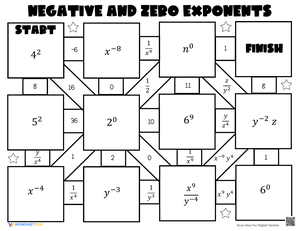
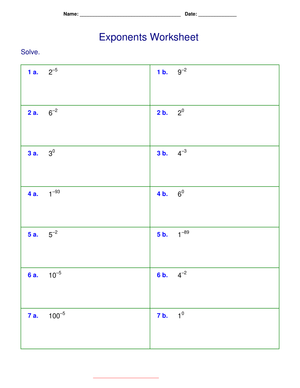
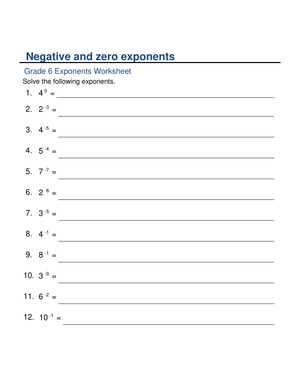
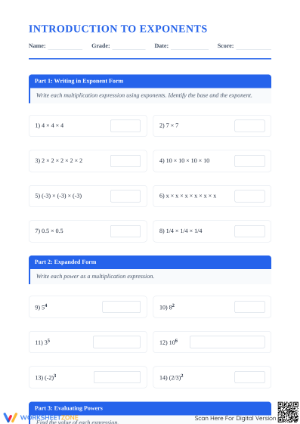
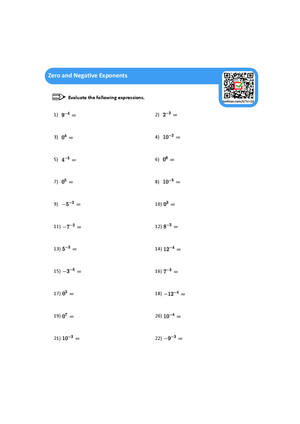
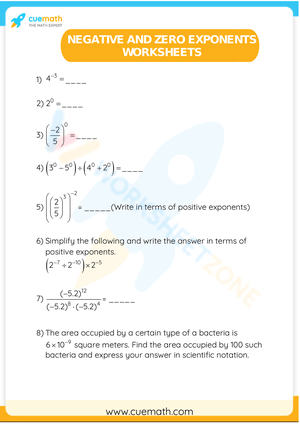
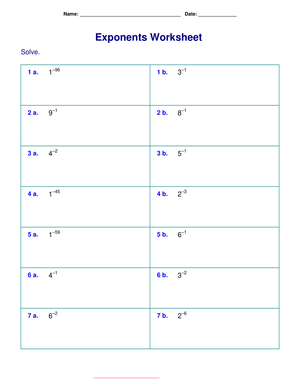
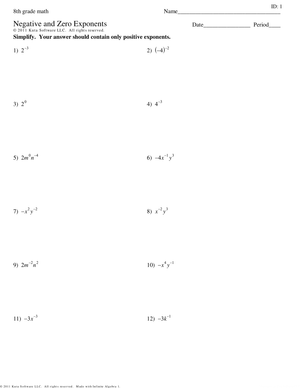
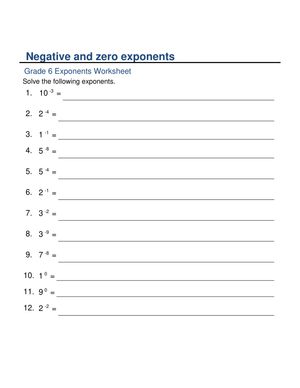
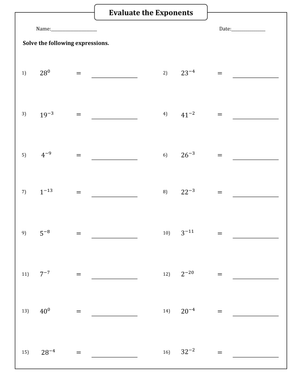
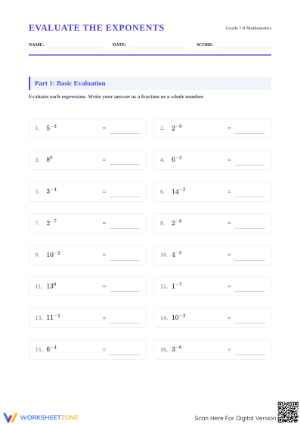
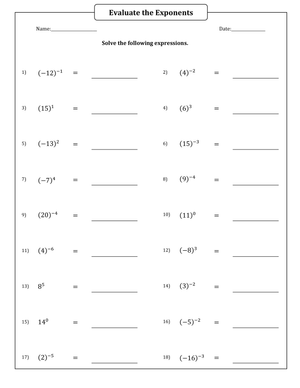
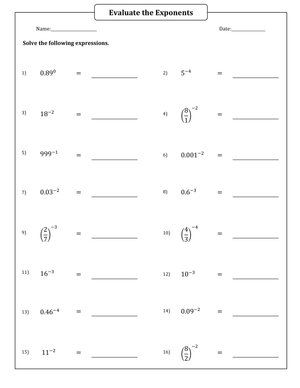
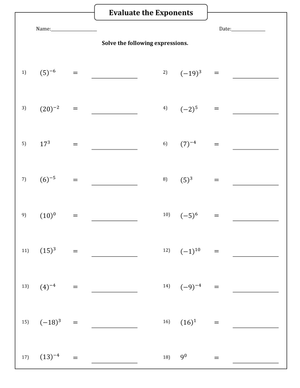
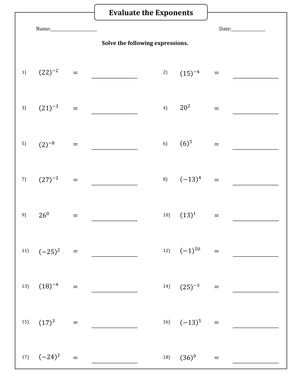
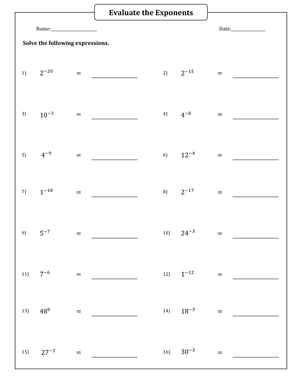
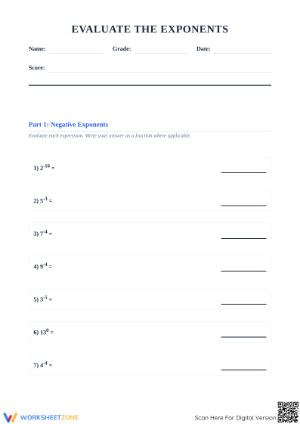
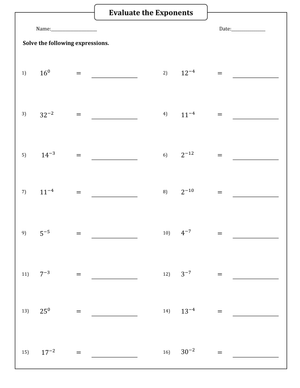
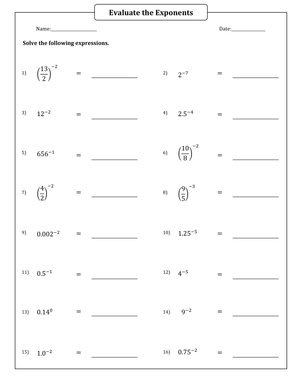
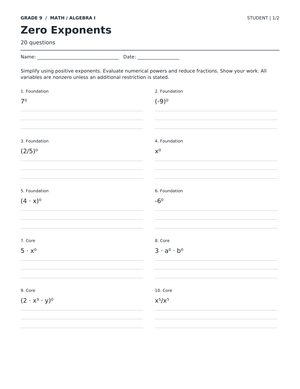
These zero and negative exponents printable worksheets for 8th grade address two rules that consistently trip students up — not because the rules are complicated, but because they contradict what students already believe. The set covers both rules across a range of expression types, from single-term numerical problems to variable forms and powers of ten, giving teachers ready-to-copy practice for initial instruction, reteaching, and review.
What's Inside the Set
The worksheets move through a deliberate sequence. Early items use simple integer bases so students can focus on the rule itself rather than arithmetic complexity. Later items introduce variables and multi-step expressions that require students to decide which rule applies before they touch the problem. The specific skills across the set include:
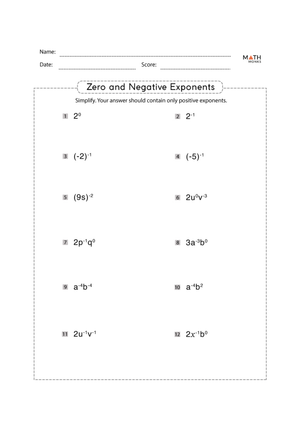
- Evaluating zero exponent expressions — recognizing that any nonzero base raised to the zero power equals 1
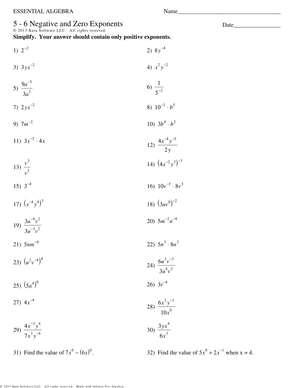
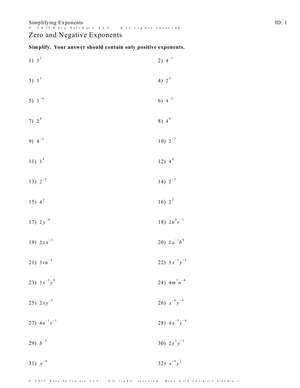
- Rewriting negative exponents as reciprocals with positive exponents, in both numerical and algebraic forms
- Simplifying mixed expressions that combine both rules so students must select the correct one for each term
- Working with variable bases: rewriting x^(-4) as 1 over x^4, or confirming that (3a)^0 = 1
- Connecting negative exponents to powers of 10 as groundwork for scientific notation later in the unit
- Error-analysis items where students identify and explain a flawed simplification
That last category earns its place. When students explain why 4^(-2) does not equal -16, they reveal far more about their understanding than a correct numeric answer alone — and they produce the kind of written reasoning teachers need before moving the class forward.
Mistakes Students Make That Are Worth Planning Around
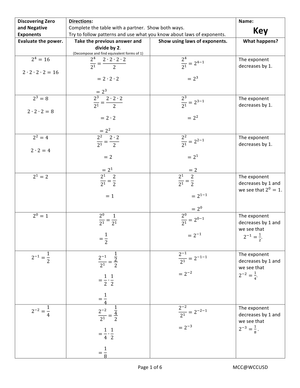
The two core errors here are so persistent they function almost as a rite of passage in 8th grade math. First: students write a^0 = 0. The reasoning is not careless — it mirrors the multiplication-by-zero pattern from earlier grades. When a student sees 5^0, they process the zero as "multiplying by nothing" and write zero. The fix is to make the decreasing-power pattern explicit: 5^3 = 125, 5^2 = 25, 5^1 = 5. Each step divides by 5, so 5^0 must equal 1. Worksheets that build this table into the practice structure make the rule feel inevitable rather than arbitrary. Students who memorize the statement "any base to the zero power is 1" still reach for zero under pressure; students who reconstruct it from the pattern do not.
The second error: students interpret 3^(-2) as -9. They apply integer sign logic — a negative in the exponent means a negative result — without yet separating the position of the negative sign (in the exponent) from a negative value (in the number itself). A worksheet item that contrasts 3^(-2) with (-3)^2 makes this distinction concrete and gives teachers a clean diagnostic. A third error surfaces in fraction expressions: a student who correctly moves x^(-3) from the numerator to the denominator will sometimes also shift y^2 from the denominator to the numerator, as if both terms must move whenever one does. These fraction errors often hide under a structure that looks almost right, which is exactly why error-analysis items belong in the set.
How to Work These Worksheets Into Your Instructional Week
The most effective placement is immediately after direct instruction on one rule at a time — not after introducing both rules in the same lesson. When zero and negative exponents appear together in a mini-lesson, students frequently merge them or forget which condition triggers which result. Spending one class session on zero exponents only, then opening the next session with a 5-minute warm-up using that worksheet before introducing negative exponents, keeps the two concepts distinct long enough for students to store them separately.
A few specific placements that hold up in practice:
- The first 6–8 minutes of the following day's class, before homework review, while the rule is still fresh from the previous lesson
- Partner comparison during guided practice, where two students each simplify the same expression independently and then compare steps before anyone is called on
- Exit tickets using 2–3 mixed items from a later worksheet, timed to the final 4 minutes before dismissal
- Intervention table work for students who need integer-base practice before variable expressions appear
The zero and negative exponents printable worksheets for 8th grade also fit well into a station rotation, particularly when the answer key is available at the station. Students check their own rewrites at the end of the rotation, which surfaces errors in real time rather than a day later when graded work returns.
Standard Alignment
These worksheets align with CCSS 8.EE.A.1, which calls on 8th graders to use properties of integer exponents to produce equivalent numerical expressions. The standard appears early in the Expressions and Equations domain for a reason: students cannot work fluently with scientific notation or the product and quotient of powers rules until they have internalized what zero and negative exponents mean. Placing this practice in the first few weeks of that unit positions it exactly where 8.EE.A.1 sits in most pacing guides. Zero and negative exponents printable worksheets for 8th grade built around this standard help teachers collect evidence of mastery before the class moves into the notation-heavy work of scientific notation.
Adjusting the Set for Different Readiness Levels
The worksheets separate naturally into tiers based on expression type, so teachers assign different sections to different groups while keeping the day's learning target the same. Students who are still shaky on reciprocals, or who conflate exponent operations with base operations, do better starting with numerical bases only — problems like 4^(-2) or 10^0 — before any variables appear. A printed reference card with the two rules stated in plain language, rather than formal algebraic notation, gives those students enough support to focus on applying the rule rather than reconstructing it from memory mid-problem. This is not a workaround — it is the same principle behind open-note practice during initial instruction, and it produces more accurate work than asking underprepared students to hold the rule and execute it at the same time.
On-level students work through the mixed items, including variable expressions and simple fraction forms — the range 8.EE.A.1 actually tests. For students who already have both rules secure, extension items that combine multiple exponent properties or link negative exponents directly to decimal notation provide genuine stretch without turning into a different lesson. Sets of zero and negative exponents printable worksheets for 8th grade that offer this range mean teachers do not have to prepare a separate extension activity for students who finish early.
Frequently Asked Questions
Do these worksheets address 0 raised to the zero power?
The set focuses on the case 8.EE.A.1 targets: nonzero bases with zero or negative integer exponents. The expression 0^0 is undefined and outside the scope of 8th grade instruction. When students raise the question — and some will — a teacher note in the materials gives a straightforward way to address it without derailing the lesson.
Can these be used for test prep?
Yes. The mixed-rule items and error-analysis questions closely match the format students encounter on state assessments and the SBAC. Pulling 4–5 items from a later worksheet makes a focused 10-minute review that targets exactly the decision-making the test requires — identifying the correct rule, applying it to the expression, and showing the rewrite step.
What if some students finish well ahead of others?
The error-analysis items and scientific notation connection problems give early finishers meaningful work that stays within the day's standard. These are not detours — they extend the same rule application the rest of the class is still building, just applied to more demanding expression forms.
Is an answer key included with each worksheet?
Each worksheet includes a complete answer key that shows the full rewritten expression, not just the simplified value. For this topic, where the error is often in the form of the rewrite — moving the wrong term, keeping the negative sign — seeing the intermediate step makes the answer key useful for diagnosis rather than just grading.













 Interactive Worksheet Maker
 Quiz Maker
 Word Search Maker
 Crossword Puzzle Maker
 Word Scramble Generator
 Sentence Scramble Generator
 Handwriting Worksheet Generator
 Name Tracing Generator
 Fill In The Blank Generator