


























Views
Downloads

Exponent Rules Worksheet | Essential Grade 9 Math
Paste this activity's link or code into your existing LMS (Google Classroom, Canvas, Teams, Schoology, Moodle, etc.).
Students can open and work on the activity right away, with no student login required.
You'll still be able to track student progress and results from your teacher account.
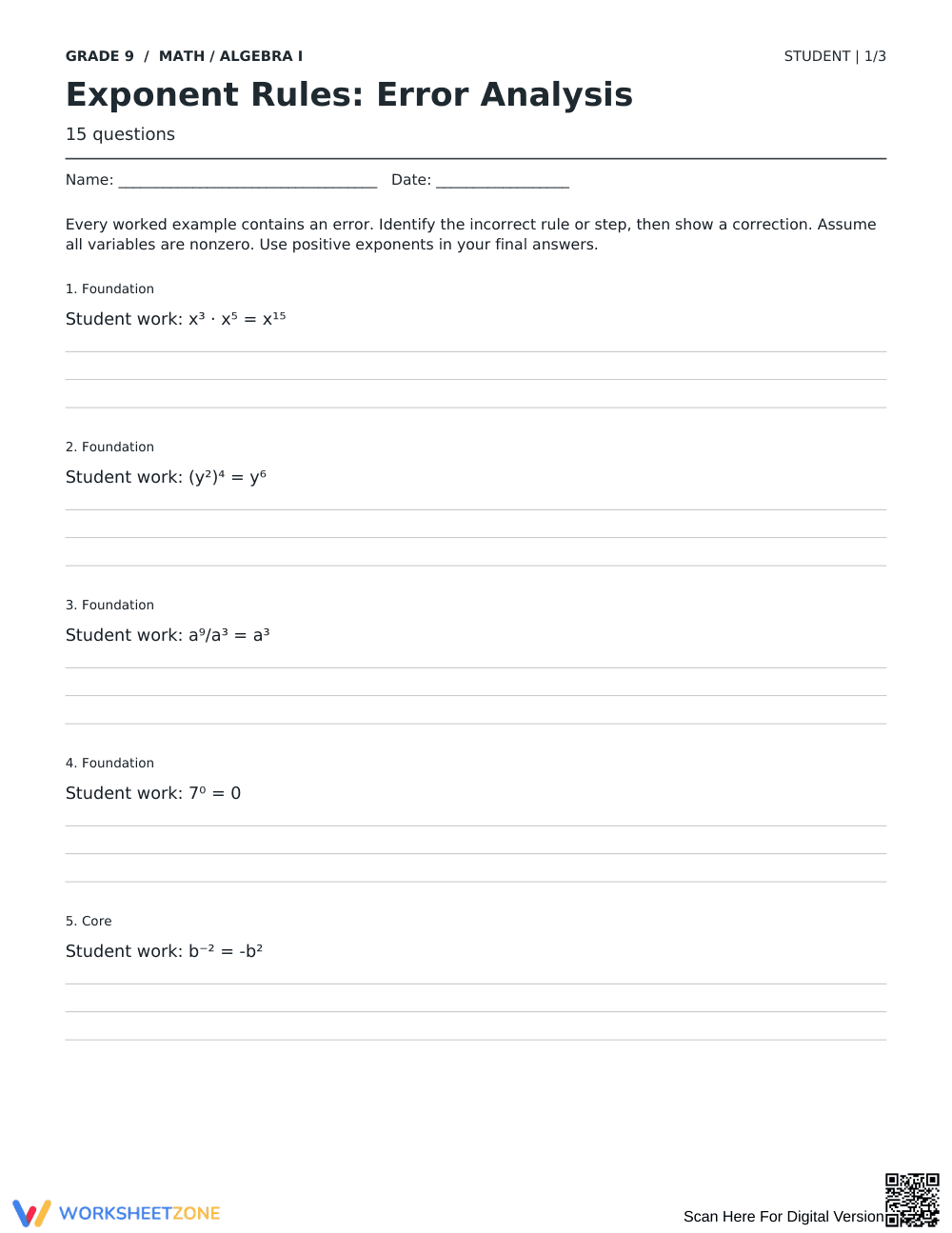
Mastering properties of exponents requires spotting conceptual misconceptions before they become routine calculation errors. This Grade 9 algebra worksheet provides 15 targeted error analysis tasks that prompt high school students to isolate flawed steps, articulate underlying mathematical properties, and compute correct simplified expressions with positive exponents.
At a Glance
- Grade: 9 · Subject: Math (Algebra I)
- Standard:
CCSS.MATH.CONTENT.8.EE.A.1— Apply properties of integer exponents to simplify and evaluate numerical and variable expressions- Skill Focus: Exponent rules error analysis
- Format: 3 pages · 15 problems · Answer key included · PDF
- Best For: Independent practice or homework review
- Time: 25–40 minutes
What's Inside
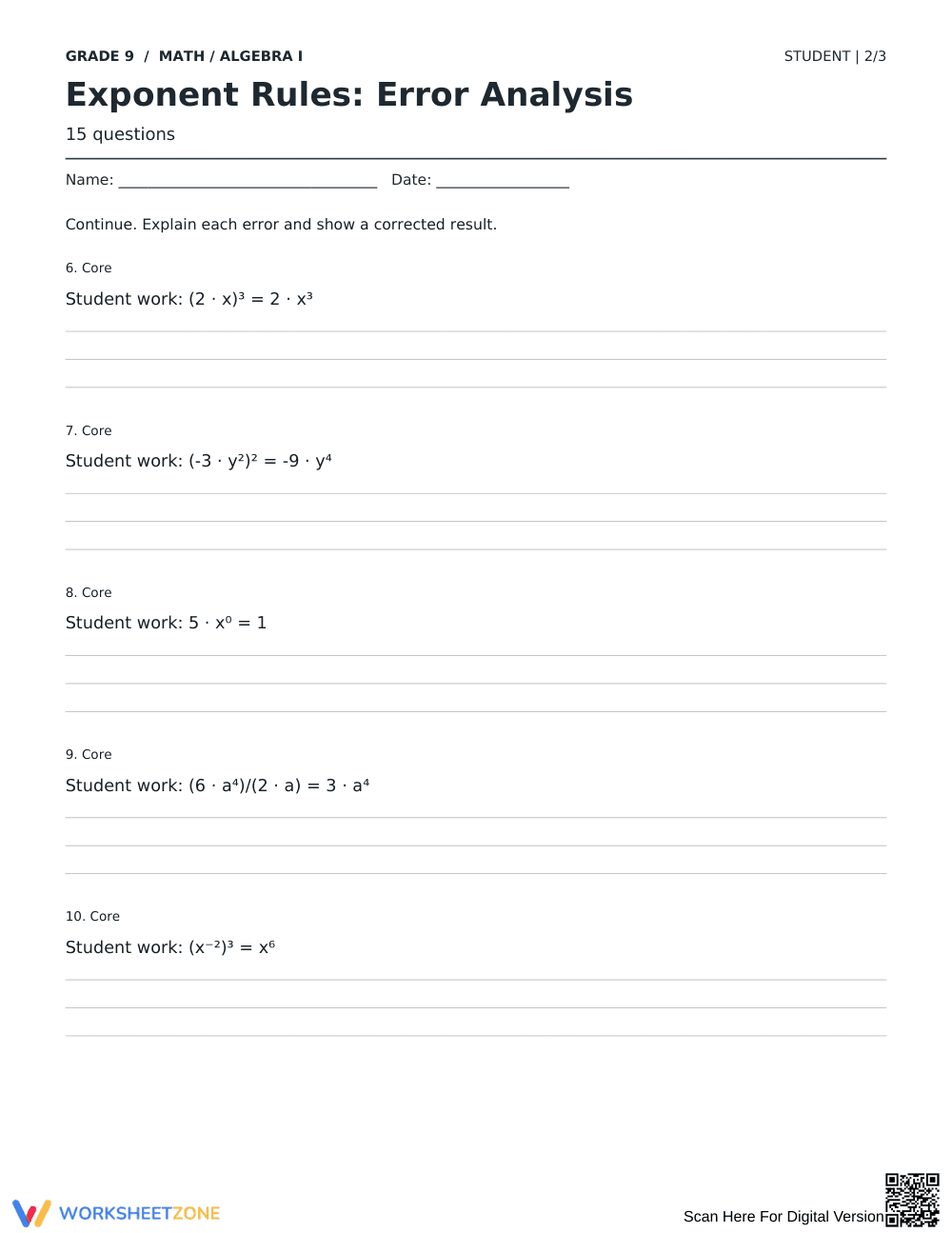
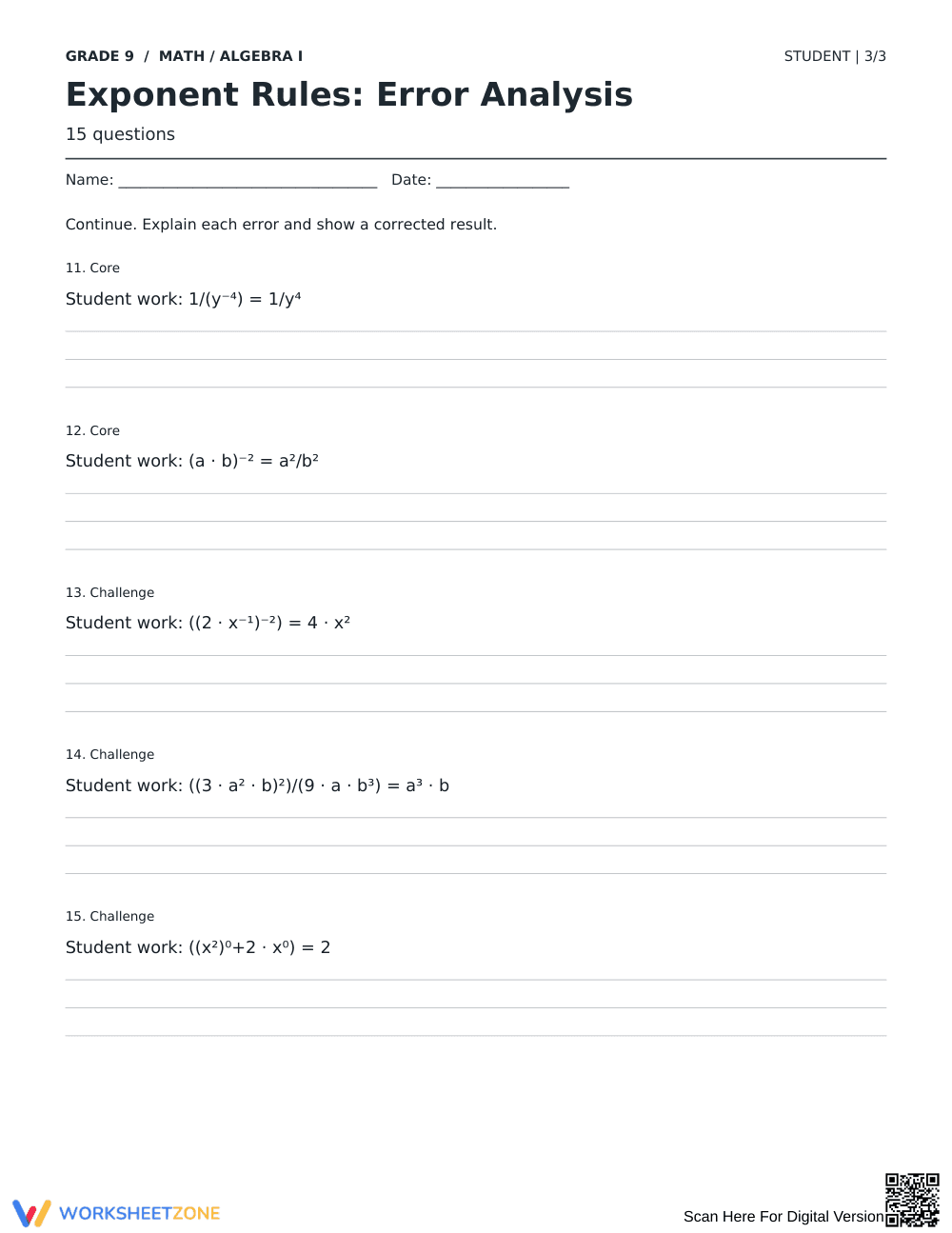
This 3-page PDF features 15 error analysis tasks organized across three developmental sections. Every prompt exhibits flawed student work with lines for explaining the mistake and calculating the correct form. A two-page answer key provides step-by-step corrections, explanatory teacher notes, and a clear two-point scoring guide allocating one point for error identification and one for accurate simplification.
Skill Progression
- Guided practice (Foundation, Tasks 1–4): Isolates basic product, power, quotient, and zero rules with single-variable scaffolding.
- Supported practice (Core, Tasks 5–12): Targets negative exponents, distributed powers, and multi-step coefficient errors.
- Independent practice (Challenge, Tasks 13–15): Synthesizes composite expressions featuring nested parentheses, negative powers, and quotient simplification.
This gradual-release structure builds foundational confidence before prompting complex multi-property evaluation.
Standards Alignment
The core standard is `CCSS.MATH.CONTENT.8.EE.A.1`: Know and apply the properties of integer exponents to generate equivalent numerical expressions. Extending to variable terms, it reinforces `CCSS.MATH.CONTENT.HSA.SSE.A.2` by developing fluency in seeing structure within algebraic expressions. Both standard codes can be copied directly into lesson plans, IEP goals, or district curriculum mapping tools.
How to Use It
Implement this resource after completing direct instruction on negative and zero power definitions. During independent work, check whether students multiply coefficients rather than distributing powers in questions 6 and 7 to catch notation confusion early. The complete set requires approximately 25 to 40 minutes and works well for homework or collaborative review stations.
Who It's For
This worksheet serves Grade 9 Algebra I students sharpening prerequisite skills or remediating exponent misconceptions. Teachers can differentiate by assigning Foundation problems to emerging learners while guiding advanced students directly to Core and Challenge items. Pair this practice with an exponent rules anchor chart or graphic reference summary.
According to Fisher & Frey (2014), structured error analysis accelerates conceptual mastery by prompting students to externalize mathematical reasoning through metacognitive critique rather than repetitive procedural drill. This Grade 9 algebra resource directly targets CCSS.MATH.CONTENT.8.EE.A.1 by requiring learners to evaluate, explain, and correct misconceptions across 15 integer exponent scenarios. Rather than merely computing answers, students inspect authentic student errors involving product rules, negative exponents, zero powers, and distributed coefficients. By articulating why an exponential transformation is mathematically invalid and providing positive-exponent solutions, learners reinforce core algebraic properties. Research on gradual release emphasizes that identifying flawed logic bridges the gap between rote memorization and true symbolic fluency. The scaffolded three-tier design provides teachers with immediate formative feedback on whether students confuse base arithmetic with exponent operations, ensuring high school algebra classes establish durable mathematical foundations before progressing to rational exponents and exponential growth functions.


