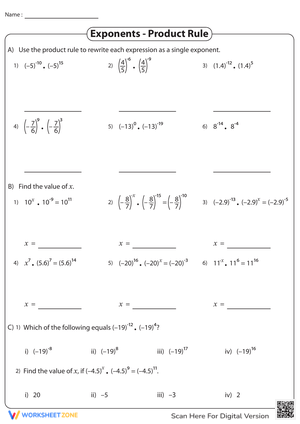
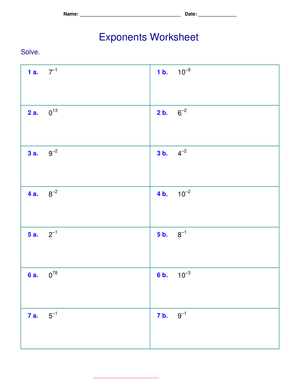
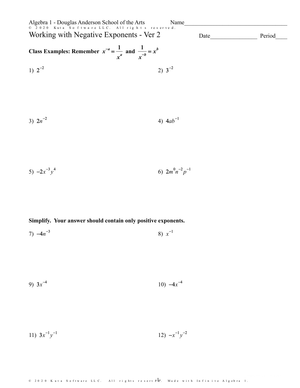
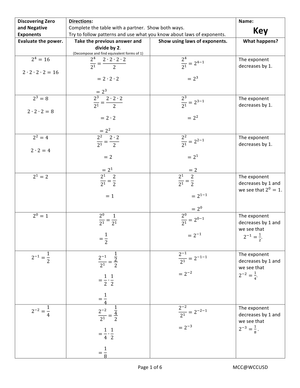
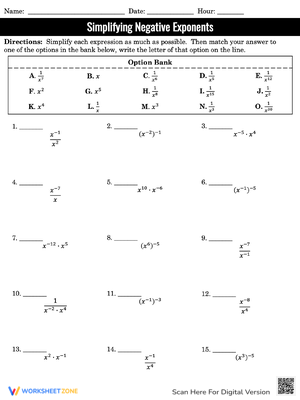
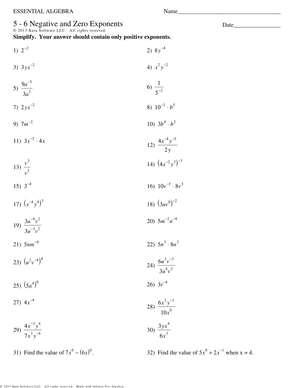
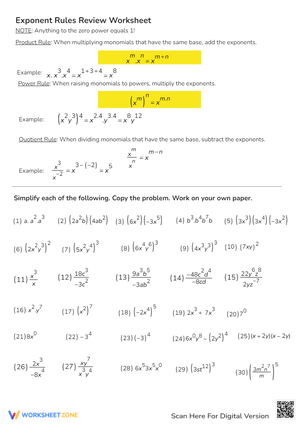
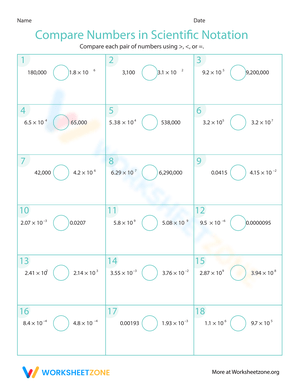
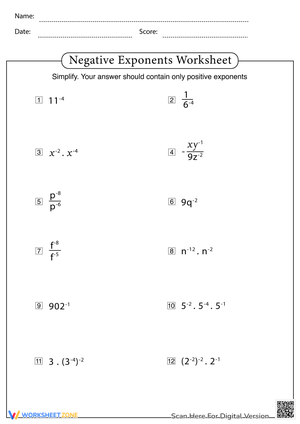
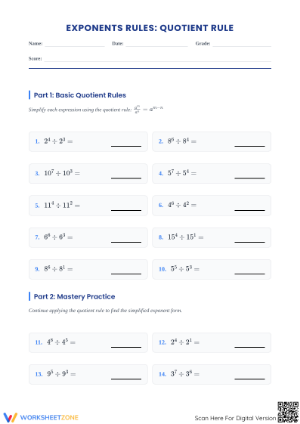
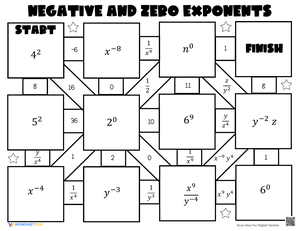
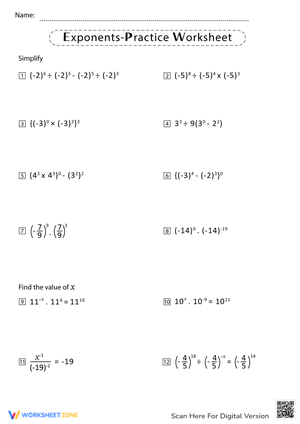
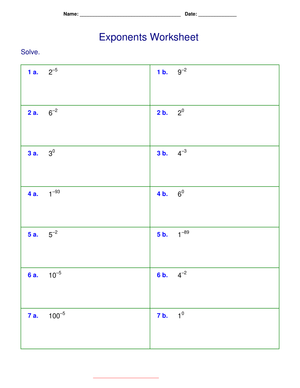
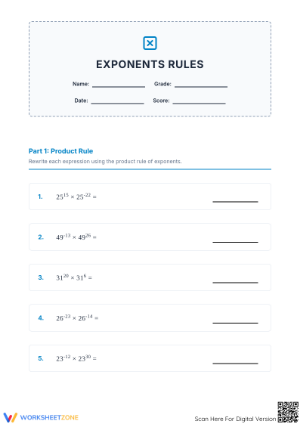
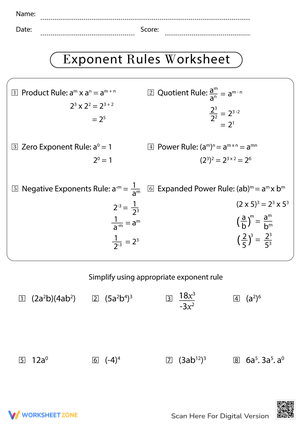
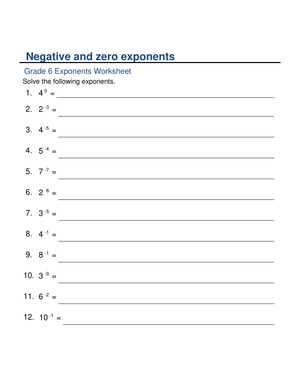
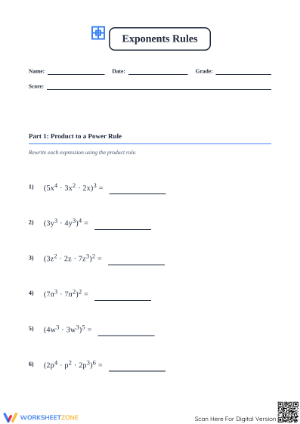
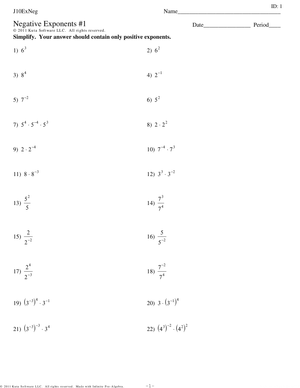
These exponents printable worksheets for 8th grade give teachers a set of standalone, focused worksheets for every major stage of an exponent unit — from evaluating simple powers to converting numbers in scientific notation. Each worksheet targets a specific skill or a deliberate mix of rules, so teachers can assign exactly what the class needs rather than hunting through a larger collection for the right problems. The set is built around the predictable misconceptions students bring to exponent work, so the exercises surface errors early rather than waiting for the unit test.
What Each Worksheet Covers
The skills across this set move in the same direction most 8th grade teachers sequence their units — from foundational to applied. Rather than blending every concept into every worksheet, the set keeps ideas separated until students show solid accuracy with each rule individually. The result is a set teachers can drop into any lesson moment without redesigning it for the topic at hand.
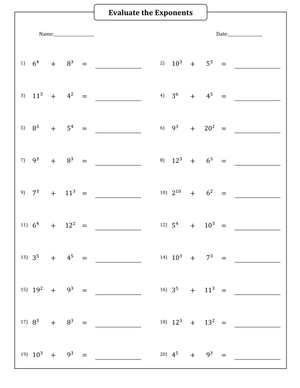
- Evaluating powers: reading exponential expressions and connecting them to repeated multiplication rather than relying on memorized shortcuts
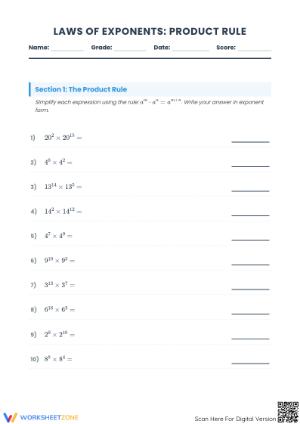
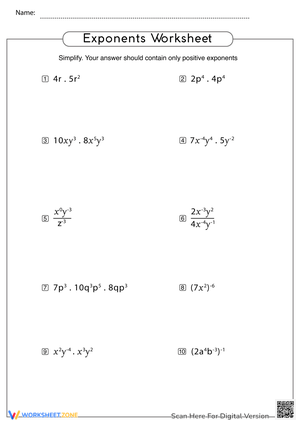
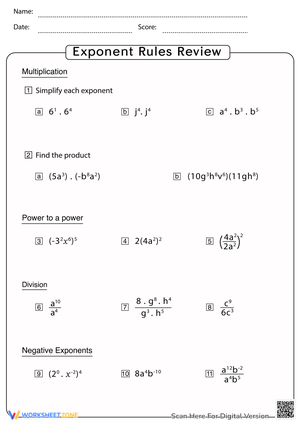
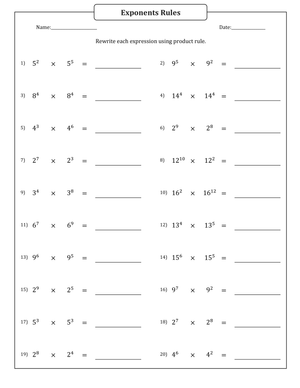
- Product of powers: adding exponents when multiplying powers that share the same base
- Quotient of powers: subtracting exponents when dividing powers with the same base
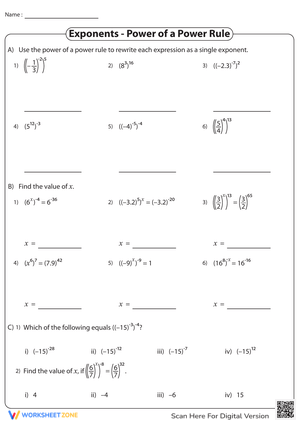
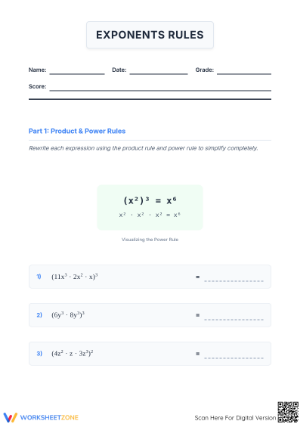
- Power of a power: multiplying exponents when raising an exponential expression to another exponent
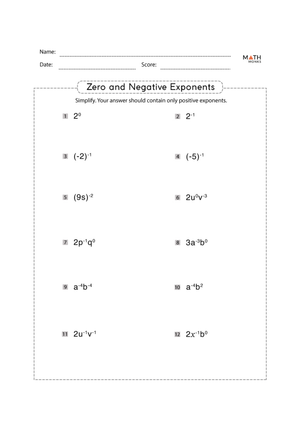
- Zero exponents: recognizing that any nonzero base raised to the zero power equals 1, not 0
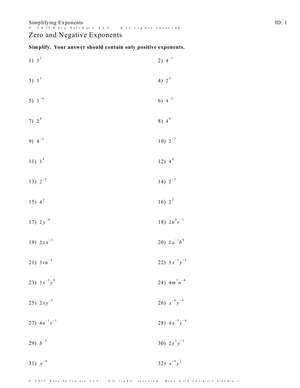
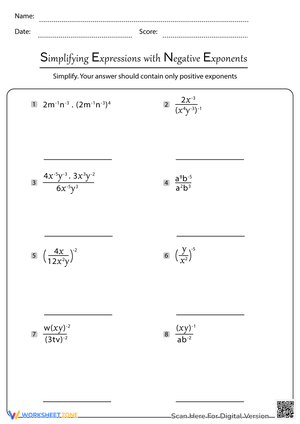
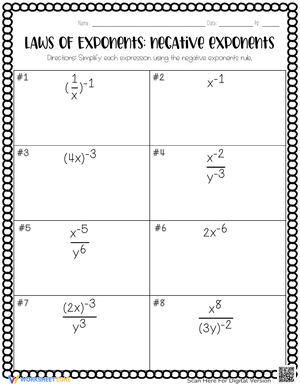
- Negative exponents: rewriting expressions as unit fractions rather than treating the result as a negative value
- Powers of 10: connecting exponent notation to place value shifts in both directions — values greater than 1 and values less than 1
- Scientific notation: converting between standard and scientific form, comparing magnitudes, and interpreting quantities in context
Several worksheets include at least one error-analysis item alongside the computation practice. Instead of solving every problem from scratch, students examine a worked example and mark what went wrong. Those items reveal whether students understand a rule well enough to evaluate someone else's reasoning — a different and often harder cognitive task than applying the rule correctly the first time.
Fitting These Worksheets Into Your Lesson Planning
The most productive use of these worksheets is usually the transition from direct instruction to independent work. In a 50-minute class, that window is often tighter than it looks — sometimes 12 to 15 minutes after a lesson opener and note-taking, just before students are expected to work on their own. A focused worksheet on the day's property keeps that moment structured without requiring students to generate their own problems or sit through another round of modeling.
When building a lesson around exponents printable worksheets for 8th grade, the most important decision is matching each worksheet to its function. A guided-practice worksheet should look different from a quiz-prep review. The single-skill worksheets in this set are especially useful for station work and small-group intervention — one group works through a product-of-powers worksheet independently while the teacher pulls a smaller group to the table for direct work on negative exponents. That is a routine these worksheets support without any additional modification.
- Warm-ups: three to five problems from a single-skill worksheet, reviewed together before the lesson begins
- Guided practice: a worksheet that mirrors the lesson's worked examples and increases complexity gradually
- Partner tasks: error-analysis items work particularly well with two students — they discuss the worked example before correcting it together
- Homework: mostly familiar problem types with one unfamiliar extension item at the end
- Exit check: two or three problems matched directly to the day's objective, collected at the door
- Pre-quiz review: a mixed-rule worksheet covering exponent properties and scientific notation conversion together
One honest tradeoff worth naming: error-analysis items frustrate students who are still building fluency with the underlying rule. A student who cannot yet apply the quotient-of-powers rule reliably is not ready to identify where someone else applied it incorrectly. Those items belong in the second half of a unit, not the first few days of instruction.
Student Errors That Surface Consistently — and What to Do About Them
The most common exponent error in 8th grade is applying the product-of-powers rule regardless of whether the bases match. A student who correctly simplifies 3² × 3⁵ as 3⁷ will often write 3² × 5⁴ as 15⁶ — carrying the rule into a situation where it does not apply, without noticing the condition that makes it valid. Worksheets that include both same-base and different-base multiplication problems in the same set force that check instead of rewarding automatic pattern use.
Negative exponents produce a different and more stubborn confusion. Students read x⁻³ and conclude the result must be negative — the sign is right there in the notation, and they are not wrong that it belongs to the expression. The conceptual gap is understanding that the negative position signals a reciprocal relationship, not a negative value. That distinction takes repeated exposure across multiple worksheets to stick. A single correction rarely holds.
Zero exponents generate their own consistent error: students write any base to the zero power as 0. The reasoning behind the mistake is not careless — it comes from years of being told that multiplying by zero gives zero, which is true and entirely unrelated to this situation. A worksheet focused entirely on zero exponents, using different bases including fractions and variables, helps students see the pattern across enough examples to trust it. One or two zero-exponent items buried in a mixed set rarely dislodges that misconception.
Scientific notation errors cluster consistently around decimal direction. When converting 0.000032 to scientific notation, many students move the decimal correctly but attach the wrong sign to the exponent, writing 3.2 × 10⁴ instead of 3.2 × 10⁻⁵. The error suggests the student knows the procedure has two moving parts but has not connected the direction of the decimal shift to the sign of the power of 10. A worksheet that presents large-number and small-number conversions in alternating order — rather than grouping all large-number cases first — forces that connection directly.
Standard Alignment
These worksheets address the Grade 8 Expressions and Equations domain in the Common Core State Standards, specifically cluster 8.EE.A: "Work with radicals and integer exponents." The skills across the set map to three standards: 8.EE.A.1 (properties of integer exponents), 8.EE.A.3 (expressing large and small quantities as a single digit times a power of 10), and 8.EE.A.4 (performing operations with numbers written in scientific notation).
In most 8th grade pacing guides, this cluster appears early in the year before work with linear equations and functions. That placement reflects the way the concepts build: the exponent properties in 8.EE.A.1 extend numerical work from 6th and 7th grade, and mastering those properties gives students the grounding they need to make sense of scientific notation in 8.EE.A.3 and 8.EE.A.4. Worksheets that sequence the skills in that same direction — exponent properties first, powers of 10 next, scientific notation last — align with how the standards themselves build across the cluster.
Adjusting the Work for Students at Different Points in Their Understanding
The clearest lever for differentiation is controlling how much a student manages at once. For students still working through basic rule application, single-skill worksheets with simple integer bases keep arithmetic out of the way so attention stays on the exponent structure itself. This is not about lowering expectations — it is about reducing cognitive load so students can process the rule they are practicing, rather than getting tangled in multi-digit computation before they even reach the exponent operation.
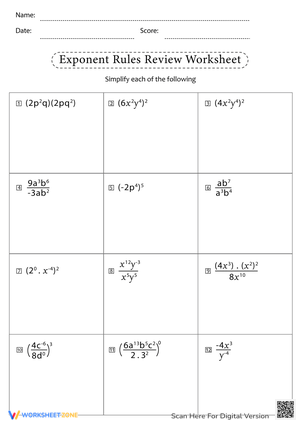
Students working at grade level move to mixed-property worksheets once they show accuracy with each rule in isolation. Adding variables, multi-term expressions, and negative bases raises the level of demand without changing the underlying concepts. A strong extension task: give students two equivalent expressions — one in standard form, one in scientific notation — and ask them to show the algebraic steps connecting the two using only the exponent properties covered in the unit. That task checks both fluency and flexibility at the same time.
Exponents printable worksheets for 8th grade are also useful for targeted intervention precisely because each worksheet covers a single skill. A student who struggles only with scientific notation does not need to repeat the product-of-powers practice already mastered. Teachers can pull the specific worksheet that addresses the identified gap without rebuilding the full unit sequence. A brief reference box printed at the top of an intervention worksheet — showing the relevant rule with a labeled worked example — gives students a model to check against without requiring them to hold the rule entirely in working memory.
Frequently Asked Questions
Do the worksheets need to be used in a specific order?
Each worksheet stands on its own and can be assigned in any sequence that matches a teacher's unit plan. That said, students make faster progress with scientific notation when they have already worked through the powers-of-10 worksheet first. The two concepts reinforce each other directly, and students who skip that step often struggle with the sign of the exponent during conversion.
Are answer keys included with each worksheet?
Yes. Each worksheet comes with a corresponding answer key. For error-analysis items, the key identifies which rule the sample error violated — not just the correct answer — which gives teachers a clear discussion anchor for small-group or whole-class review.
How long does a typical worksheet take to complete?
Single-skill worksheets typically take 10 to 15 minutes for students working at grade level. Mixed-review and scientific notation worksheets run closer to 20 minutes. Students still building fluency with a given rule will need more time, which is itself useful information — a student who needs 25 minutes on a product-of-powers worksheet is signaling something different than a student who finishes in eight.
Can these worksheets be used for formal assessment?
Some teachers use the mixed-review worksheets as quiz-grade tasks or pre-assessment tools, but these are built for instructional use rather than summative grading. The problem counts and formats reflect practice needs, and using them for formal assessment changes how students approach the work. These exponents printable worksheets for 8th grade do their best work as formative tools — the kind of quick, readable data that tells a teacher whether Thursday's lesson on negative exponents actually took hold, or whether the class needs another pass before Friday's quiz.













 Interactive Worksheet Maker
 Quiz Maker
 Word Search Maker
 Crossword Puzzle Maker
 Word Scramble Generator
 Sentence Scramble Generator
 Handwriting Worksheet Generator
 Name Tracing Generator
 Fill In The Blank Generator