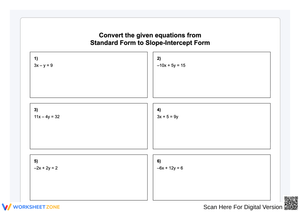
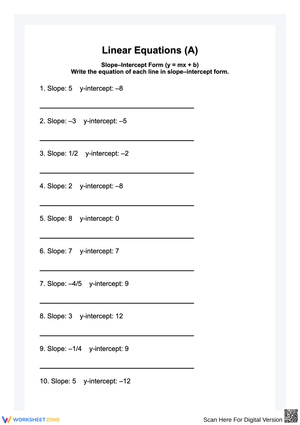
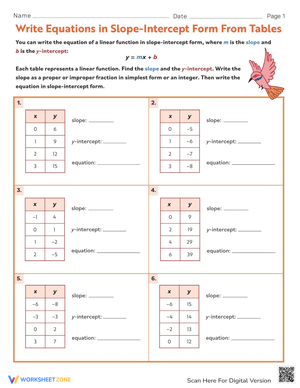
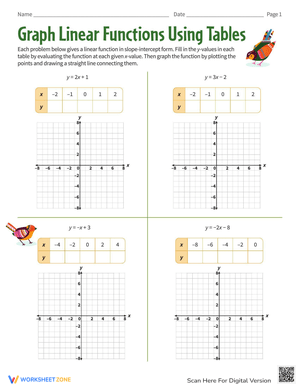
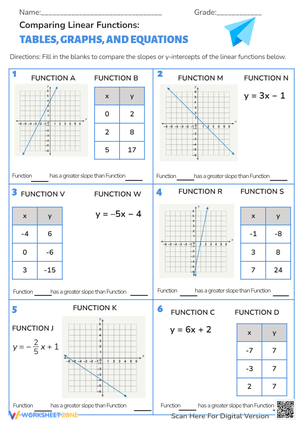
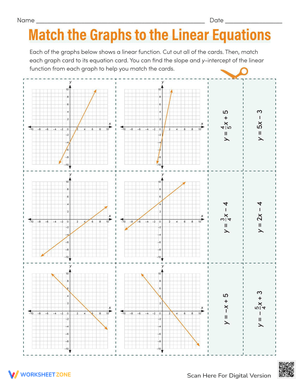
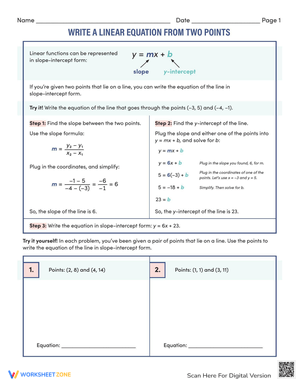
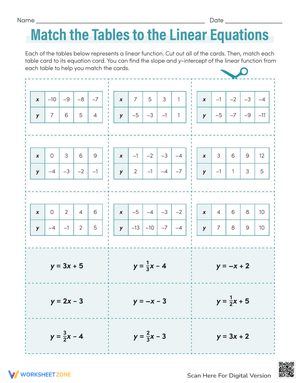
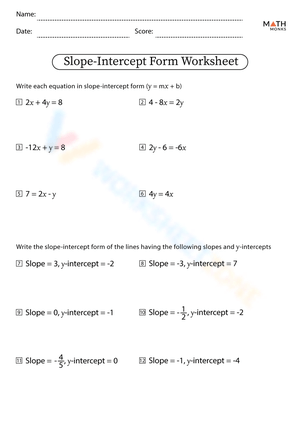
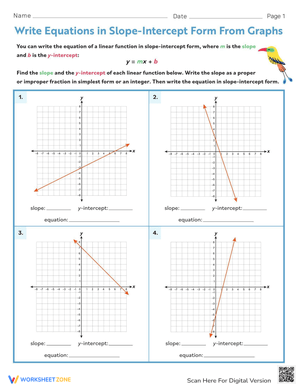
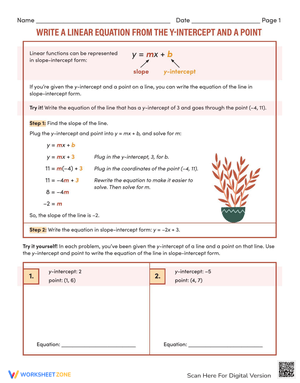
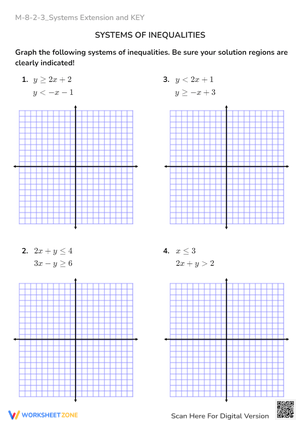
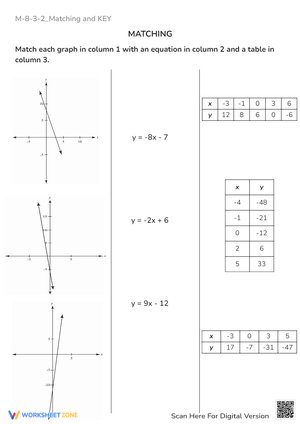
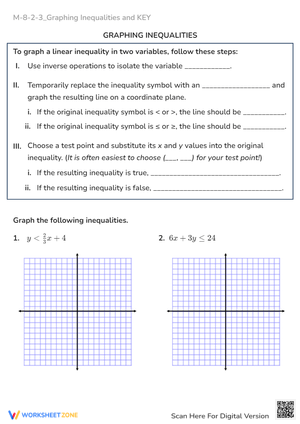
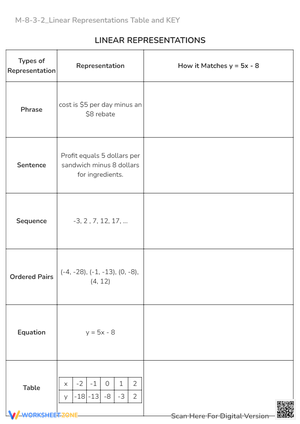
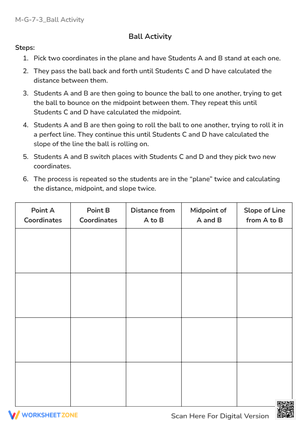
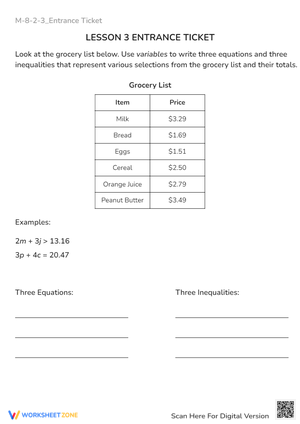
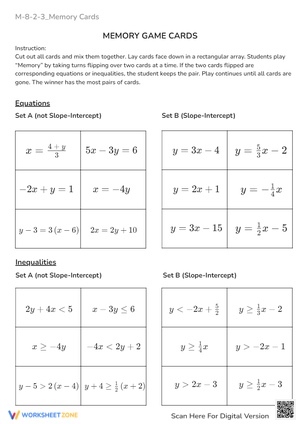
These slope intercept form printable worksheets for 8th grade give algebra teachers a targeted set of practice resources that moves students through y = mx + b across multiple representations — equations, graphs, tables, and real-world situations. Each worksheet focuses on a specific skill, so teachers can assign exactly what a class needs rather than routing everyone through the same unfocused review.
What the Set Covers
The worksheets build skills in a sequence that mirrors how most 8th grade algebra units unfold. Students start by reading m and b from equations, then move into graphing, writing equations from graphs and tables, and finally connecting the equation to a described context. Keeping those tasks on separate worksheets — rather than mixing everything without a clear instructional purpose — lets teachers use each one at the right moment in the unit.
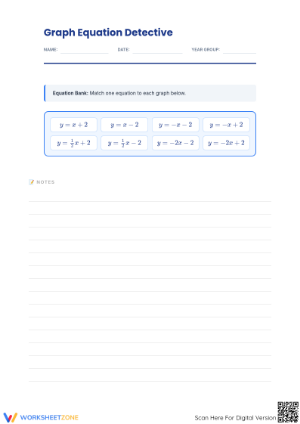
- Identifying slope and y-intercept from an equation: Students name both values from y = mx + b, including cases with negative intercepts and fractional slopes.
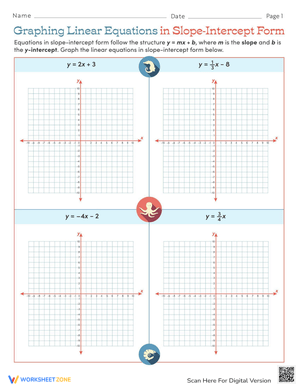
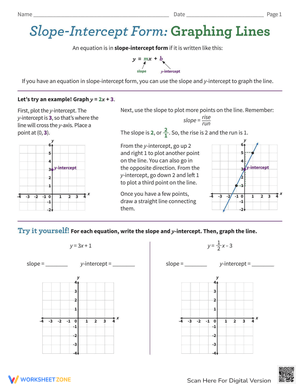
- Graphing a line from an equation: Students plot the y-intercept first, then count rise over run to locate additional points before drawing the line.
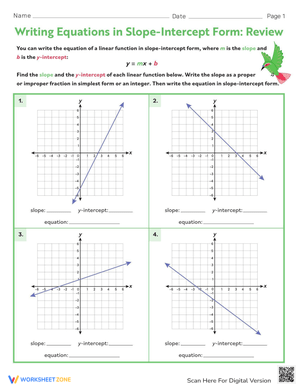
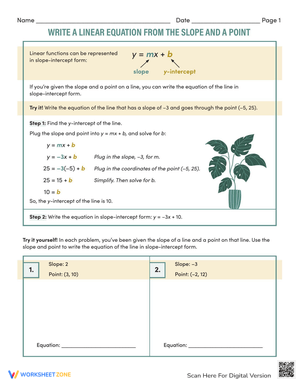
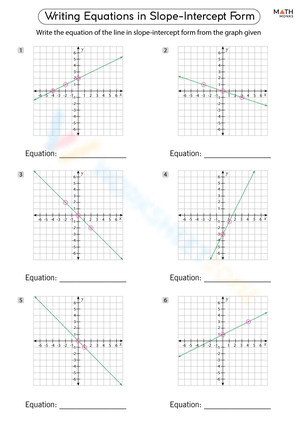
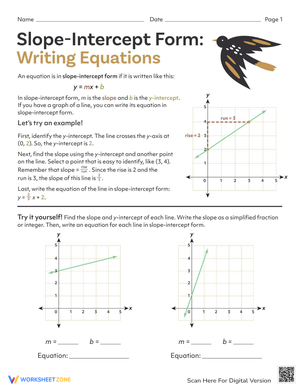
- Writing an equation from a graph: Students read the starting point and rate of change from a drawn line and write the corresponding equation.
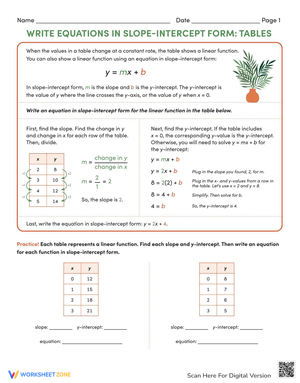
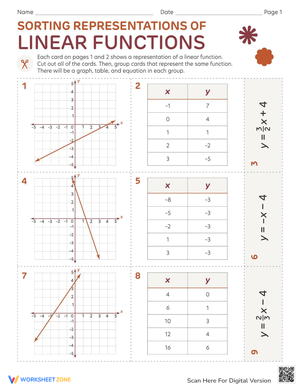
- Writing an equation from a table: Students verify that the rate of change is constant across all rows before identifying slope and initial value.
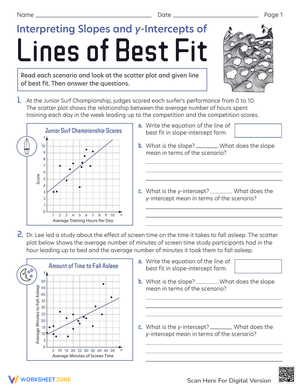
- Interpreting slope and intercept in context: Students explain what each value means in a real situation — a cost per unit, an opening balance, a growing measurement — rather than just labeling letters in a formula.
Mixed-representation worksheets, where equations, graphs, and tables appear on the same worksheet, belong later in the sequence, not at the start of a unit. Students who seem confident when every problem looks identical will sometimes struggle once the format shifts. That's exactly when teachers get the clearest picture of what students actually understand.
Error Patterns That Show Up Early in Slope-Intercept Work
The most consistent mistake is treating the slope as a point to plot rather than a ratio to count. A student who correctly marks (0, 2) as the y-intercept for y = 3x + 2 will then place a second dot at (3, 0) or (0, 3) instead of moving 3 units up and 1 unit right from that starting position. The resulting line passes through the intercept but runs in the wrong direction, and students often don't notice because the first point looks correct. Having students draw slope arrows in a second color before they draw the line makes this error visible before it gets reinforced.
Other patterns worth watching:
- Negative slope errors — students who graph y = 2x + 1 correctly still draw an upward line for y = -2x + 1, defaulting to moving up from the intercept regardless of sign.
- Intercept placement confusion — placing b on the x-axis instead of the y-axis, which signals the student has memorized the term without connecting it to a specific axis.
- Table shortcuts — writing the slope from a single pair of rows without checking that the difference is constant throughout the whole table, producing an equation that fits only part of the data.
- Letter knowledge without meaning — students can say "m is slope and b is y-intercept" but cannot describe what either value tells them about a line's actual behavior.
Where These Worksheets Fit in an 8th Grade Algebra Unit
The identification worksheets — reading m and b from equations — work well as warm-ups on the day after slope-intercept form is first introduced. Three or four problems at the start of class let teachers scan the room for confusion before it compounds into graphing errors. Once students begin graphing, one worksheet per class period is usually the right pace; moving faster often means students are executing a memorized procedure rather than building genuine understanding.
For the final seven or eight minutes before class ends, a worksheet targeting one skill gives every student a completed artifact. A teacher who collects those at the door gets a fast read on who is ready for the next concept and who needs the same skill revisited before the lesson moves on. That kind of low-stakes daily check tells you more about where to pitch tomorrow's instruction than any single quiz score.
In stations, splitting the representations across separate worksheets is efficient. One station focuses on graphing from equations, another on writing equations from graphs, a third on tables. Students rotate through the same content in different forms without needing different materials at each station — just different worksheets from the set.
Standard Alignment
These worksheets align to three CCSS 8th grade standards. 8.EE.B.6 requires students to explain why the slope m is the same between any two distinct points on a non-vertical line and to derive y = mx + b for a line that intersects the y-axis at a value other than zero. 8.F.A.3 addresses interpreting y = mx + b as a linear function whose graph is a straight line. 8.F.B.4 asks students to construct a function to model a linear relationship between two quantities. In classroom sequence, 8.EE.B.6 tends to come first — it builds the conceptual foundation — while 8.F.A.3 and 8.F.B.4 carry more weight once students are reading contexts and writing equations. Having slope intercept form printable worksheets for 8th grade that address all three standards means teachers are not hunting down separate resources to cover each one.
Entry Points for Different Learners in the Same Class
For students who need additional support, limit the early worksheets to equations with integer slopes and intercepts and pair each with a labeled coordinate grid. Removing the setup step — drawing and scaling axes — keeps attention on the actual skill of plotting the intercept and counting slope. For on-level students, progressively reduce those supports across the set and introduce fractional slopes and negative intercepts earlier in the sequence.
Extension goes well beyond graphing accuracy. Ask students to take two equations — one with a steeper slope, one with a higher intercept — and predict where the lines would cross before graphing to check. Or give students specific values for m and b and ask them to write a realistic scenario the equation could represent, then justify why the intercept makes sense as a starting value. These tasks use the same worksheet format but demand reasoning that straightforward drill does not require.
In mixed-ability classes, teachers can assign the same worksheet to everyone while differentiating through response expectations. A student who needs more time works through the first half with guided support before continuing independently. A student who finishes early explains each step aloud or annotates the worksheet to justify why each answer is correct. The format stays consistent; the depth of processing varies. That flexibility is one reason slope intercept form printable worksheets for 8th grade remain practical across classroom settings that differ widely in student readiness.
Frequently Asked Questions
How many worksheets should I plan for before a unit assessment?
Most 8th grade slope-intercept units run two to three weeks. If students arrive with solid coordinate graphing skills, three to five targeted worksheets — one for identification, one or two for graphing, one for writing equations, one mixed — is usually enough. Add more practice at any stage where exit slips or warm-up checks show that students are still making the same errors they made on the first attempt.
Can these worksheets replace direct instruction on y = mx + b?
No. These resources build fluency through deliberate repetition — they do not replace the initial teaching moment. Students who attempt a graphing worksheet without first seeing a modeled example tend to produce confident, incorrect work. Confident errors are harder to undo than tentative ones, so these worksheets belong after instruction, not instead of it.
Are these appropriate for students who have already studied slope and y-intercept as separate ideas?
Yes, and that prior knowledge makes them more effective. When students have already worked with rate of change and initial value, slope intercept form printable worksheets for 8th grade let them connect those two concepts into a single equation rather than learning something entirely new. Students who understand what m and b represent before they practice the formula hold onto it longer than students who learn the meaning and the procedure at the same time.
What is the most effective way to use these worksheets during small-group intervention?
Use four to six problems from a single-skill worksheet rather than assigning every item. In a small-group setting, the goal is discussion and correction, not volume. Two graphing problems that lead to a conversation about exactly where an error occurred teach more than ten problems completed in silence. Students who identify their own mistake during discussion are far less likely to repeat it than students who simply receive a corrected answer on a returned assignment.













 Interactive Worksheet Maker
 Quiz Maker
 Word Search Maker
 Crossword Puzzle Maker
 Word Scramble Generator
 Sentence Scramble Generator
 Handwriting Worksheet Generator
 Name Tracing Generator
 Fill In The Blank Generator