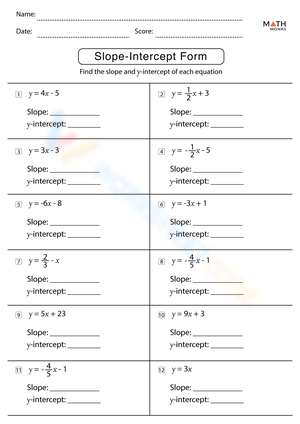
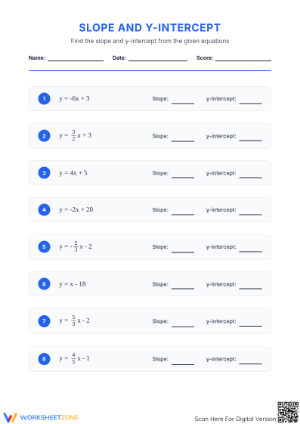
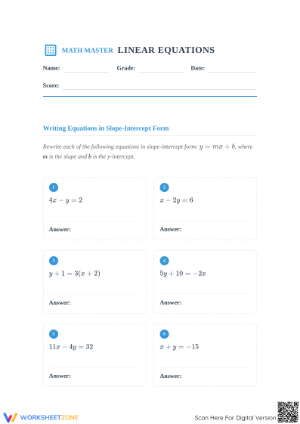
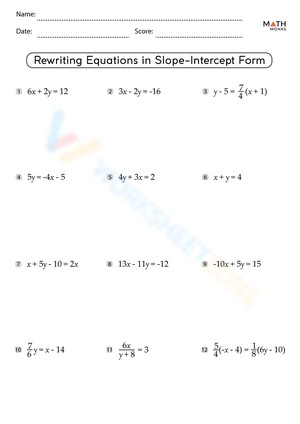
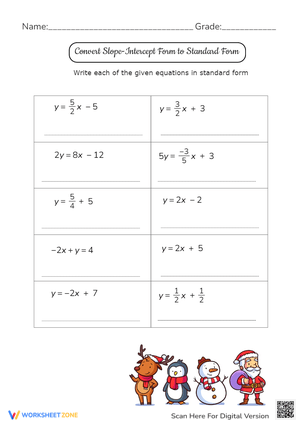
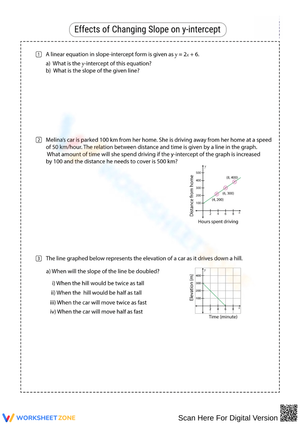
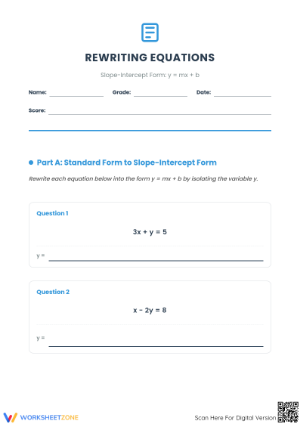
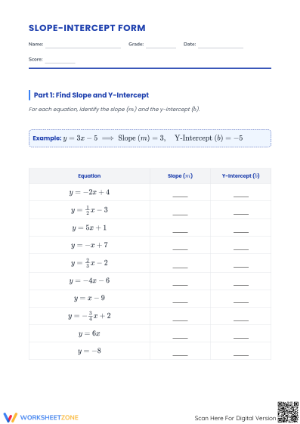
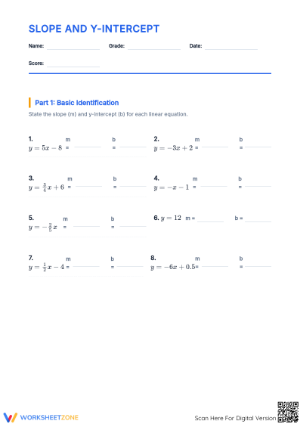
These 8th grade key slope intercept form pdf worksheets cover the three representations of linear equations that 8th graders move between all year — equations, graphs, and tables — in standalone printable practice that fits anywhere in the lesson cycle. The set targets y = mx + b from identification through contextual interpretation, so teachers have material for both initial instruction and review in the weeks before an algebra assessment.
What's Inside the Set
Each worksheet addresses a distinct piece of slope-intercept work. The skills build from reading toward producing and interpreting rather than treating identification, graphing, and equation writing as disconnected tasks.
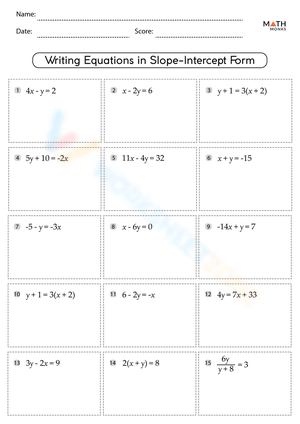
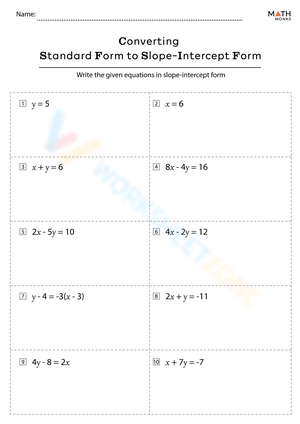
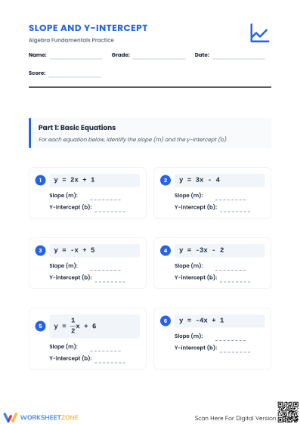
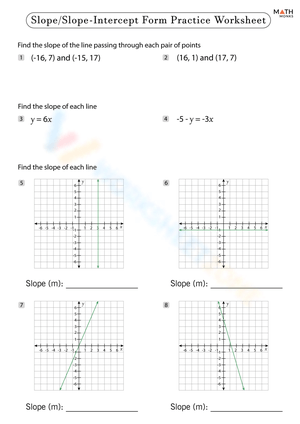
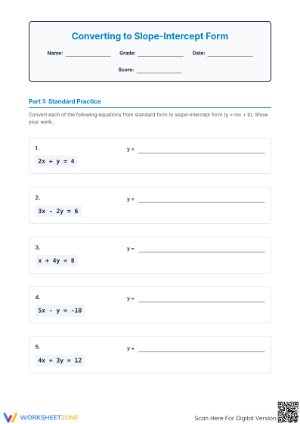
- Reading slope and y-intercept from equations — including equations with negative, fractional, and zero slopes, not only the positive integers students see in early examples.
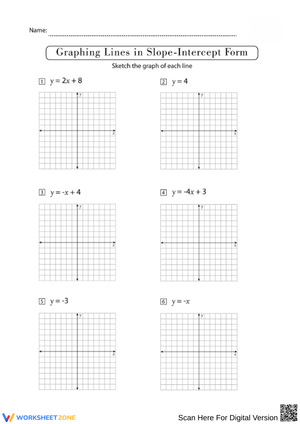
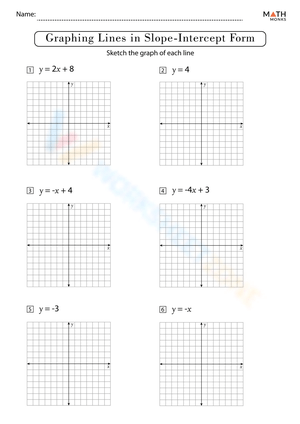
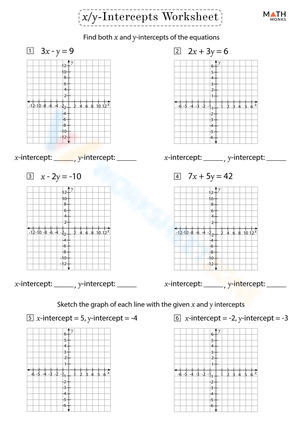
- Graphing from an equation — students plot the y-intercept first, then use rise over run to place a second point. Coordinate planes are sized to support accurate work, not just approximate sketches.
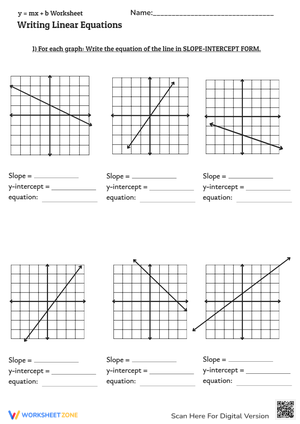
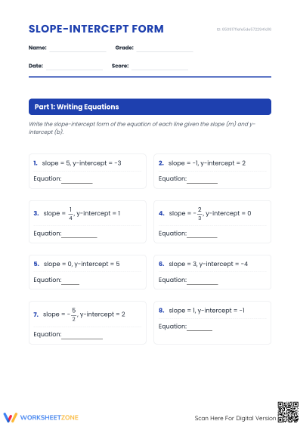
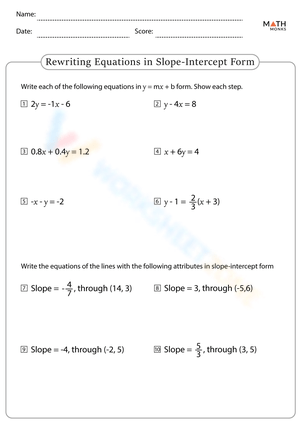
- Writing equations from graphs and tables — students locate the y-intercept visually or calculate it from a table, determine slope from two points, and express both in equation form.
- Comparing linear relationships — tasks that ask which of two equations describes a steeper line, or which real-world scenario has the greater starting value, push students past formula recall toward structural reasoning.
- Short contextual interpretation — scenarios such as a gym membership with a sign-up fee plus a monthly rate give students a reason to explain what the slope and intercept mean in terms of the situation, not just the equation.
Frequent Student Errors Worth Watching For
The most persistent mistake at the 8th grade level is misplacing the y-intercept on the coordinate plane. A student who recites that b is the y-intercept will still plot y = 3x + 4 by starting at (4, 0) on the x-axis rather than (0, 4) on the y-axis. They have the vocabulary and the number right — what they are missing is the understanding that the intercept describes where the line is when x equals zero. That is a conceptual gap, not a notation error, and it surfaces repeatedly during the first week of graphing practice.
Negative slopes produce a second consistent problem. Students who handle y = 2x + 5 correctly will write the slope of y = -3x + 1 as 3, dropping the sign when they pull the coefficient out of the equation. The consequence is a line that rises left to right instead of falling, and because students are focused on procedure, they often do not catch the direction error unless they are explicitly asked whether the graph matches the equation. Worksheets that include a direction-check step — "Should this line rise or fall from left to right?" — help students intercept that mistake before it becomes habitual.
Fractional slopes produce a third pattern. In y = (2/3)x - 1, students frequently treat the numerator and denominator as two separate movements rather than a single ratio, plotting 2 units in one direction and then 3 in another without consistent logic. Enough fractional-slope practice in the set surfaces this error during class rather than on a test.
How to Work These Worksheets Into Your Lesson Planning
Slope-intercept form typically receives one to two weeks of initial instruction in 8th grade, with periodic reinforcement as the year moves into systems of equations and functions. The most effective use of the set is to select based on where students are in the lesson cycle rather than assigning worksheets in a fixed order.
During direct instruction, a strong routine is to model one problem on the board — say, graphing y = -2x + 3 — and then ask students to complete the next two on the worksheet independently before the class checks together. That alternating rhythm keeps students active during whole-group instruction without requiring them to transfer skills they have not yet seen modeled. By midweek, once graphing is underway, a math center can hold the graphing worksheet while a small group works through equation-writing from tables at the teacher table, where prompting on slope direction is available when students get stuck.
One annotation routine that consistently reduces graphing errors: before students touch the coordinate plane, ask them to circle the constant in the equation and write "start" next to it, then rewrite the slope as an explicit fraction and draw a small arrow indicating direction. Students who build this habit before plotting make noticeably fewer intercept-misplacement errors than students who try to hold both values in working memory while managing the grid at the same time.
Standard Alignment
These worksheets align to CCSS 8.EE.B.6 — deriving and using y = mx + b for a line that crosses the vertical axis at b — and CCSS 8.F.A.3, which asks students to interpret y = mx + b as defining a linear function. In classroom terms, 8.EE.B.6 is the standard that requires students to understand why slope stays consistent between any two points on a line, not just that it does. Worksheets that include rise/run annotation or ask students to verify slope between multiple point pairs address that standard more directly than equation-only identification tasks. The 8.F.A.3 alignment is most visible in the interpretation worksheets, where students read a table or graph to determine whether a relationship is linear and connect that decision to the structure of the equation.
Differentiating the Worksheets Across Ability Levels
For students who need additional support, begin with worksheets that use whole-number slopes and y-intercepts that land on clearly labeled grid lines. Adding a sentence frame — "The line crosses the y-axis at ___ and moves ___ up for every ___ right" — gives students language for what they are seeing before they write it symbolically. That expressive support reduces the burden of translating a visual into an equation without lowering the mathematical expectation.
On-level students benefit from mixed-representation worksheets where one problem gives an equation, the next a graph, and the next a table — all asking for the same output. That variation prevents students from relying on surface-level pattern matching and reveals whether they can actually move between forms rather than just complete a single format.
For students ready for extension, error-analysis items add real challenge: present an incorrectly graphed line and ask students to identify exactly where the mistake occurred and produce the correct version. Comparison tasks without graphing — "Which line is steeper? Explain without drawing it." — push students to reason from the structure of the equation rather than computing their way to an answer.
Frequently Asked Questions
Do these worksheets include answer keys?
Yes. The 8th grade key slope intercept form pdf worksheets include answer keys formatted to match each worksheet, including graphing problems where the correctly plotted line and labeled intercept are shown on a duplicate coordinate plane so teachers can check student work at a glance.
Are the worksheets sequenced, or can they be used independently?
Each worksheet functions as a standalone resource. The set moves from identification through graphing, equation writing, and contextual interpretation, but teachers are not required to follow that order. A teacher running a Friday review block can pull the equation-writing worksheet without assigning the graphing ones first.
Can these work for intervention as well as whole-class instruction?
The set works in both settings because the earlier worksheets use clean, integer-based equations while later ones introduce fractional slopes, negative intercepts, and cross-representation tasks. A reteach group can work through the identification worksheet at the table while the rest of the class handles graphing and equation-writing practice. The 8th grade key slope intercept form pdf worksheets also serve 9th grade students who arrive in algebra needing a firm review of linear equation structure before moving into systems.
Do slope-intercept form problems appear on standardized assessments?
Slope-intercept form appears consistently on state algebra assessments in both procedural and applied formats. The 8th grade key slope intercept form pdf worksheets include both — identification and graphing tasks alongside short contextual problems — which reflects the range of item types students encounter on assessments aligned to 8.EE.B.6 and 8.F.A.3.













 Interactive Worksheet Maker
 Quiz Maker
 Word Search Maker
 Crossword Puzzle Maker
 Word Scramble Generator
 Sentence Scramble Generator
 Handwriting Worksheet Generator
 Name Tracing Generator
 Fill In The Blank Generator