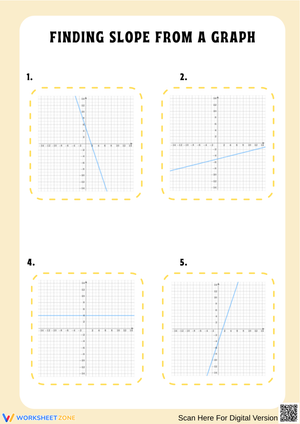
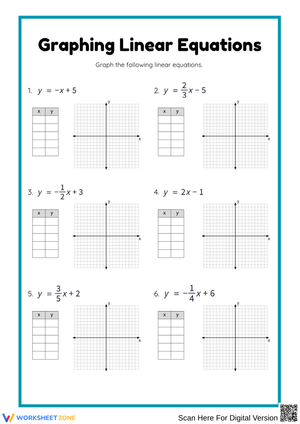
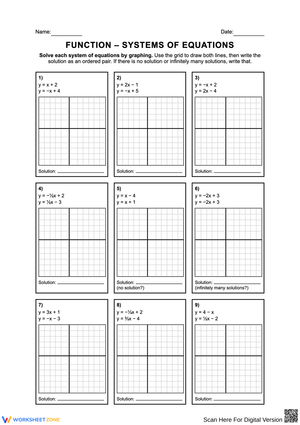
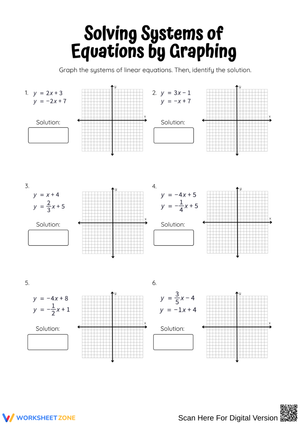
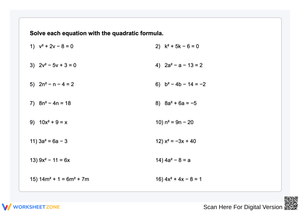
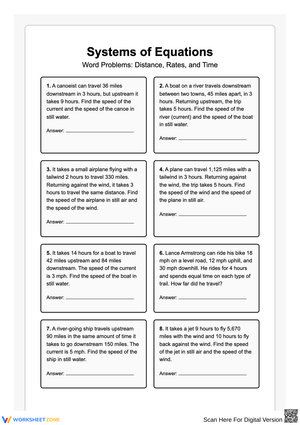
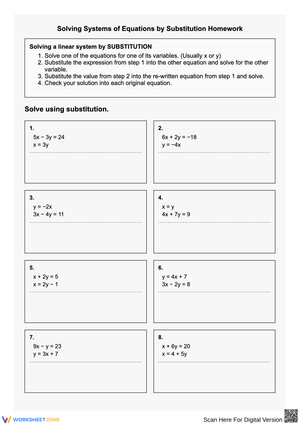
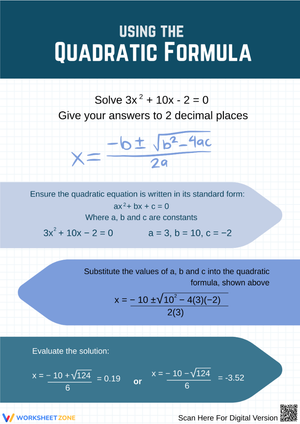
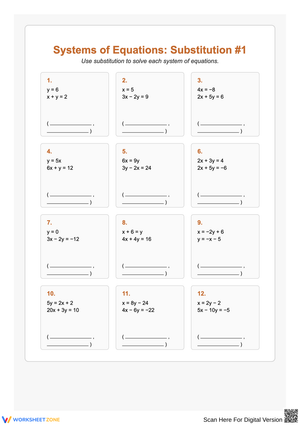
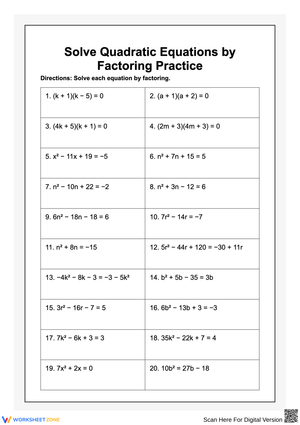
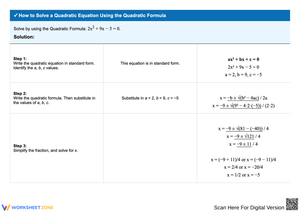
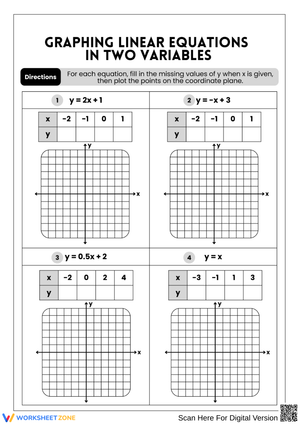
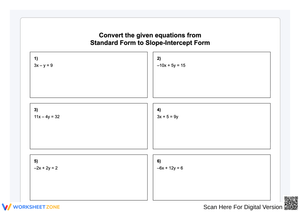
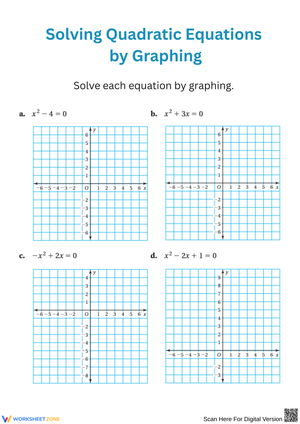
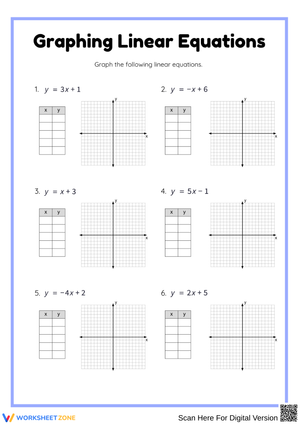
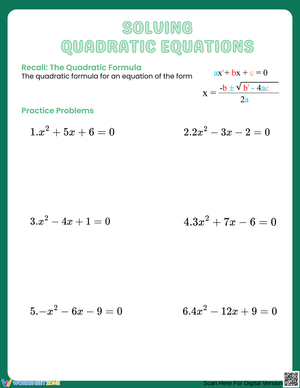
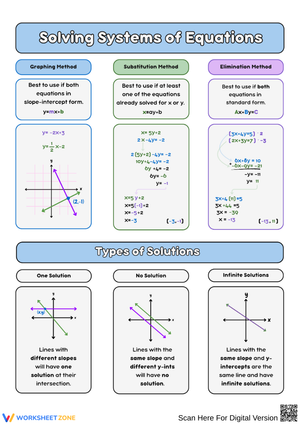
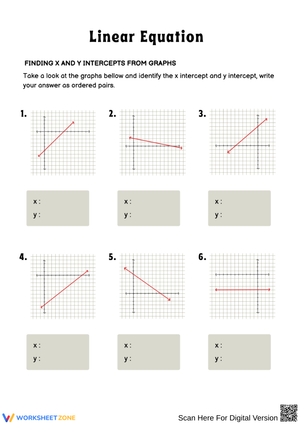
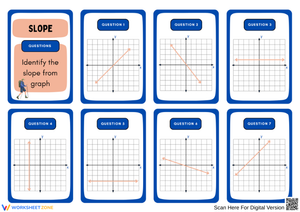
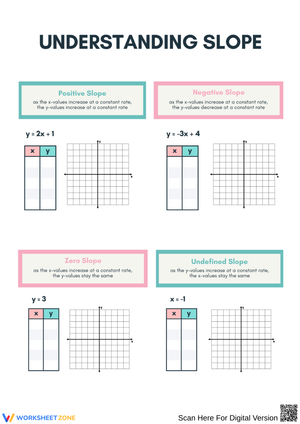
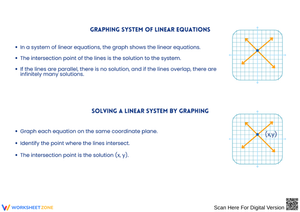
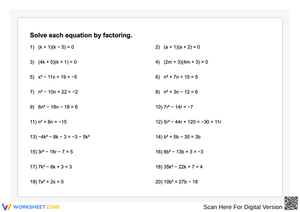
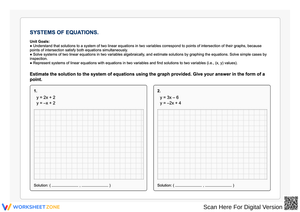
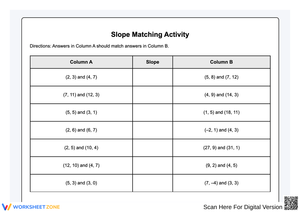
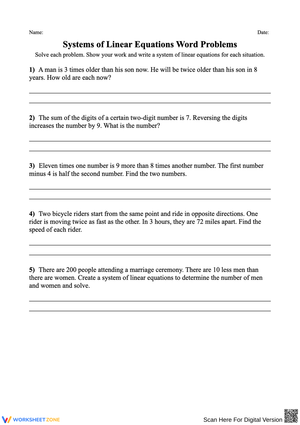
These 8th grade equations worksheets resources give teachers a full progression of linear equation practice — from one-step solving through multi-step work with rational coefficients and variables on both sides — without extra prep to fit different instructional purposes. Each worksheet targets a specific skill level, which matters in Grade 8 classrooms where students in the same room can be a full year apart in algebra readiness. The layouts are print-friendly with enough workspace for students to show their algebra steps clearly, and every worksheet in the set comes with an answer key so formative checks during class stay fast.
The Skill Sequence Across the Set
The worksheets follow a progression that mirrors how Grade 8 students actually build equation fluency. One-step equations come first — not as filler, but because they are the clearest diagnostic tool for whether students understand inverse operations. A student who solves x + 7 = 15 correctly in September but hesitates on x – (–4) = 11 in October is giving teachers specific information about sign rules, not just about equations generally.
Two-step equations introduce the sequencing problem: students must decide which operation to undo first, and many try to combine the constant and coefficient before isolating anything. Multi-step work adds combining like terms and distribution, revealing whether students understand expression structure before they solve. Variables on both sides come last in the main progression because they require students to manage two simultaneous moves — shifting variable terms to one side while shifting constants to the other — without losing track of signs in either direction.
- One-step equations — integers first, then rational numbers; most useful for warm-up review and intervention check-ins
- Two-step equations — with integers and fractions; strong for mini-lesson follow-up and exit ticket checks
- Multi-step equations — combining like terms and distribution before solving
- Variables on both sides — the algebraic balance concept that trips up the most 8th graders
- Equation word problems — setting up equations from context, not just solving pre-written problems
Student Errors That Show Up Most Consistently in Equation Work
Distribution errors are the most predictable issue in multi-step problems. When students see 2(x + 3) = 14, a common response is to write 2x + 3 = 14 — they apply the multiplication to the first term only and treat the 3 as already outside the parentheses. That gives x = 5.5 instead of the correct x = 4, and the mistake stays invisible when teachers only check the final answer. Worksheets that require students to write each step on its own line make this error visible before it calcifies into habit.
Sign errors with subtraction run a close second. Students solving x + 7 = 15 will sometimes write x = 22 because they recognize they need to deal with the 7 but then add instead of subtract — their attention is on the number rather than the inverse operation. With variables on both sides, the error shifts: students move the smaller variable term correctly but then forget to flip the sign of the constant as it crosses the equal sign. Worksheets with short error-analysis tasks — where students identify the mistake in a fully worked-out problem — surface this pattern more reliably than straight problem sets alone.
How to Work These Worksheets Into Your Lesson Planning
The most reliable routine is using each worksheet type for a full day before introducing the next level. A day-by-day structure — one-step on Monday, two-step on Tuesday, multi-step on Wednesday, variables on both sides on Thursday, mixed review on Friday — keeps transition time low and gives teachers comparable data across the week. Students know what to expect at the bell, which means the first five minutes are productive rather than organizational.
For intervention blocks, the integer-only one-step and two-step worksheets are the most practical starting point. Students who are significantly behind grade level often need to re-establish operation fluency before working with rational number coefficients. Pulling those worksheets for a small group during independent work time — while the rest of the class works on variables on both sides — keeps instruction differentiated without requiring entirely separate lesson plans.
These 8th grade equations worksheets materials also work well in stations. Placing different equation types at separate tables and rotating groups every 10 to 12 minutes gives students structured repetition without the fatigue that comes from a long unbroken problem set. Answer keys at each station allow immediate self-correction, which delivers more useful feedback than returning a marked worksheet two days later.
Standard Alignment
These worksheets address CCSS 8.EE.C.7 — solving linear equations in one variable. The two sub-standards have direct instructional implications: 8.EE.C.7a covers equations that yield one solution, no solution, or infinitely many solutions, which the variables-on-both-sides worksheets build toward naturally. 8.EE.C.7b targets equations with rational number coefficients that require distribution and combining like terms before solving, which maps directly to the multi-step worksheet set. For teachers planning instruction around these standards, a well-sequenced 8th grade equations worksheets set covers the equation-solving strand from initial direct instruction through assessment review without requiring separate materials for each phase of the unit.
Adapting the Worksheets for Students at Different Points in the Progression
Differentiation in equation practice works best when teachers adjust number complexity before adjusting algebraic structure. A student who is not yet confident with negative integers will struggle to show what they know about variables on both sides when fractions appear in the same problem. Giving that student integer-only equations with the same algebraic structure — variables on both sides, no fractions — lets teachers assess the algebra concept without number complexity getting in the way.
- For students below grade level: assign integer-only versions of each worksheet type, reduce problem count, and leave more workspace; consider a partially worked reference example on a separate card rather than embedded in the worksheet itself
- For on-level students: use the standard versions with rational number coefficients and a mix of positive and negative solutions
- For advanced students: assign the distribution-heavy multi-step worksheets, the word problem sets, and error-analysis tasks where students identify and correct incorrect worked steps
Sorting worksheets by observed error pattern is often more effective than sorting by overall level. If a student's main issue is combining unlike terms, assign multi-step worksheets that front-load simplification before any equation solving begins. If the problem is maintaining balance when moving terms across the equal sign, give variables-on-both-sides practice with smaller coefficients first, then increase the complexity. Targeted practice of this kind resolves specific errors faster than broad mixed-review packets for most struggling students.
Frequently Asked Questions
What equation types should 8th graders spend the most time on?
The bulk of Grade 8 equation practice should focus on two-step and multi-step linear equations in one variable, including problems with rational number coefficients, distribution, and variables on both sides. One-step equations are still worth reviewing — especially with negative numbers — but the major instructional investment belongs in equation types that require multiple algebraic moves and reveal whether students can maintain balance across the equal sign throughout the process.
Can the same worksheet serve double duty as classwork and homework?
Yes. A teacher can use the first several problems during a mini-lesson follow-up and then assign the remaining items for homework, using the same answer key for both purposes. Making the answer key available briefly for self-check after grading — rather than only using it to assign a score — builds the correction habit that makes homework review more instructionally useful than returning a marked worksheet with nothing on it but a grade.
How do these worksheets help students preparing for Algebra 1?
Students heading into Algebra 1 need reliable fluency with linear equations in one variable before they hit systems of equations, slope-intercept form, and function notation in the same course. These 8th grade equations worksheets resources build that fluency through the same problem types Algebra 1 teachers expect students to handle independently from the first week of class. The multi-step and variables-on-both-sides worksheets in particular mirror the review problems that appear in the opening chapters of most Algebra 1 textbooks.
Are answer keys included with every worksheet?
Every worksheet in the set comes with a full answer key. Teachers can use it for rapid grading, for self-check stations during group work, or for short reflection tasks where students write one sentence explaining an error they found and corrected. That last approach turns practice time into feedback time, which is where most durable learning from equation work actually happens.













 Interactive Worksheet Maker
 Quiz Maker
 Word Search Maker
 Crossword Puzzle Maker
 Word Scramble Generator
 Sentence Scramble Generator
 Handwriting Worksheet Generator
 Name Tracing Generator
 Fill In The Blank Generator