


























Views
Downloads

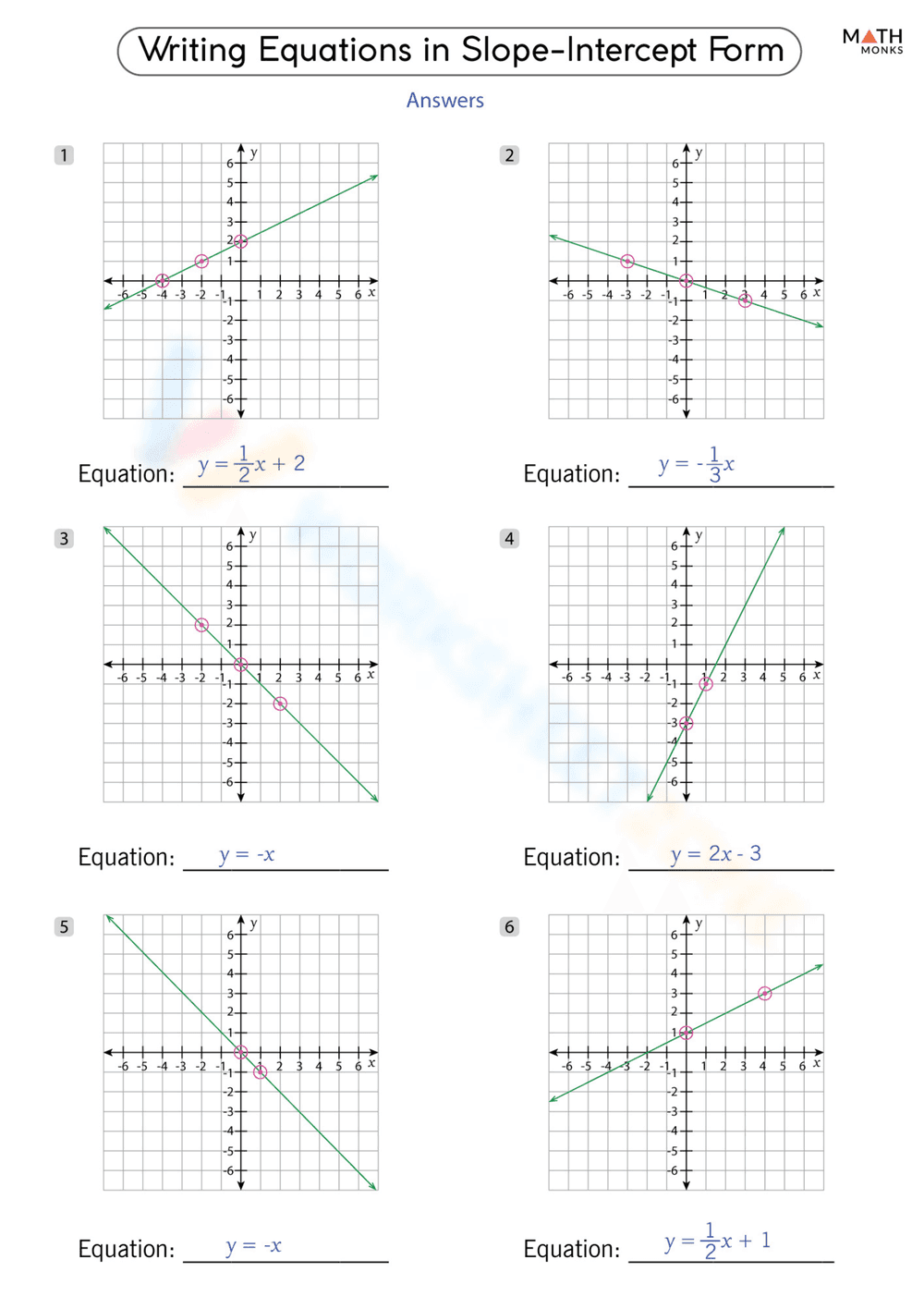

Grade 8 Slope-Intercept Form — Printable No-Prep Worksheet
Paste this activity's link or code into your existing LMS (Google Classroom, Canvas, Teams, Schoology, Moodle, etc.).
Students can open and work on the activity right away, with no student login required.
You'll still be able to track student progress and results from your teacher account.
This printable math worksheet helps eighth-grade students master writing linear equations in slope-intercept form directly from coordinate graphs. By identifying the y-intercept and calculating the rise-over-run slope, learners build a concrete understanding of linear functions. Students translate visual lines into algebraic equations, establishing a strong foundation for high school algebra.
At a Glance
- Grade: 8 · Subject: Math
- Standard:
CCSS.MATH.CONTENT.8.F.B.4— Construct a function to model a linear relationship from a graph- Skill Focus: Writing linear equations in y=mx+b form
- Format: 2 pages · 6 problems · Answer key included · PDF
- Best For: Independent practice and quick formative assessment
- Time: 15–20 minutes
This resource contains a single-page student practice sheet featuring six distinct coordinate plane graphs. Each graph displays a linear function with two highlighted points, including the y-intercept, to scaffold the slope calculation process. The clean layout provides dedicated space for students to write their final equations. A complete, identical teacher answer key is included for rapid grading.
Zero-Prep Workflow
This resource is designed for immediate classroom integration with minimal teacher effort:
- Print (1 minute): Print the single student page. No collating or stapling required.
- Distribute (1 minute): Hand out the worksheet as a warm-up or independent practice task.
- Review (5 minutes): Use the provided answer key to project correct equations or grade work.
With a total preparation time under two minutes, this worksheet serves as an excellent emergency sub plan.
Standards Alignment
This activity aligns directly with the Common Core State Standard CCSS.MATH.CONTENT.8.F.B.4. Students construct a linear function to model the relationship between two quantities by determining the rate of change and initial value from a graph. Both standard codes can be copied directly into lesson plans, IEP goals, or district curriculum mapping tools.
How to Use It
Use this worksheet during the independent practice phase of your lesson after teaching the slope formula and y-intercept identification. Alternatively, assign it as a mid-unit formative assessment to check student understanding. While students work, walk around and observe if they correctly identify negative slopes on decreasing lines, which is a common point of confusion. Expect students to complete the six problems in 15 to 20 minutes.
Who It's For
This worksheet is designed for eighth-grade math students learning linear algebra, but it also serves as a valuable review for high school algebra students. For students needing extra support, pair this worksheet with physical slope triangles or coordinate grid whiteboards. Advanced learners can be challenged to write a corresponding real-world scenario for one of the graphed lines.
This linear equations worksheet targets the core requirements of CCSS.MATH.CONTENT.8.F.B.4 by requiring students to translate graphical representations of lines into algebraic equations. According to research from EdReports 2024, structured visual practice with coordinate planes helps middle school students bridge the gap between concrete geometric representations and abstract algebraic notation. By focusing on six high-quality graphing problems, this resource provides targeted practice that reinforces the connection between the rate of change and the y-intercept. Teachers can utilize this worksheet to gather reliable formative data on student mastery of linear functions. The inclusion of pre-marked points on each graph supports student accuracy while maintaining the cognitive demand of calculating slope. This balanced approach ensures students develop the procedural fluency necessary for success in subsequent algebra coursework.


