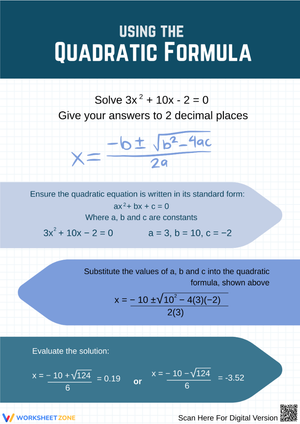
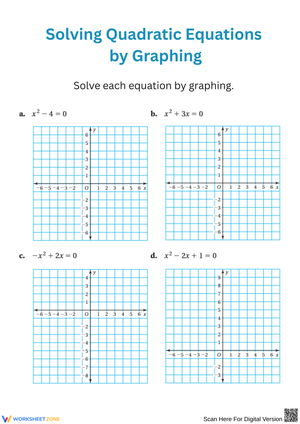
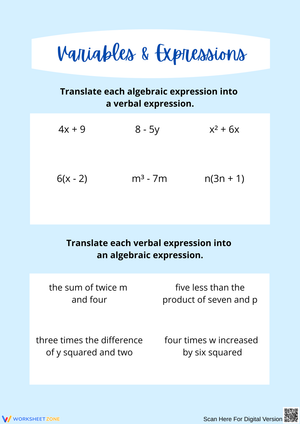
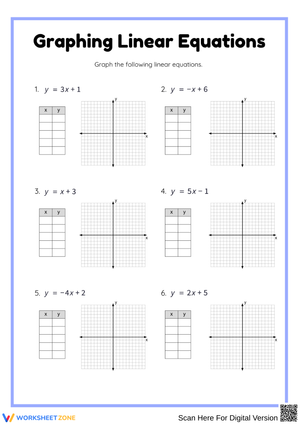
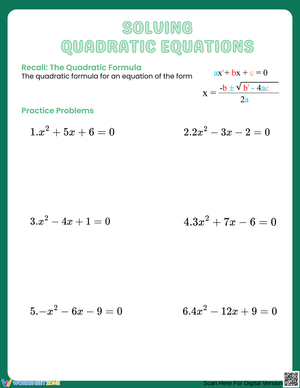
These algebra printable worksheets for 8th grade address the skills students need at the precise moment arithmetic thinking has to expand into abstract algebraic work — linear equations, slope and graphing, functions across multiple representations, integer exponents, and systems of equations. Each worksheet gives students enough workspace to show steps, annotate operations, and sketch quick reference graphs without running out of room. The full set includes answer keys throughout.
Topics and Skills Covered in the Collection
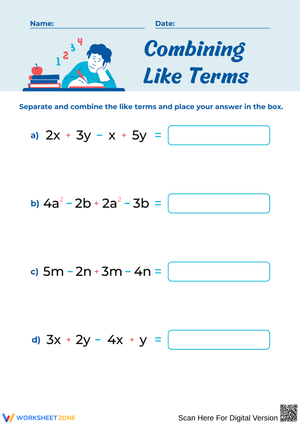
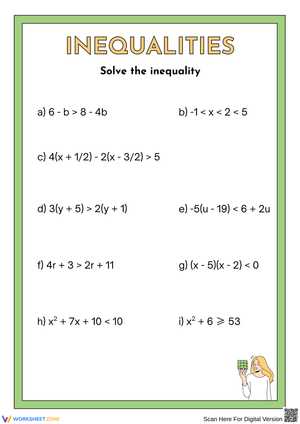
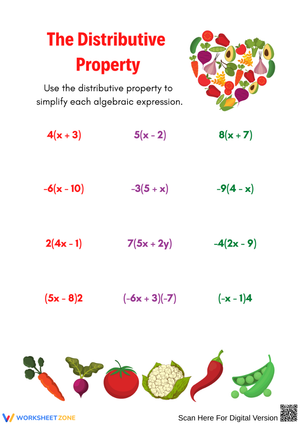
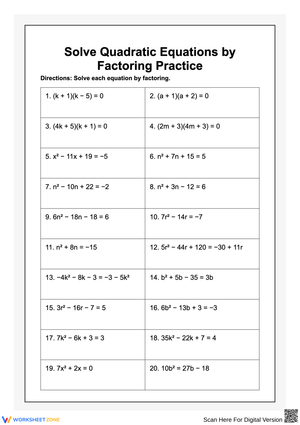
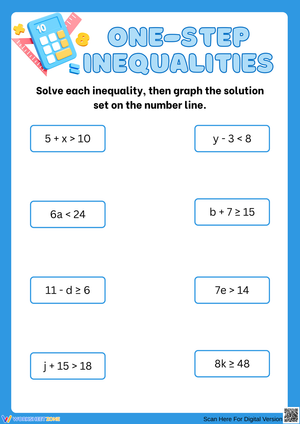
Linear equations form the core of the set. Students work through one-step problems, two-step problems, equations with variables on both sides, and equations requiring the distributive property before solving. The algebra printable worksheets for 8th grade in the equations cluster also include setups from word problem contexts, where students write the equation before they solve it — a step many students skip when given only symbolic problems.
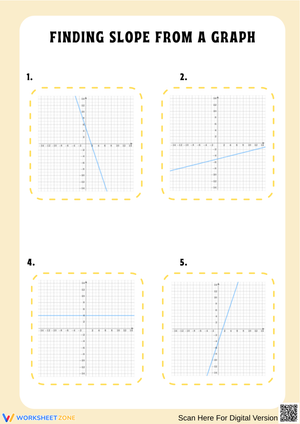
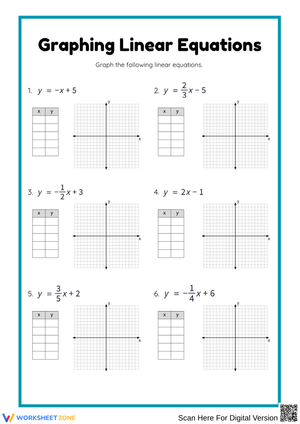
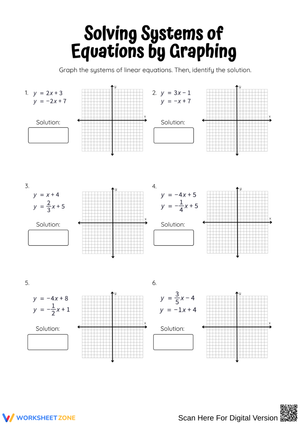
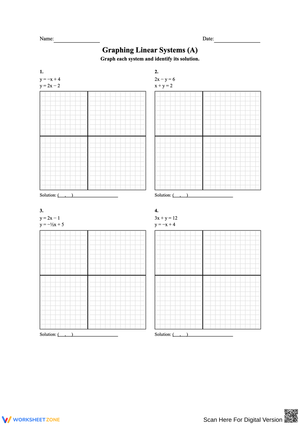
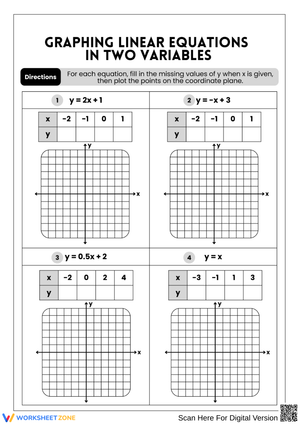
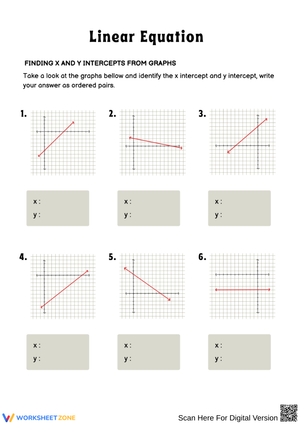
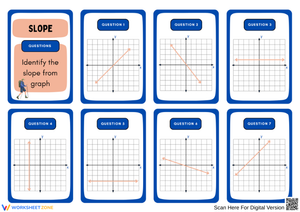
Slope and graphing worksheets ask students to calculate slope from two coordinate pairs, graph lines from slope-intercept form, and match equations to their corresponding graphs. One worksheet places three equations on the same coordinate grid so students compare slopes directly rather than treat each problem as independent. That side-by-side format makes the connection between slope values and line steepness visible in a way that isolated problems rarely do.
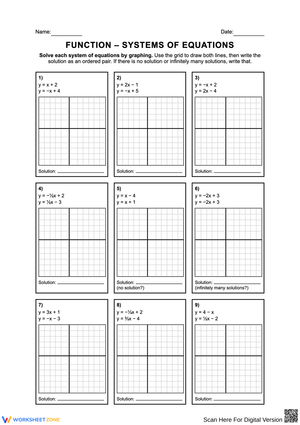
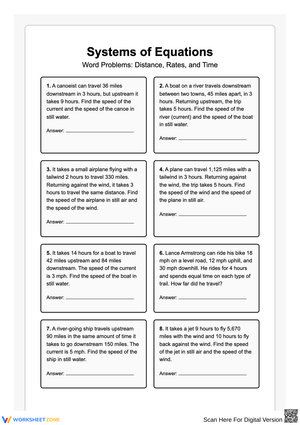
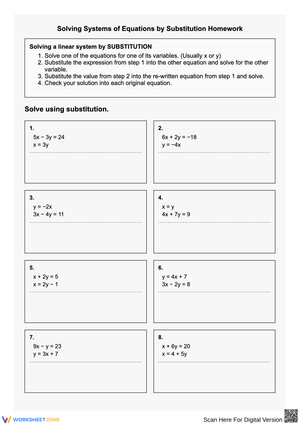
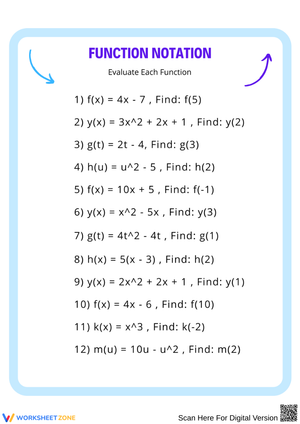
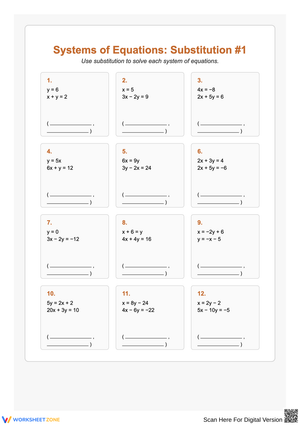
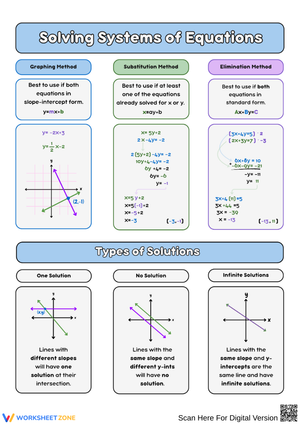
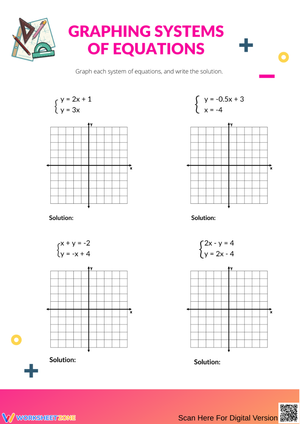
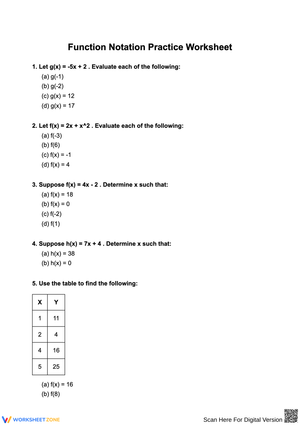
Function worksheets move students between tables, graphs, equations, and verbal rules within the same problem set. Students aren't just identifying functions — they're translating between forms. Exponent worksheets cover the product rule, quotient rule, negative exponents, and scientific notation. The systems worksheets work through substitution and elimination separately before mixing both methods in later problems.
Student Errors That Show Up Consistently in This Work
The most predictable error in equation solving appears when students encounter variables on both sides. Students who handle two-step equations accurately will add a constant correctly to both sides, then fail to apply the same reasoning to a variable term — treating it as a fixed part of the equation rather than something that can be moved. The result looks almost right and produces a numerical answer that passes quick inspection without triggering any alarm.
Slope errors cluster in two places. When a table lists coordinate pairs out of sequential order, students tend to grab the first and last values instead of applying the slope formula systematically, which generates wrong rates of change from accurate arithmetic. When graphing from slope-intercept form, students often plot the y-intercept correctly then move horizontally for rise and vertically for run — exactly backward. Both errors stay hidden unless you ask students to label each step before moving forward.
Function identification produces a specific, recurring mistake. Students mark a table as not a function when they see a y-value repeated — for instance, when both x = 3 and x = 5 map to y = 7, students flag that as a non-function. But repeated outputs don't violate the function rule; repeated inputs do. That reversal is consistent enough that it is worth addressing directly before assigning any function identification worksheet in the set.
Fitting These Worksheets Into the School Week
A three-category rotation works well across the week: skill practice, mixed review, and quick checks. Skill practice keeps each session focused on one concept — slope one day, function notation the next. Mixed review worksheets fold earlier topics into current work, which supports retention without requiring a dedicated spiral day. Quick checks are three to five problems that give a real-time read on whether the class needs to revisit a concept or is ready to advance.
Monday warm-ups after attendance are a practical slot for a short equation worksheet. Students have something concrete to do immediately, and their work shows what carried over from the previous week before the day's new instruction begins. Midweek suits the function worksheets, especially following a mini-lesson on representations. The Friday block is where mixed-review worksheets earn their keep — they surface who is solid across several skills and who needs another targeted session before any unit assessment.
Intervention blocks are where the algebra printable worksheets for 8th grade do some of their most practical work. A small group working through a slope worksheet or an exponent worksheet gets structured practice without the teacher building new materials from scratch. The clean, print-ready format also makes each worksheet straightforward for tutoring, centers, and make-up assignments.
Making This Set Work Across Different Readiness Levels
For students still consolidating foundational skills, limiting the assignment to the first portion of any worksheet keeps cognitive load manageable without pulling the student off the skill entirely. Problems in the first half of each worksheet isolate the core procedure before additional steps or complexity appear, so a teacher can differentiate by problem selection rather than by building separate materials.
Extension prompts after a finished worksheet add depth without extra prep. After solving a two-step equation, ask a student to write three equations that share the same solution. After graphing a line, ask how the graph changes if the slope doubles or flips negative. Those additions push students toward explanation and generalization rather than stopping at a correct numerical answer.
Answer keys make peer review and self-check stations practical. Students can verify slope calculations before continuing, or partners can compare function table answers and work through any disagreement together. For teachers who hold brief individual conferences, an answer key allows a fast scan of a student's work before the conversation starts — which matters when the clock is tight and every minute with a student counts.
Standard Alignment
The equation worksheets address CCSS 8.EE.C.7, covering linear equations in one variable — including cases with variables on both sides and the distributive property. Slope and graphing work aligns to 8.EE.B.5 and 8.EE.B.6, which address proportional relationships on graphs and the derivation of y = mx + b from similar triangles. Function worksheets cover 8.F.A.1 through 8.F.B.5, addressing function definitions, input-output relationships, qualitative graphing, and comparison across representations. Exponent practice falls under 8.EE.A.1 and 8.EE.A.3 through 8.EE.A.4. Systems of equations align to 8.EE.C.8.
For teachers in states that have adapted or replaced the CCSS, the skill groupings here correspond closely to most Grade 8 algebra progressions. The sequence — from single-variable equations to two-variable relationships to functions — reflects the conceptual logic of the math itself, which is why it appears in nearly every state-level Grade 8 framework regardless of specific standards language.
Frequently Asked Questions
Do all the worksheets include answer keys?
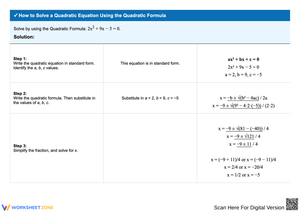
Yes. Every worksheet in the set comes with a complete answer key. For multi-step problems — systems of equations and distributive property equations especially — the keys show the solution process rather than just a final answer, which makes it easier to spot exactly where a student's work went wrong.
Are these appropriate for students who are still building basic equation skills?
The equation worksheets start with one-step and two-step problems before introducing variables on both sides or the distributive property. Teachers running small-group reteach sessions often begin there and move forward as students gain confidence. Students who stall when a variable appears on both sides benefit from working through those earlier problems before attempting the more complex setups.
How do these fit into a sub plan or end-of-unit review?
Directions on each worksheet are written clearly enough for students to work without live instruction, which makes the set reliable for sub days. For review, the algebra printable worksheets for 8th grade with mixed-topic coverage give a practical cross-section of the unit — teachers can assign one worksheet and get a real read on student retention across equations, graphing, and functions.
Can individual worksheets work inside a standards-based grading system?
Because each worksheet addresses one or two specific standards, they map directly onto learning targets in a standards-based gradebook. A slope worksheet generates evidence specifically for the relevant 8.EE standards rather than a broad algebra score. Teachers can use these as formative evidence or as one data point in a larger body of work alongside assessments and class observations.













 Interactive Worksheet Maker
 Quiz Maker
 Word Search Maker
 Crossword Puzzle Maker
 Word Scramble Generator
 Sentence Scramble Generator
 Handwriting Worksheet Generator
 Name Tracing Generator
 Fill In The Blank Generator