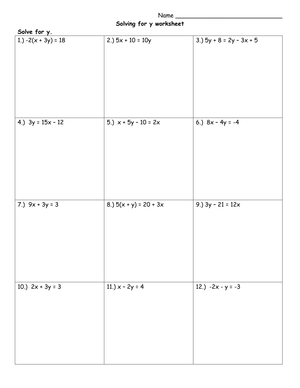
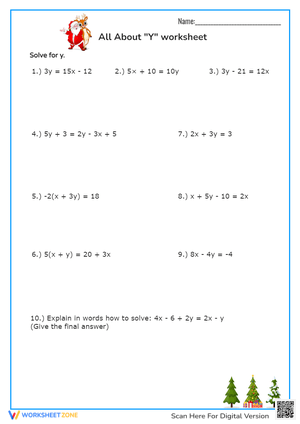
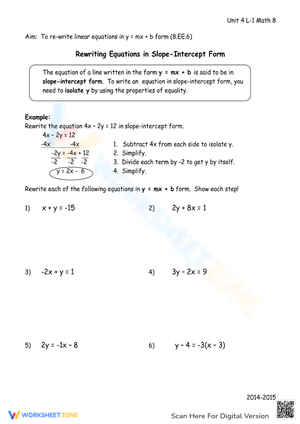
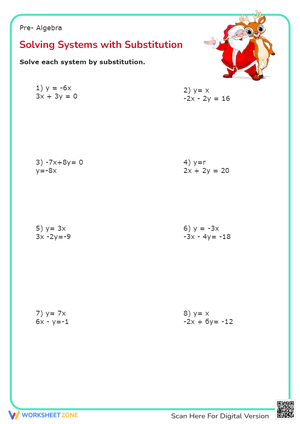
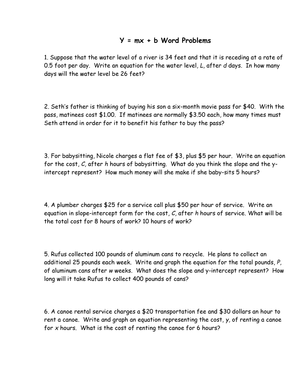
8th grade solving for y printable worksheets give teachers targeted practice for one of Grade 8 algebra's most load-bearing skills: rewriting linear equations so y stands alone on one side. When students rearrange an equation into y = mx + b form, they are not just executing steps — they are making slope and y-intercept visible, which pays off immediately in graphing and comparing linear relationships. That connection between equation structure and graphical meaning is exactly what makes this skill worth practicing deliberately across several class periods.
The Algebra Skills These Worksheets Build
On the surface, solving for y looks procedural. In practice, it asks students to coordinate several algebra habits at once: maintaining equation balance, choosing the correct inverse operation, tracking negative signs across multiple steps, and recognizing what a finished equation should look like. This skill lands at a specific intersection in the 8th grade year — students already know inverse operations from earlier grades, but they have not yet had to apply them together with distribution, fraction clearing, and variable collection all appearing in the same problem.
Across the set, students work through problems that require them to:
- Isolate y by applying inverse operations in a logical order
- Distribute correctly before moving other terms
- Collect variables that appear on both sides of the equation
- Clear fractions to simplify the path to isolating y
- Identify slope and y-intercept in the rewritten equation
- Verify that the rewritten form is equivalent to the original
That last point — verifying equivalence — is the one students most consistently skip. 8th grade solving for y printable worksheets that build a verification step into each problem help students carry that habit into graphing work, where a misrewritten equation produces a visibly wrong line on the coordinate plane.
Errors Students Make That Are Worth Catching Early
The error that appears most often is also the subtlest: students reach y = 7 - 2x and identify the slope as 7 because that number comes first. They read left to right rather than matching terms to the y = mx + b template. Students who practice rearranging y = 7 - 2x into y = -2x + 7 before labeling anything are far less likely to carry that misread into graphing work when the equations become more complex.
A second error surfaces with negative leading coefficients. When an equation simplifies to -y = 3x + 5, many students stop there and treat the result as complete. They read the slope as 3 and the y-intercept as 5 without recognizing that the coefficient on y is still -1. Multiplying both sides by -1 — and flipping every sign on the right — is a step that gets skipped under time pressure or when students feel "almost done."
A third pattern shows up during distribution. Given 2(x + 3) + y = 10, students often distribute the 2 to only the first term in the parentheses, writing y = 10 - 2x + 3 instead of y = 10 - 2x - 6, which simplifies to y = 4 - 2x. The error produces a y-intercept that is off by exactly the amount of the undistributed product — a diagnostic clue that helps teachers pinpoint the mistake quickly once they know to look for it.
How to Build These Worksheets Into Your Lesson Sequence
A common approach is to introduce the mechanics with two or three worked examples on the board, then assign a short set of integer-only problems the same day so students can focus on process without also navigating negatives or fractions. The next session, move into equations that require one extra step — distributing, collecting variables, or clearing fractions — before isolating y. Spacing that progression over several days gives students time to notice patterns in their own errors before those errors get reinforced through rushed repetition.
For the ten minutes before the end of class, a four-problem exit worksheet works well: two problems at the current difficulty level and two that preview the next day's variation. That window reveals who is ready to move forward and who needs a targeted reteach. For intervention in a small group, pull problems that isolate a single barrier rather than assigning a full mixed-review worksheet too early. If students are losing track during distribution, five problems that all require distributing first — and nothing else — produce cleaner diagnostic information than twenty mixed problems where the distribution errors get buried in other steps.
One routine worth adding: after students isolate y, have them circle the coefficient of x and underline the constant, then write one sentence explaining what each value tells them about the graph. "The slope is -2, so the line falls as x increases" is enough. That follow-up takes about 90 seconds per problem and keeps the exercise from functioning as disconnected symbol manipulation.
Tailoring the Set for Different Readiness Levels
Grade 8 classrooms carry a wide range of readiness, and sorting the available resources into three bands makes differentiation manageable. The foundational group works with problems that have clean integer coefficients, no distribution, and no variables on both sides — the goal is building fluency with inverse operations without adding cognitive load from simultaneous demands. The on-level group handles standard form equations involving negatives and two or three steps. The stretch group tackles problems with fractional coefficients, multi-step distribution, or equations that require collecting like terms on both sides before y can be isolated.
8th grade solving for y printable worksheets that include answer keys make peer checking and station rotations significantly smoother. Students can self-check a completed section, mark mistakes in a different color, and attempt corrections before comparing with a partner — a process that surfaces reasoning differences more efficiently than a teacher circulating to review individual papers. The key is making the answer key available at the right moment: after completion, not before.
Standard Alignment
This skill sits directly under CCSS 8.EE.B.6, which asks students to use similar triangles to explain why slope is constant between any two distinct points on a line and to derive y = mx + b. It also connects to 8.EE.C.7b, which addresses solving linear equations with rational number coefficients. In classroom terms, solving for y bridges these two standards: students apply equation-solving techniques developed in 7.EE into the graphing context that 8.EE.B.6 requires. Teachers who sequence these worksheets between an introduction to slope-intercept form and the first formal graphing lesson find students enter that lesson with a procedural base that lets the conceptual discussion move faster.
Frequently Asked Questions
What does "solving for y" mean in 8th grade math?
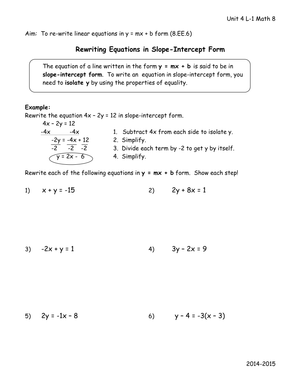
It means rewriting a linear equation so that y is alone on one side, typically in the form y = mx + b. Unlike solving a one-variable equation where the result is a single number, solving for y produces an equivalent equation that expresses y in terms of x. That form makes slope and y-intercept readable without any additional steps.
What problem types should a set like this cover?
A well-structured set of 8th grade solving for y printable worksheets moves from simple integer equations — where students need only one or two inverse operations — to multi-step problems involving distribution, variables on both sides, and rational coefficients. Including prompts to identify slope and y-intercept after rewriting connects the procedure to its geometric meaning rather than leaving it as isolated symbol manipulation.
How many problems per session is reasonable?
For a bell-ringer or exit check, three to five problems at a consistent difficulty level work well. For independent practice in a 20-minute block, eight to twelve problems spanning two or three difficulty levels give a clearer picture of where individual students stall. Assigning more than fifteen problems at once rarely produces additional learning — it mainly produces more errors made quickly.
Can these worksheets support students who are working below grade level?
Yes, with deliberate problem selection. Students who are still shaky on one-variable equations benefit from worksheets that use only integer coefficients and require just one or two steps. Once they can work through those reliably, introducing distribution or fraction clearing as one new demand at a time keeps the next step manageable. The risk is assigning a mixed-difficulty worksheet that combines too many demands at once — frustration replaces practice, and errors stop being informative.













 Interactive Worksheet Maker
 Quiz Maker
 Word Search Maker
 Crossword Puzzle Maker
 Word Scramble Generator
 Sentence Scramble Generator
 Handwriting Worksheet Generator
 Name Tracing Generator
 Fill In The Blank Generator