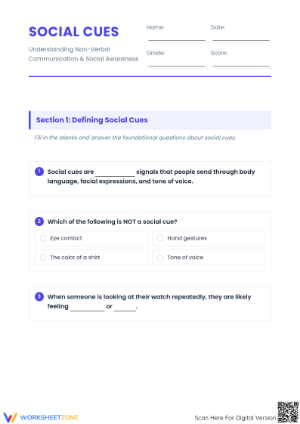
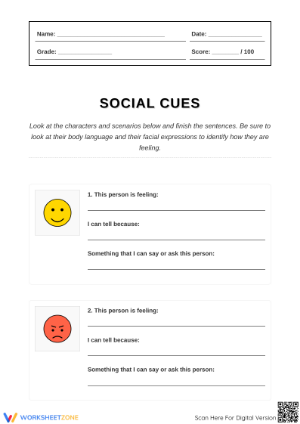
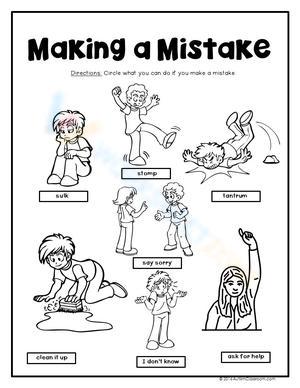
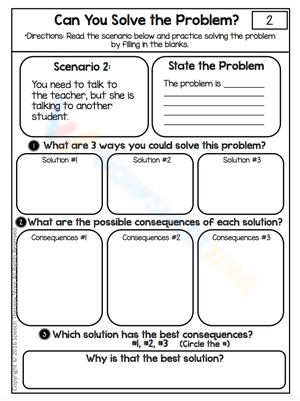
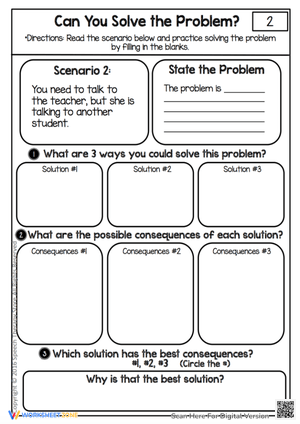
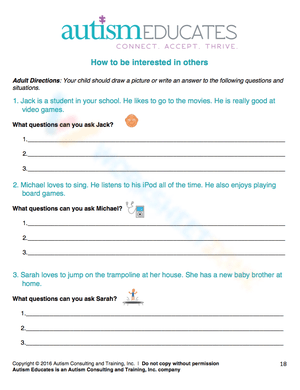
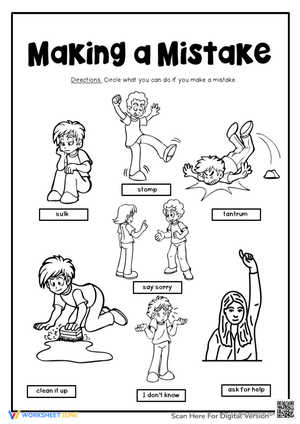
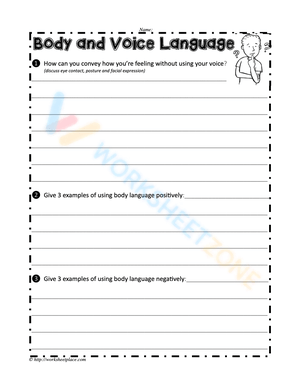
These 7th grade social skills for autism worksheets printable cover the social communication demands that define middle school for autistic students: joining a group, staying on topic in a discussion, reading a peer's tone, and recovering from a social mistake. Each worksheet targets one skill with concrete language, structured prompts, and scenarios drawn from the actual environments students move through daily — not simplified elementary situations relabeled for an older grade.
What Each Worksheet in the Set Targets
The collection covers five skill areas that show up most in 7th grade — from cooperative science labs to lunch conversations to partner work in language arts. These are not abstract social concepts; they are the specific situations where autistic students often face the clearest mismatches between their social communication style and the expectations of middle school peer culture.
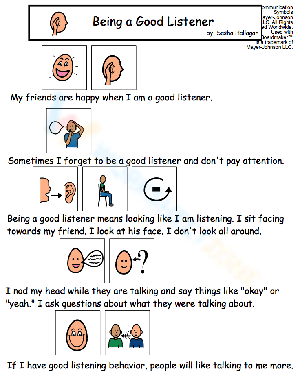
- Conversation and listening: turn-taking signals, sentence starters for entering a discussion, and concrete ways to show active attention without requiring eye contact as a performance
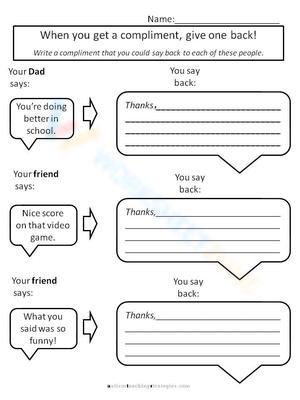
- Perspective-taking and social cues: scenario-based practice reading tone, body language, and unstated expectations during peer interactions — including text message misreads, which is a high-frequency problem in seventh grade
- Group work and peer interaction: how to join a group already in progress, share an idea when someone else is talking, handle a disagreement without shutting down, and stay collaborative when a task gets frustrating
- Emotional regulation: frustration scales, emotion check-ins, and pre-planned calm-down strategies for transitions, unexpected schedule changes, and high-demand academic blocks
- Social repair: scripts and decision trees for handling a misunderstanding, apologizing briefly and clearly, or trying a different response after a social mistake
Seventh grade is when peer relationships grow more layered and less forgiving than they were in elementary school. That developmental shift is why direct instruction in these areas matters more at this grade, not less — and why the scenarios in these worksheets reflect what actually happens in seventh grade hallways and classrooms rather than generic "friendship" situations.
Frequent Errors Worth Watching For in Student Work
The most consistent pattern we see with perspective-taking worksheets: a student correctly identifies what a peer is probably feeling, then responds in the role-play as if their own preference is the only consideration. A student might write "Jaylen probably wants to change the subject" and then spend two more minutes expanding on the same topic anyway. That gap — knowing what the skill looks like on paper and actually deploying it in a social moment — is exactly what a well-structured worksheet surfaces. It is useful diagnostic information.
Emotional regulation worksheets reveal a different issue. Students who rate their frustration at a 2 on a calm pre-planning sheet may be operating at a 7 when the transition or unexpected change actually hits. These worksheets work best as planning tools used before a known challenge point — a substitute day, a field trip, a group presentation — rather than handed out mid-meltdown. The calm-down plan completed ahead of time becomes a reference point when regulation gets hard, not another demand on an already overwhelmed student.
On social repair worksheets, watch for script rigidity. Students practice "I'm sorry, I didn't realize that" accurately during the worksheet activity, then freeze when the real social moment is messier than the scenario on the page — when the peer is still visibly frustrated, or the language doesn't match the script exactly. Brief role-play with slight variations closes that gap faster than additional worksheet practice alone.
Smart Ways to Work These Worksheets Into Your Teaching Week
A consistent weekly structure around 7th grade social skills for autism worksheets printable might look like this: introduce the target skill with examples and non-examples, model it aloud, work through part of the worksheet together as a class, practice through role-play, and then return to the worksheet for brief reflection. That sequence gives students multiple exposures to the same concept before independent application is expected — and it creates a natural checkpoint where teachers can see exactly where understanding breaks down.
Timing matters as much as sequence. Advisory blocks, the ten minutes after morning meeting, and the final stretch of a resource period are all low-stakes windows where one worksheet can be completed well without sacrificing instructional time elsewhere. Pre-teaching is especially effective here: a group-work planning worksheet completed the morning before a cooperative science lab gives students something concrete to refer back to when the group hits a friction point. Afterward, the same worksheet becomes the debrief — what worked, what felt hard, what to try differently next time.
One shift that reduces resistance in seventh grade: frame each worksheet as a strategy tool, not a behavior correction. Students who believe the page is about fixing something they did wrong tend to disengage or answer defensively. Students who believe it gives them a way to handle confusing situations or advocate for themselves in group work tend to complete it more honestly and carry the thinking further into real interactions.
Adjusting the Set for Different Support Levels
In inclusion settings, the 7th grade social skills for autism worksheets printable in this set work best when the core skill target stays fixed while the response format shifts to match what each student needs. One student might write a full reflection; another might circle from provided options; another might talk through answers with a paraprofessional while someone else records the responses. What changes is the language production required — not the skill being practiced. A student who discusses answers aloud is still engaging with the same perspective-taking task as the student who writes three sentences.
Reading load is the first practical adjustment to make. Reading a scenario aloud, highlighting the key sentence, or narrowing a multi-part prompt down to a single question all reduce the language barrier without diluting what students are working on. For students who need support with abstract vocabulary, front-loading terms like perspective, compromise, or misunderstanding before the worksheet goes out prevents the page from stalling on word meaning instead of the social concept itself.
For students who move through these concepts quickly, the extension is built into the format: instead of choosing from provided response options, they write an alternative response that would have played out differently, or they rate each option and explain the trade-offs. That reasoning push keeps the worksheet useful without requiring a completely separate document for advanced learners.
Frequently Asked Questions
Which skill areas should I start with for autistic 7th graders who are new to explicit social skills instruction?
Start with emotional regulation and conversation turn-taking. These two skill areas have the clearest connection to daily classroom routines, and students typically see immediate relevance — group work and transitions happen every day. Building competence in those two areas first also makes perspective-taking and social repair practice more productive, because students have more regulation resources available when they engage with more cognitively demanding scenarios.
How do these worksheets hold up in a full inclusion classroom where not every student has an IEP?
The design stays age-respectful enough — realistic scenarios, clean layout, no elementary clip art — that many of these activities work as whole-class SEL tasks during advisory or homeroom. Individual support (sentence stems, alternate response formats, an adult to read aloud) can be added quietly without requiring a separate document. That invisibility matters in seventh grade more than teachers sometimes realize.
Can I use the same worksheet more than once with the same student?
Yes, and repeated use tends to produce better data. Using one worksheet during small-group instruction, referencing it again before the specific classroom situation it targets, and returning to it for reflection afterward gives students three separate exposures to the same skill language. This is a stronger use of 7th grade social skills for autism worksheets printable than introducing a new topic each session, especially for students who need more time to generalize a skill across settings.
What should I do if a student is already dysregulated when a social skills worksheet is planned?
Set the worksheet aside. A page completed mid-meltdown rarely produces genuine thinking and can feel punitive. The better move is to use calm-down planning worksheets proactively — before substitute days, high-stakes presentations, or schedule changes — so there is already a concrete plan in place when regulation gets hard. Return to any planned worksheet later, when the student is calm enough to actually use it as a thinking tool.












 Interactive Worksheet Maker
 Quiz Maker
 Word Search Maker
 Crossword Puzzle Maker
 Word Scramble Generator
 Sentence Scramble Generator
 Handwriting Worksheet Generator
 Name Tracing Generator
 Fill In The Blank Generator