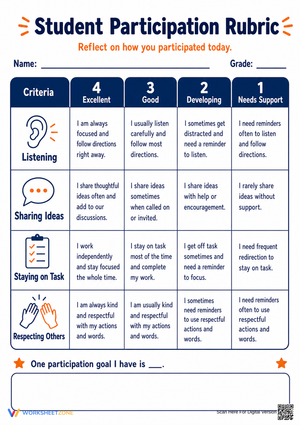
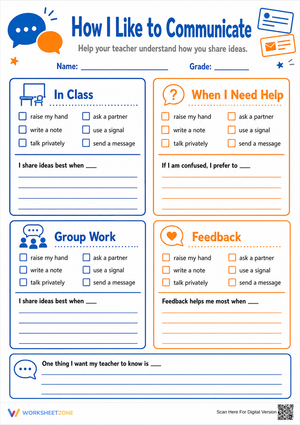
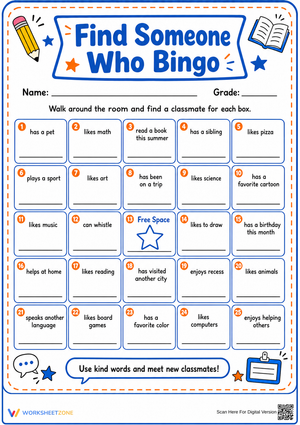
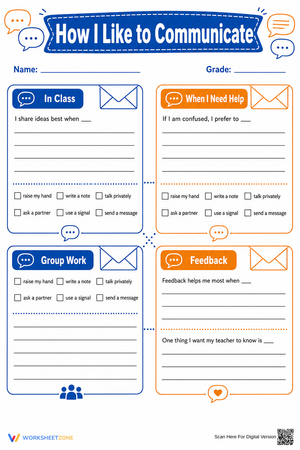
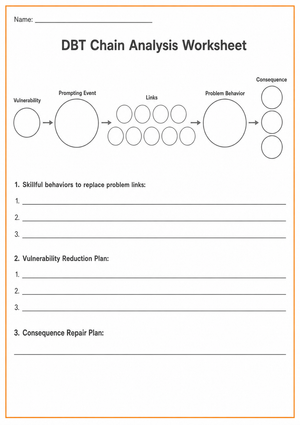
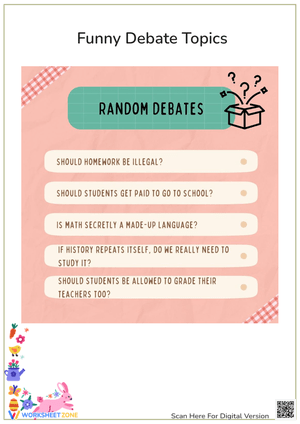
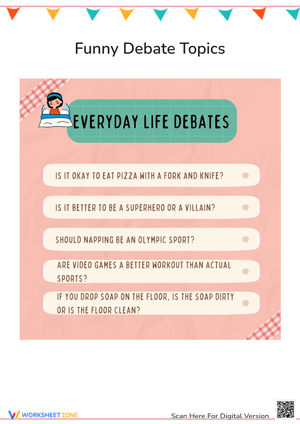
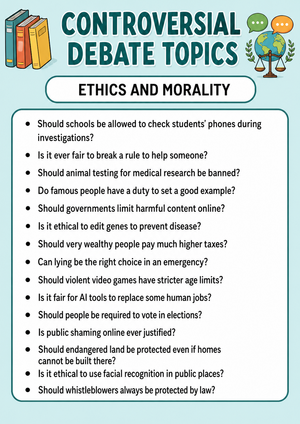
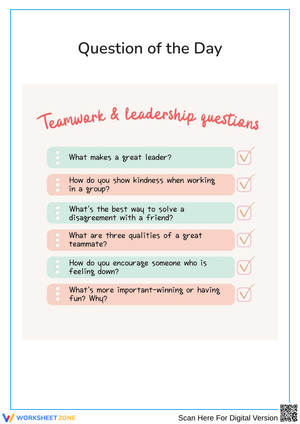
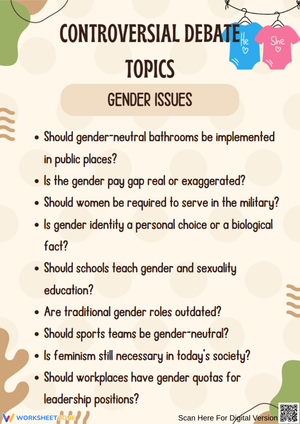
These 7th grade communication skills worksheets printable give teachers a low-prep set of resources covering active listening, respectful disagreement, nonverbal cues, and peer conversation skills that middle schoolers need but rarely receive direct instruction in. Each worksheet targets the moment seventh graders tend to fall apart — not because they don't understand what good communication looks like in theory, but because peer dynamics and real emotion make it genuinely hard to apply.
The Specific Skills Each Worksheet Targets
Seventh grade is when communication expectations shift. Students are supposed to hold a position in discussion, take turns without explicit teacher direction, and navigate disagreement without adult mediation. These worksheets isolate the subskills that actually break down in real classrooms.
- Active listening: Students distinguish hearing from listening, track the key claim in a peer's message, and practice specific response behaviors — eye contact, posture, brief verbal acknowledgment — rather than treating "listening" as a vague attitude.
- Precise speaking: Students organize a position before stating it, choose words that communicate intent clearly, and back a claim with a concrete example or reason rather than restating the same idea louder.
- Nonverbal reading: Students interpret facial expression, gesture, and body language as separate channels of meaning, including moments when the nonverbal and verbal messages contradict each other.
- Assertive disagreement: Students practice sentence frames for pushing back without sarcasm, asking clarifying questions instead of dismissing a peer's point, and keeping tone neutral when the content is tense.
- Conflict repair: Students sort productive versus unproductive responses to miscommunication, then write out what a repair conversation could sound like — not just the apology, but how to reopen a conversation after a shutdown.
Several worksheets also address discussion participation directly: how to enter a conversation already in progress, how to build on someone else's idea rather than simply redirect it, and how to signal that you want to speak without cutting someone off. These are the specific behaviors that separate productive group work from a collection of competing monologues.
Mistakes Students Make That These Worksheets Help You Catch
The most consistent error pattern at this grade isn't ignorance — it's the gap between knowing and doing. A student can correctly list active listening behaviors on a worksheet ("make eye contact, nod, don't interrupt") and then in the very next partner activity turn their body sideways, fidget with a pencil, and cut in twice. The worksheet revealed understanding. Transfer is the harder problem. Several tasks in this set address that directly by asking students to self-monitor during the activity itself, not just reflect after the moment has passed.
Assertive disagreement tasks surface a second predictable pattern. When asked to disagree respectfully without preparation, most seventh graders default to one of two extremes: aggressive ("that's wrong, though") or passive — surface agreement they don't actually mean. Give them the sentence frame "I see it differently because..." and most will write it accurately. The problem is delivery. Flat, fast, or accompanied by a slight eye roll that undercuts the words entirely. Worksheets that include a verbal rehearsal step catch this. Having students say the response out loud with a partner for two or three minutes produces more usable skill than five minutes of silent writing alone.
On nonverbal reading tasks, a third error shows up reliably: students over-interpret a single cue. Crossed arms in an image gets marked "angry" with confidence, even though the same posture appears in someone who is cold, thinking, or simply a habitual arm-crosser. The worksheets address this by presenting multiple cues at once and asking students to write a full interpretation before assigning a label — which slows down the jump to conclusion that makes peer misreads so common in middle school hallways.
How to Build These Worksheets Into Your Lesson Plans
These resources fit wherever brief, focused communication practice belongs — which in most middle school schedules is several places. In advisory or homeroom, one worksheet used across a week as a five-minute opener can anchor a skill for the full week. On Monday, students read a peer scenario and mark what went wrong. Wednesday, they practice a sentence frame during partner work. Friday, they write one sentence about what they would do differently in a real moment like it. That rhythm teaches more than a one-off lesson because students encounter the same skill across slightly different demands, which is how retention actually builds.
In ELA, these worksheets attach naturally to accountable talk routines. A disagreement sentence frame practiced on Tuesday shows up in how students argue about a character's choices during Wednesday's discussion. After a Socratic seminar or literature circle, a short self-monitoring worksheet closes the loop — students rate one specific behavior, not their overall participation, which makes the reflection honest and actionable rather than generic.
For counseling or small-group intervention, slow the pace. Model the worksheet before asking students to complete it, run each scenario as a read-aloud, and add a verbal rehearsal after the writing step. In those settings, one worksheet can anchor a full 20-minute session rather than serving as a warm-up. The same content carries more weight when it's processed out loud, physically, and in writing — not just silently on the worksheet alone. These 7th grade communication skills worksheets printable also hold up well as substitute leave-behinds: each includes enough written direction that a sub can facilitate without subject-matter expertise, and the written reflection gives the returning teacher a quick window into what students were thinking that day.
Standard Alignment
The worksheets align most directly with CCSS Speaking and Listening standards for grade 7, particularly SL.7.1, which requires students to engage effectively in collaborative discussions, follow agreed-upon discussion norms, and build on others' ideas. SL.7.1b addresses preparation and participation specifically — students who have worked through active listening and assertive disagreement tasks are more ready to meet that standard in live discussion because they have already rehearsed the behaviors in a lower-stakes format. Several worksheets also support SL.7.4 (presenting claims with appropriate detail) and SL.7.6 (adapting speech to context and task).
For schools using SEL frameworks, these skills map to CASEL's relationship skills and self-management competencies at the middle school level, which cover effective communication, conflict resolution, and impulse control in social situations. Advisory or counseling programs that document SEL progress can use student reflections from these worksheets as evidence of skill development over time.
Adjusting the Worksheets for a Range of Learners
The variety of formats across the 7th grade communication skills worksheets printable set makes differentiation practical without requiring separate materials for different learners. Students who need more support do best with forced-choice and sentence-stem formats — they select from a set of possible responses rather than generating language from scratch. Pairing those students during verbal rehearsal steps, rather than leaving them to write independently, provides the kind of live support that the worksheet itself can't supply on its own.
Students ready for a more demanding task can revise a weak dialogue sample, write their own peer scenario for a classmate to analyze, or produce a second version of a response that shifts the communication style deliberately — from passive to assertive, from aggressive to neutral. These extensions keep the worksheet relevant without requiring a separate resource. That matters in a mixed-readiness seventh grade class where you need the same task to work at different depths.
For students with IEPs or language goals, the nonverbal and scenario-based worksheets often work better than writing-heavy reflection formats. A student who struggles with extended written response can still demonstrate clear understanding by annotating a dialogue transcript, circling problematic nonverbal cues in an illustration, or verbally explaining an answer before writing a single summary sentence. The assessment evidence still holds — it just arrives through a different mode.
Frequently Asked Questions
Do these worksheets work in ELA, or are they only useful in advisory and counseling settings?
They work across settings. In ELA, the discussion-focused worksheets connect directly to accountable talk, Socratic seminar preparation, and literature circle protocols. A disagreement sentence frame practiced on a worksheet on Tuesday shows up in how students argue about a character's motivation the following day. The content is social-emotional, but the academic transfer is real.
How much time does a typical worksheet take to complete?
Most run 8 to 15 minutes for independent completion. Worksheets with a verbal rehearsal or partner discussion step extend the activity to around 20 minutes. Bell ringers and exit ticket formats in the set run shorter — closer to 5 minutes — and work well when you want to touch the skill without giving it the full block.
Can students complete these independently, or do most require teacher facilitation?
Most worksheets are written to stand alone. The scenario and role-play formats produce better results with at least brief teacher modeling first — showing students one run-through of an assertive disagreement exchange, for example, makes the writing task more grounded. For the 7th grade communication skills worksheets printable that include a verbal rehearsal step, a partner is necessary; those require paired or small-group work rather than solo completion.
Are these appropriate for students reading below grade level?
Yes. The scenarios use short paragraphs and conversational language. Students who read below grade level can access the content, especially in sort-and-classify formats where the reading demand is lower. The reflection prompts are open-ended enough that students can respond at their own depth without a minimum response requirement pushing them out of reach.












 Interactive Worksheet Maker
 Quiz Maker
 Word Search Maker
 Crossword Puzzle Maker
 Word Scramble Generator
 Sentence Scramble Generator
 Handwriting Worksheet Generator
 Name Tracing Generator
 Fill In The Blank Generator