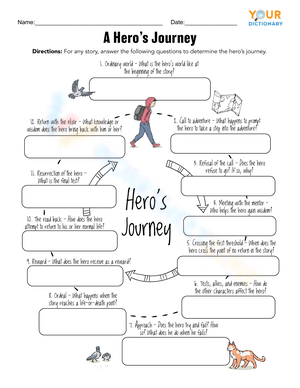
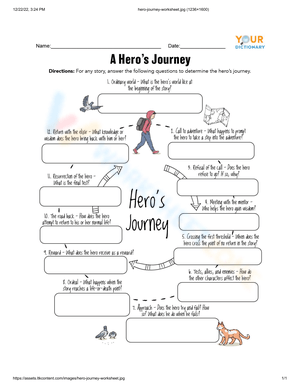
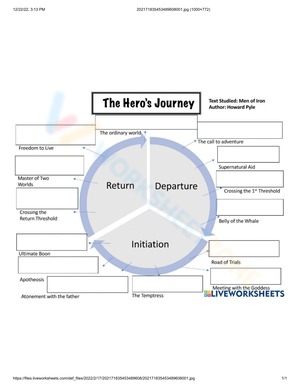
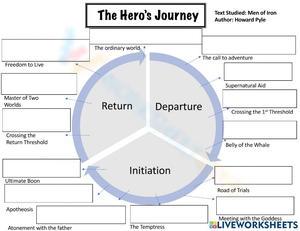
These 7th grade heros journey worksheets pdf give ELA teachers a set of standalone, printable resources for introducing, practicing, and extending the hero's journey arc across reading and writing units. Each worksheet handles one specific phase of instruction — initial stage exposure, text-based analysis, character transformation tracking, or narrative prewriting — so teachers can select what a class actually needs on a given day rather than following a fixed sequence. The resources work across genres: epic myths, class novels, and short stories all serve as strong anchor texts.
The Specific Skills These Worksheets Target
The worksheets do not all ask students to do the same type of work. Depending on where a class is in the unit, students underline textual evidence and match it to stage names, annotate specific scenes to identify what the protagonist risks or loses, rewrite a key moment in their own words to demonstrate comprehension, or map an original protagonist through the stages as a prewriting step. That range is intentional — a single task type stops being useful the moment students have mastered it.
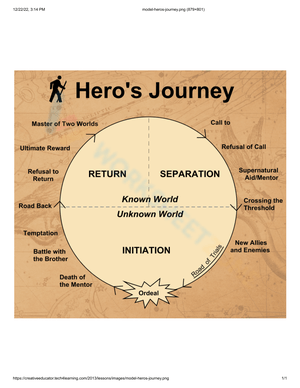
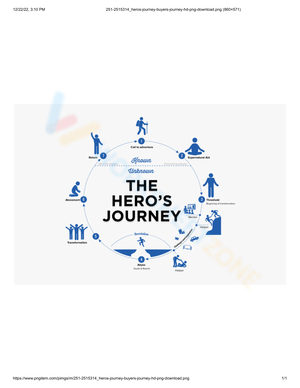
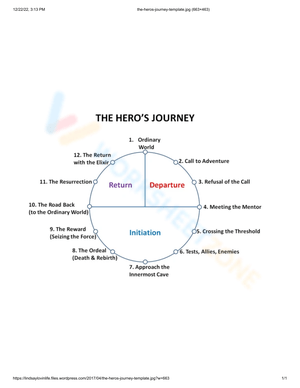
- Stage identification: Students match events from a familiar or assigned text to a simplified stage sequence, using brief definitions to distinguish the call, threshold, trials, ordeal, and return.
- Character transformation analysis: Students identify what the protagonist had to lose, sacrifice, or confront before changing — not just that change happened.
- Plot diagram comparison: Students place the hero's journey and a standard plot diagram side by side and identify where the two structures overlap and where they diverge.
- Evidence-based stage matching: Students cite specific scenes, quotations, or paraphrased events and explain why each one qualifies for the stage they assigned it to.
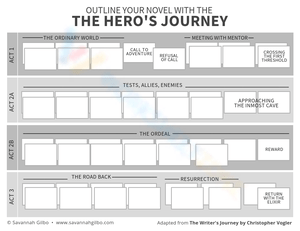
- Narrative prewriting: Students build a protagonist, define the central challenge, map major trials, and decide what the character understands or loses by the return.
The progression moves from recognition to explanation to creation, which mirrors the instructional sequence most Grade 7 ELA units follow when introducing a new analytical lens.
Where Students Typically Go Wrong on Hero's Journey Analysis
The most predictable error is misidentifying the ordeal. Students consistently choose whichever scene has the most physical action — typically a battle or confrontation — rather than the moment of deepest internal risk. A student analyzing Orpheus will often name the descent into the underworld as the ordeal, when the actual crisis is the moment Orpheus chooses to turn back. The evidence prompt on the ordeal worksheet forces students to explain why their chosen scene qualifies, which surfaces that confusion during pair-share before it hardens into an incorrect essay claim.
Character change responses are a second consistent problem. Students write "Odysseus got stronger" or "she became brave" — observations that name an outcome without identifying a cause or a cost. The character transformation worksheet asks students to name what the protagonist had to lose or give up in order to change, pushing them past surface summary toward genuine literary reasoning. Collecting these responses mid-unit gives teachers specific formative data before students tackle a longer piece.
A third issue surfaces when a text does not follow the pattern cleanly. Some seventh graders conclude either the story is wrong or their analysis is wrong, rather than understanding that the hero's journey is a thinking tool, not a rulebook. Realistic fiction is where this appears most often. Turning it into a class discussion — asking students to name which stages a contemporary protagonist skips or compresses, and to argue why — produces some of the sharpest analytical conversation of the unit.
Where These Worksheets Fit in a Teaching Week
The reliable entry point is a whole-class model using a story students already know well — a fairy tale, a superhero film, a picture book with a clear quest structure. The first time students encounter the hero's journey framework, they should not also be working through an unfamiliar text. When both tasks are new at once, cognitive load splits between decoding plot and learning structure, and students do neither well. Starting with a known story lets the class focus entirely on the framework itself.
After that initial model, the most common pattern is one worksheet per phase of the class reading. A stage identification worksheet fits the opening chapters of a novel or myth, when students are still learning vocabulary and the story's events are limited. A fuller analysis worksheet belongs mid-reading, when students have enough material to compare stages and notice where the protagonist begins to shift. The character transformation worksheet works at the end of a unit, when students can reflect on the complete arc before writing an essay or preparing for Socratic seminar.
Teachers working with the 7th grade heros journey worksheets pdf find that using each one as a discussion tool before a written product changes the quality of student responses. When students talk through possible stage matches in pairs before writing them down, their evidence is more specific and their reasoning is more complete. This matters especially with realistic fiction or stories that end ambiguously, where stage assignments are not obvious and students need to commit to an interpretation before they can defend it.
Standard Alignment
The stage analysis and character transformation worksheets address CCSS RL.7.3, which asks students to analyze how plot elements and character decisions interact. When students identify an ordeal, cite the specific scene, and explain how that moment redirects the protagonist's choices, they are doing the work RL.7.3 requires — not just naming events, but tracing how those events produce change. This standard is often the primary target during novel and myth units in Grade 7 because it connects plot comprehension to character analysis in a single task.
RL.7.2 — determining theme and tracing its development through character and plot — connects directly to the return and transformation worksheets. When students articulate what the protagonist gains or understands by the end of the journey and link that insight to a central idea in the text, they are building the thematic analysis RL.7.2 targets. The narrative prewriting worksheet addresses W.7.3, asking students to build well-structured event sequences with meaningful character development before drafting their own stories.
Adjusting the Set for Students at Different Readiness Levels
Students who need more support work well with a partially completed organizer — two or three stages already filled in with text evidence, so they can see what a complete response looks like before they attempt the remaining stages independently. Sentence starters help at the explanation level: "This scene qualifies as the ordeal because..." gives students a way into the analytical move without removing the thinking. Reducing the required stages to five or six, rather than the twelve or seventeen in more extended versions of the arc, keeps the task manageable without losing the core concept.
Students ready for extension benefit from different challenges entirely. Asking them to argue whether a specific text fully completes the hero's journey — naming which stages are missing, compressed, or reordered, with textual evidence — pushes them into genuine literary argumentation. A two-protagonist comparison is another strong option: students map two characters from different texts onto the same stage framework and argue which protagonist's journey is more complete or more transformative. That task requires holding multiple story lines in mind while making evidence-based comparisons, which is demanding analytical work for seventh graders.
One practical note on using the 7th grade heros journey worksheets pdf with mixed-readiness classes: the format is flexible enough that teachers can annotate printed copies before distributing them. Pre-filling one stage, adding a brief example at the top, or attaching a short word bank takes a few minutes of prep and can make the difference between a student completing the analysis and a student shutting down at the first stage that is not immediately obvious from the text.
Frequently Asked Questions
Which version of the hero's journey works best for 7th graders?
A simplified arc of six to eight stages — ordinary world, call or challenge, threshold crossing, trials, ordeal, transformation, and return — is more useful at this grade level than the full seventeen-stage version Campbell describes. Students build a more solid understanding of the pattern when they work with fewer, clearly distinct stages they can actually locate in a text. Teachers can introduce additional stages in later units once students are comfortable with the core sequence.
How do these worksheets handle texts that do not fit the pattern neatly?
The evidence and explanation prompts make imperfect fits instructionally useful rather than frustrating. When a text is missing stages or compresses the arc, the worksheet becomes a discussion tool: students argue which stage is absent, why the author may have made that choice, and what effect it has on the protagonist's growth. Realistic fiction and contemporary YA novels produce the most productive version of this conversation. The mismatch between the framework and the text pushes students to reason, not just locate and label.
Can these worksheets serve as formative assessment?
That is one of their most practical uses. The character transformation and evidence prompts give teachers a clear window into whether students understand how events connect to character development, rather than simply recognizing vocabulary. Collecting worksheets mid-unit reveals who needs targeted instruction before a summative essay. Teachers who use the 7th grade heros journey worksheets pdf for this purpose find that the structured prompts make grading fast — the format is clear enough that responses reveal comprehension gaps immediately rather than hiding them inside paragraph-length answers.












 Interactive Worksheet Maker
 Quiz Maker
 Word Search Maker
 Crossword Puzzle Maker
 Word Scramble Generator
 Sentence Scramble Generator
 Handwriting Worksheet Generator
 Name Tracing Generator
 Fill In The Blank Generator