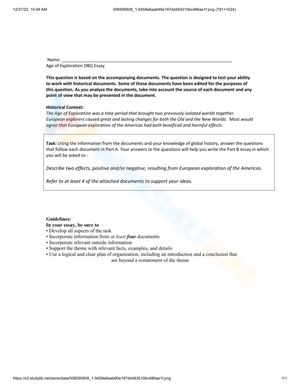
7th grade age of exploration worksheets give social studies teachers a structured path from surface-level memorization—names, dates, ships—toward the kind of historical thinking that 7th graders can actually do when the tasks are well-built. Each worksheet in the set targets a distinct skill: reading for central ideas, tracing routes on a map, sequencing major voyages, analyzing vocabulary in context, or weighing the consequences of contact between continents. Teachers find these easiest to integrate across a full unit, treating each worksheet as a tool for a specific lesson moment rather than a review dump at the end.
The Historical Thinking Skills Each Worksheet Builds
The strongest work in this set lives at the intersection of content knowledge and analysis. Students don't just read that the Portuguese developed the caravel—they explain what problem it solved and how that changed what voyages were possible. The map worksheets ask students to trace routes and label key crossing points, then connect those movements to trade relationships. The cause-and-effect organizers push beyond "Columbus sailed west" to questions like "What changed in the Caribbean in the decade after 1492, and for whom?"
Specific skills addressed across the set:
- Reading a short informational passage and identifying explicit and implied causes of European expansion
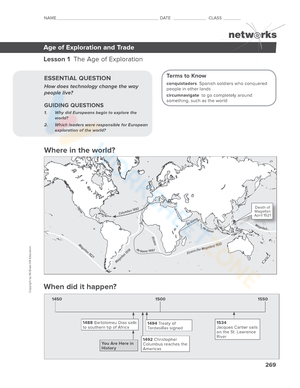
- Labeling and tracing major exploration routes across the Atlantic, Pacific, and Indian Oceans
- Sequencing events chronologically, distinguishing Portuguese from Spanish-sponsored expeditions on a shared timeline
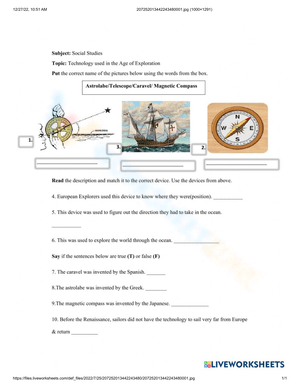
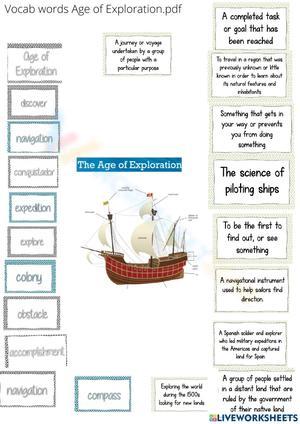
- Working with key vocabulary—navigation, colonization, mercantilism, missionary, circumnavigation—in context rather than in isolation
- Analyzing the Columbian Exchange by sorting transfers of goods, crops, animals, and disease into short-term and long-term effects
- Writing brief perspective-based responses that compare outcomes for European rulers, explorers, merchants, and Indigenous communities
That last skill matters most at this grade level. Students in 7th grade are ready to hold more than one perspective at a time, but only if the task makes that expectation explicit. A prompt that asks "What changed for the Taíno people in the decade after Columbus's arrival?" does different historical work than one that asks "What did Columbus find?" Both have a place in a unit, but only the first requires genuine analytical thinking rather than recall.
Frequent Student Errors Worth Anticipating Before the Lesson
The most persistent error in student work on this topic isn't a vocabulary gap—it's the empty-continent assumption. Even after reading a passage that explicitly mentions Indigenous populations, students often write that "explorers discovered new lands where no one had been before." This shows up most reliably in cause-and-effect tasks where students list European gains without accounting for the other side of those gains. The perspective-response worksheets address this directly, but naming the error in a brief class discussion before students encounter the prompt makes the correction stick faster.
Explorer confusion is a close second. Students mix up Magellan's circumnavigation with Columbus's Caribbean voyages, or they place Vasco da Gama's eastward route to India on the wrong ocean. Map worksheets help here because the spatial work forces students to slow down and distinguish routes by direction and endpoint. A student who has physically traced both the Cape of Good Hope route and a Trans-Atlantic route is far less likely to conflate those two explorers in a written response.
On timeline activities, watch for students who treat Portuguese and Spanish expeditions as if they happened in separate eras rather than as overlapping, competitive programs running simultaneously. Asking students to mark both countries' major voyages on the same timeline—using different colors—makes that chronological overlap visible in a way that a reading passage alone rarely achieves.
Building These Worksheets Into a Unit That Moves
The most effective sequence starts before the reading, not with it. Opening a lesson with the map worksheet—asking students to look at the Atlantic and Indian Oceans and identify what would make sailing across them dangerous in the 1400s—gives them a frame for everything the passage explains next. That pre-reading geography task takes about eight minutes and dramatically reduces the number of students who stare blankly at questions about why the caravel mattered.
For station rotations, four tasks work well in a 45-minute period: vocabulary sort, route mapping, timeline sequencing, and a short cause-and-effect written response. Students rotate through two stations the first day and finish the remaining two the next, which also provides natural spaced retrieval—students revisit the same key terms and events across two class sessions instead of cramming them into one sitting. 7th grade age of exploration worksheets slot into this kind of two-day rotation without any modification; the standalone format of each worksheet means you pull exactly what fits that day's instructional goal.
Each worksheet also works for sub plans because the directions are self-contained. The reading-passage worksheets carry enough background information that a substitute doesn't need to introduce the historical context beforehand. Map and timeline tasks run especially smoothly with a sub because the task expectations are concrete enough that students rarely need clarification to get started.
Adjusting the Set for Students at Different Readiness Levels
Differentiation across 7th grade age of exploration worksheets doesn't mean lower content—it means adjusted access. The reading passages are written at a level that most 7th graders handle with some effort, but students reading two or more years below grade level benefit from a few structural additions: bolded key terms, a brief glossary at the bottom of the worksheet, and sentence frames like "European rulers wanted to sponsor voyages because ___" that give students a syntactic entry point without reducing the intellectual demand of the question.
For students who move through material quickly, the perspective-response prompts extend naturally into evidence-based paragraph writing. Instead of answering in two or three sentences, advanced students analyze competing motives—Spain's interest in gold alongside its interest in spreading Catholicism, for example—and argue which motive had the longer historical impact. That kind of task doesn't require a separate worksheet; it requires a harder question written at the bottom of the same one.
Students with significant reading barriers often access the map and timeline worksheets independently, which keeps them working on grade-level content even when the text-heavy tasks need more support. Pairing those students with a stronger reader for the reading worksheet—one reads aloud, the other annotates, both answer—preserves the rigor of the task while reducing the isolation that struggling readers experience when left to work through dense historical text on their own.
Standard Alignment
These worksheets align directly to the Common Core ELA standards for Literacy in History/Social Studies. CCSS.ELA-LITERACY.RH.6-8.1 (citing textual evidence to support analysis) is the backbone of the reading-comprehension worksheets, where students pull specific details to explain cause and effect. CCSS.ELA-LITERACY.RH.6-8.3 (analyzing how a series of events unfolds over time) is addressed through the timeline and cause-and-effect activities. CCSS.ELA-LITERACY.RH.6-8.7 (integrating visual and textual information) covers the map worksheets, which ask students to read a passage and then locate its events geographically.
Within the C3 Framework for Social Studies, the set addresses D2.His.1.6-8 (analyzing connections among historical events and developments across time periods) and D2.His.5.6-8 (explaining how and why perspectives of people have differed). Most 7th grade world history and global studies courses that cover European expansion at this grade level will find these standards directly applicable. Teachers working in states with standalone social studies frameworks should look for analogous history-literacy standards in the 6–8 band—the skills these worksheets practice translate across most state-level equivalents.
Frequently Asked Questions
Do these worksheets address the Columbian Exchange, or only the voyages themselves?
The Columbian Exchange is a dedicated focus within the set. One worksheet asks students to sort transferred goods, crops, animals, and diseases into two columns—Europe to Americas and Americas to Europe—and then write a sentence explaining which transfer had the most significant long-term consequence and why. That final writing prompt routinely produces answers students didn't anticipate before they did the sorting exercise.
Are these worksheets appropriate for both world history and global studies courses?
Yes. The content is framed around global movement and its consequences rather than any single nation's history, which makes the set work in both course structures. Teachers in global studies courses sometimes use the perspective-response worksheets as a standalone lesson on colonization without running the full sequence. Teachers in world history courses more often use every worksheet across a week-long unit on European expansion.
How many class periods does the full set typically cover?
Most teachers spread 7th grade age of exploration worksheets across four to six class periods, depending on how much whole-class discussion they build in. A lean three-day sequence might use a reading worksheet on day one, map plus timeline on day two, and the Columbian Exchange and perspective response on day three. A fuller unit treats each worksheet as the anchor activity for one lesson and builds in debrief time before moving on.
Can I use individual worksheets with students who missed earlier lessons?
The reading-passage worksheets are written to stand alone, which makes them workable for absent students. The map and timeline activities build on vocabulary introduced in the reading, so students who missed that lesson should complete the reading worksheet first before attempting the spatial tasks. When answer keys are available, students self-check and correct independently, which makes the makeup sequence largely self-directed without requiring extra teacher time.












 Interactive Worksheet Maker
 Quiz Maker
 Word Search Maker
 Crossword Puzzle Maker
 Word Scramble Generator
 Sentence Scramble Generator
 Handwriting Worksheet Generator
 Name Tracing Generator
 Fill In The Blank Generator