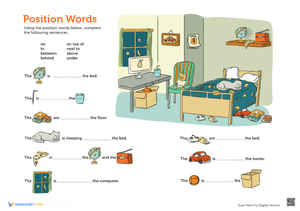
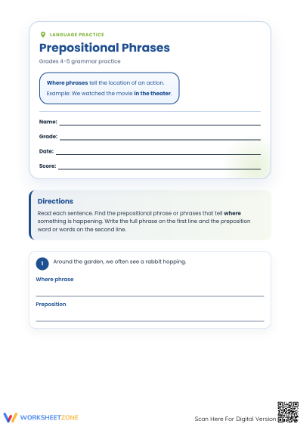
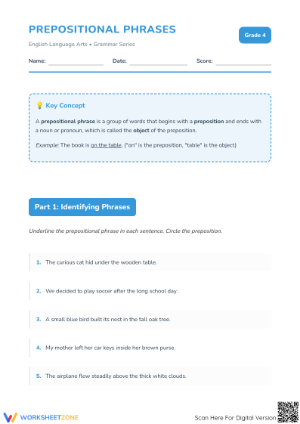
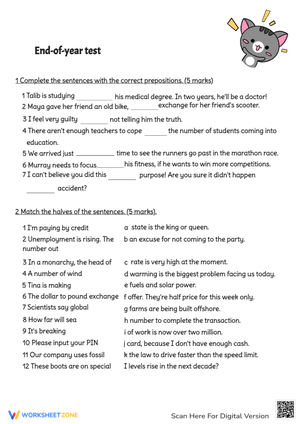
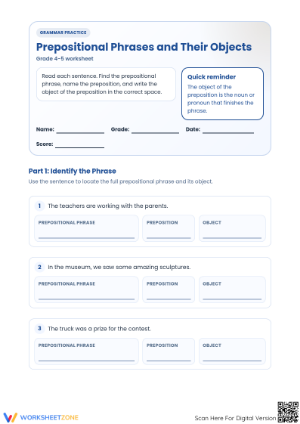
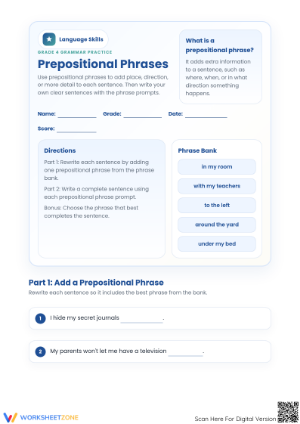
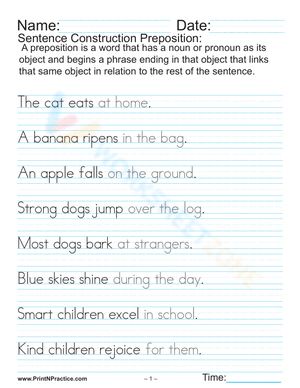
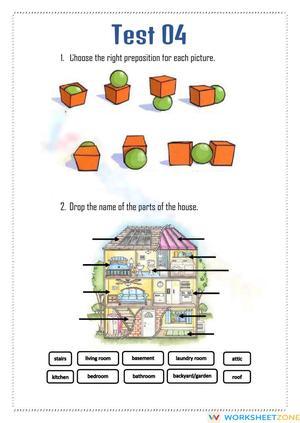
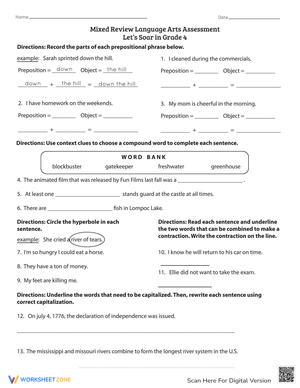
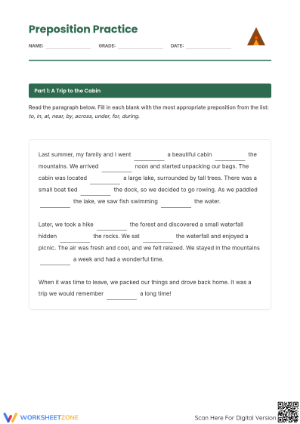
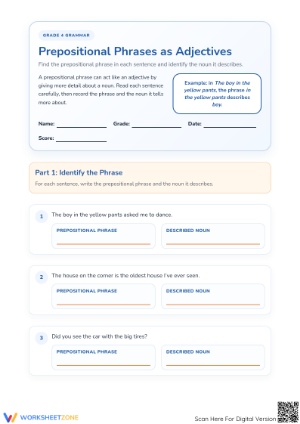
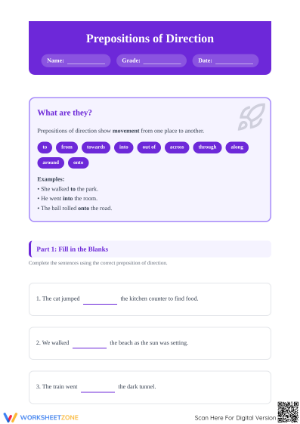
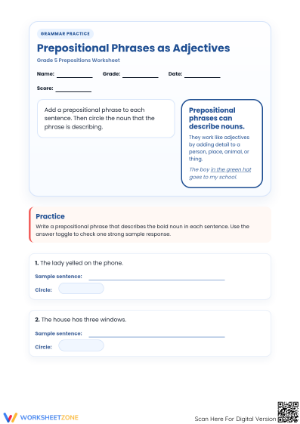
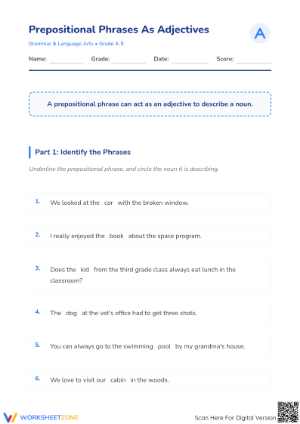
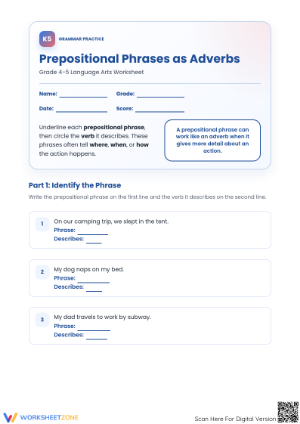
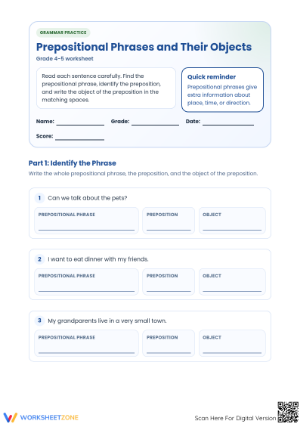
These 4th grade prepositions pdf worksheets give students focused practice moving beyond single-word recognition toward fluent use of complete prepositional phrases — in reading, in annotation, and in their own sentences. The set targets three distinct tasks: identifying phrases in context, sorting prepositions by type, and expanding bare-bones sentences with spatial, temporal, and directional detail that makes writing genuinely more precise.
The Specific Skills Inside the Set
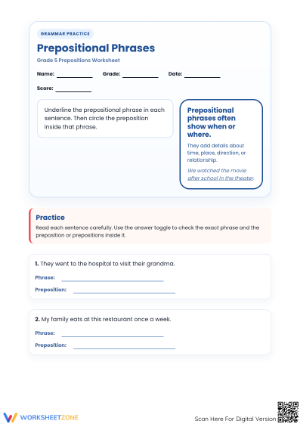
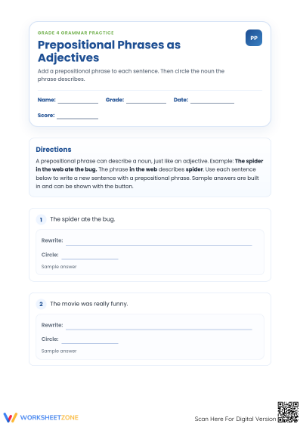
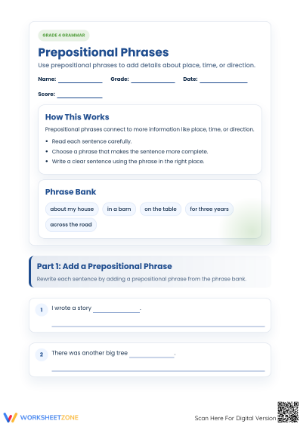
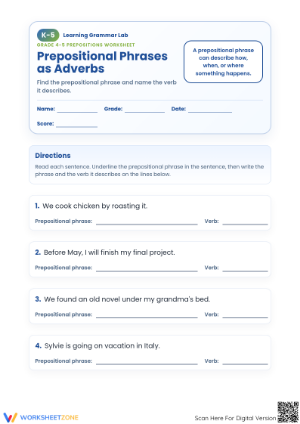
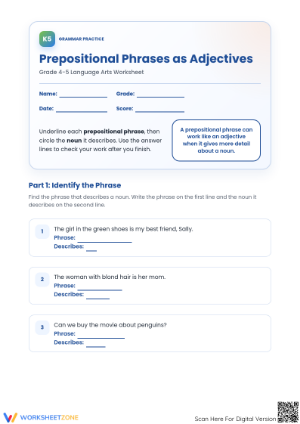
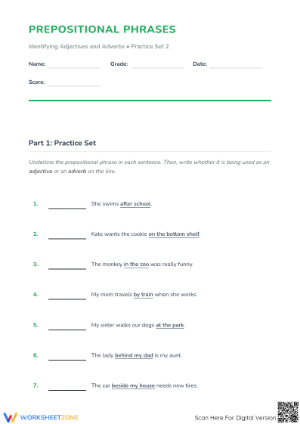
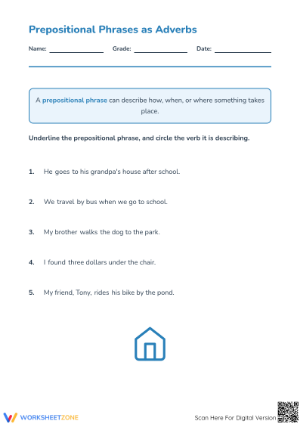
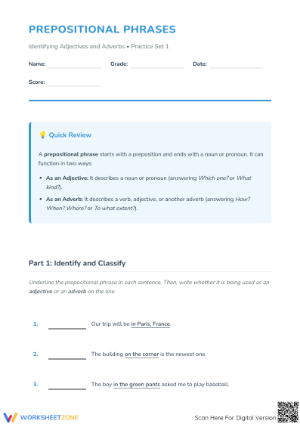
Each worksheet targets a distinct layer of the same skill. Early tasks ask students to underline prepositional phrases and circle the preposition within them — a mechanical step, but one that makes the phrase's internal structure visible before students are asked to produce anything independently. Later worksheets shift into production: students take a stripped-down sentence like "The dog barked." and attach prepositional phrases that answer where, when, and toward what — arriving at something like "The dog barked at the mail carrier from the front porch during the afternoon delivery." That exercise also surfaces the upper limit — how many prepositional phrases can stack before the sentence buckles — which is a real 4th grade writing issue worth addressing directly.
The sorting work organizes prepositions into three functional categories:
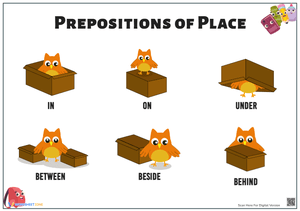
- Place: above, below, beside, behind, between — locating something in space
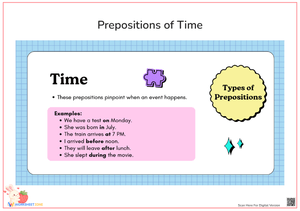
- Time: during, after, before, until, since — positioning something in a sequence
- Direction: across, through, into, toward — describing movement toward a destination
These categories give students a mental framework that transfers. A student who understands that "during" signals time is less likely to reach for it when describing position — a mix-up that appears in mid-year writing samples with some regularity.
Where Students Stumble With Prepositions
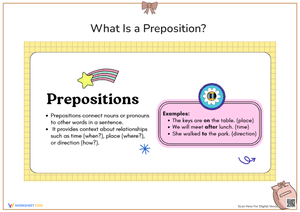
The most consistent confusion at this grade level is preposition versus adverb when the same word can function as both. "The cat walked in" uses "in" as an adverb. "The cat walked in the yard" uses it as a preposition. The difference is the object. Prepositions govern a noun or pronoun that completes the relationship — without that object, the word modifies a verb instead. Teaching students what some teachers call the Object Test — Is there a noun this word is pointing toward? — gives them a reusable check rather than a case-by-case memorization problem. Left untreated, this confusion carries into sentence diagramming and, more practically, into writing workshop when students insist that "come in" contains a prepositional phrase.
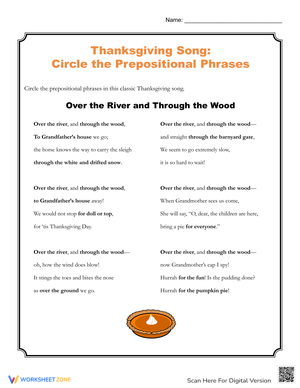
A second error is treating the preposition itself as the whole phrase. Students circle "under" and consider the job done, missing "the wooden table" entirely. These 4th grade prepositions pdf worksheets include bracketing tasks and arrow-drawing activities that require students to mark the full phrase as a unit — from the opening preposition through the final noun — so they build the habit of seeing the phrase, not just its first word.
Fitting These Worksheets Into Your Grammar Week
Identification and circling worksheets fit naturally at the tail end of a direct instruction block. Introduce the concept, model two examples with think-aloud, then release students to work independently for the final 10–12 minutes. The format mirrors the modeling closely enough that the transition is low-friction — students don't have to decode what they're being asked to do before they start.
Sorting worksheets work better at the opening of the second lesson, after a night away from the material. Running one as Monday warm-up following a Friday introduction turns the review into spaced retrieval, which cements the category distinctions more effectively than two consecutive instruction days. The sentence-expansion worksheets are worth doing in pairs: one student writes the base clause, the other adds a prepositional phrase, then they swap and each adds one more. The conversation that happens mid-swap — "That one tells me when, not where" — is the kind of peer correction a solo worksheet can't generate on its own.
A quick read-aloud before distributing any of these resources lowers the blank-stare rate noticeably. Read a paragraph from a library book and have students clap when they hear a prepositional phrase. The auditory exposure makes the written task that follows feel connected to real language rather than isolated grammar drill.
Standard Alignment
These 4th grade prepositions pdf worksheets address CCSS.ELA-LITERACY.L.4.1.E, which requires students to form and use prepositional phrases correctly. In classroom terms, that standard lives in two instructional contexts simultaneously: the grammar block, where students practice identification and categorization, and the writing workshop, where they apply prepositional phrases during revision to add precise detail. Teachers working in a workshop model will find that the practice in these worksheets pays off directly when students revise drafts for specificity — the student who can bracket a phrase during a grammar task will also notice when one is absent from a flat paragraph.
Making the Set Work Across Different Skill Levels
Students still building confidence with basic sentence structure get the most return from the identification and circling tasks, which keep cognitive demand narrow by asking for recognition before production. A printed reference list of the 10–15 most common prepositions — of, to, in, for, with, on, at, by, from, up — lets these students participate in sorting activities without getting stuck at retrieval. That small adjustment keeps the sorting work accessible without lowering the conceptual target.
Students with a firm command of common prepositions are ready for exposure to less familiar ones — throughout, against, beyond, despite — which start appearing in content-area texts by mid-4th grade. Pairing these students with a science or social studies paragraph and asking them to annotate every prepositional phrase they find applies the same skills in a meaningfully harder context. The 4th grade prepositions pdf worksheets in this set span both levels, so the same lesson can run across a mixed classroom without requiring two entirely separate sets of materials.
Frequently Asked Questions
How do I explain a prepositional phrase to a 9-year-old?
The bridge analogy tends to land well: the preposition is where the bridge starts, and the noun at the far end is the destination. You can also call it a "detail package" — a small cluster of words that tells the reader where, when, or in which direction. What matters most is that students understand the phrase as a unit, not just a single preposition sitting alone.
What prepositions should 4th graders control by the end of the year?
Students should use the high-frequency list without hesitation — of, to, in, for, with, on, at, by, from, up — both when reading and in their own writing. By late 4th grade, exposure to more specific prepositions like throughout, against, beyond, and despite prepares students for the denser sentence structures they'll encounter in 5th grade informational and argumentative texts.
How can students tell a preposition from an adverb when the word looks the same?
The object is the giveaway. In "Please come in," there is no noun after "in" — it modifies the verb and functions as an adverb. In "Please come in the room," "room" is the object, which makes "in" a preposition. Training students to ask "What noun is this word connected to?" builds a habit that transfers to any sentence, not just the ones on the worksheet.
What are some fast classroom activities for practicing prepositions?
Preposition Simon Says runs with no materials: give movement directions that use prepositional phrases, such as "Put your pencil beside your notebook" or "Stand behind your chair." A classroom location hunt — students write the position of three objects using complete prepositional phrases — takes about eight minutes and fits cleanly into the transition time before pickup or at the end of a grammar block. Both activities give students a physical experience of the spatial and directional relationships that prepositions name.
Why do printed worksheets support this skill better than purely digital exercises?
Physical markup forces a slower engagement with sentence structure than clicking or tapping allows. When a student draws a bracket around "under the wooden table" and an arrow pointing to "table," that physical gesture requires processing the phrase as a grammatical unit rather than skimming past it. Printed worksheets also stay in a writing folder where students can reference them during independent writing time — something a closed browser tab does not offer.












 Interactive Worksheet Maker
 Quiz Maker
 Word Search Maker
 Crossword Puzzle Maker
 Word Scramble Generator
 Sentence Scramble Generator
 Handwriting Worksheet Generator
 Name Tracing Generator
 Fill In The Blank Generator