




























Views
Downloads


Essential Prepositional Phrases as Adverbs | Grade 4-5

Paste this activity's link or code into your existing LMS (Google Classroom, Canvas, Teams, Schoology, Moodle, etc.).
Students can open and work on the activity right away, with no student login required.
You'll still be able to track student progress and results from your teacher account.
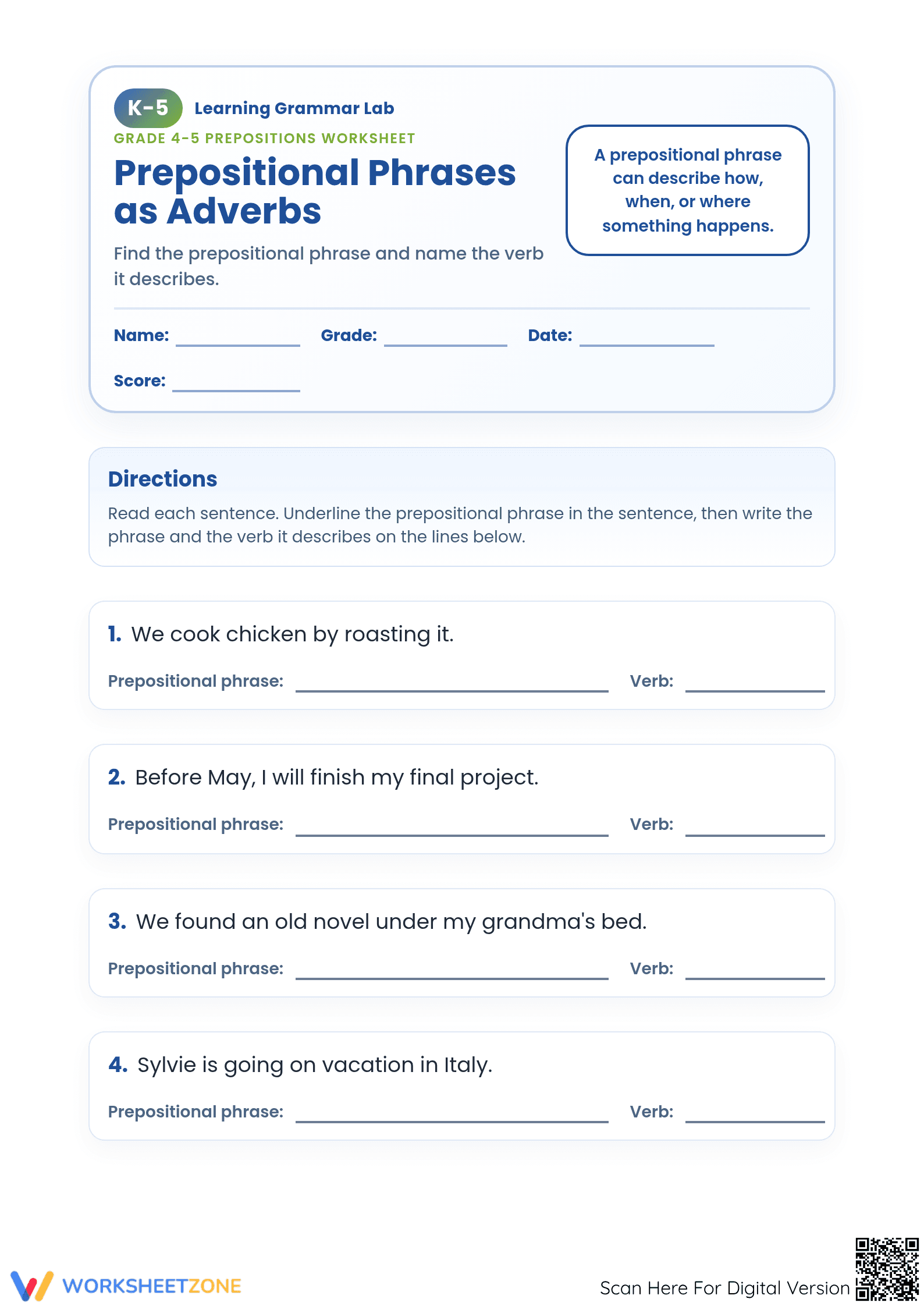
This Grade 4-5 grammar worksheet helps students master the functional use of prepositional phrases as adverbs. By identifying how these phrases describe when, where, or how an action occurs, students improve their ability to analyze sentence structure and enhance their own descriptive writing. This resource provides immediate, focused practice on a core linguistic skill.
At a Glance
- Grade: 4-5 · Subject: ELA
- Standard:
CCSS.ELA-LITERACY.L.4.1.E— Use prepositional phrases to convey specific meanings in sentences- Skill Focus: Adverbial Prepositional Phrases
- Format: 2 pages · 10 problems · Answer key included · PDF
- Best For: Independent practice and formative assessment
- Time: 15–20 minutes
What's Inside: This comprehensive two-page PDF features 10 carefully crafted sentences designed to challenge upper elementary learners. Each task requires a two-step response: underlining the prepositional phrase within the sentence and then explicitly writing both the phrase and the specific verb it modifies on provided lines. A helpful instructional call-out box at the top reinforces the concept that these phrases describe how, when, or where something happens. A full answer key is included for rapid grading.
The zero-prep design of this resource allows for immediate integration into any ELA block. First, print the two-page document for your class, which takes less than 60 seconds. Second, distribute the sheets; the clear directions and the instructional tip box ensure students can begin working with minimal teacher explanation. Finally, use the provided answer key to review student work in under 2 minutes, or have students self-correct to promote metacognition. This streamlined workflow makes it an ideal choice for substitute folders or unexpected schedule changes.
Standards Alignment: This worksheet is directly aligned to `CCSS.ELA-LITERACY.L.4.1.E`, which requires students to use prepositional phrases effectively. It also supports the broader Grade 5 goal of demonstrating command of standard English grammar conventions. Both standard codes can be copied directly into lesson plans, IEP goals, or district curriculum mapping tools.
How to Use It: Use this worksheet as a formative assessment following a direct instruction lesson on adverbs. It is particularly effective during the "independent practice" phase of a lesson. Teachers should observe if students are correctly identifying the verb being modified rather than just finding the prepositional phrase. Expect most students to complete the 10 tasks within 15 to 20 minutes, making it a perfect warm-up or exit ticket activity.
Who It's For: This resource is tailored for Grade 4 and Grade 5 students who are transitioning from basic part-of-speech identification to functional grammar analysis. It is also an excellent tool for English Language Learners (ELL) who need structured practice with English syntax. Pair this worksheet with a mentor text passage to have students hunt for adverbial phrases in professional writing.
According to research by Fisher & Frey (2014) on the gradual release of responsibility, students require targeted practice to move from identifying parts of speech to understanding their functional roles within complex sentences. This worksheet addresses CCSS.ELA-LITERACY.L.4.1.E by requiring students to isolate prepositional phrases and explicitly link them to the verbs they modify, a critical step in developing syntactic awareness. By focusing on the adverbial function—answering how, when, or where an action occurs—students build the linguistic framework necessary for more sophisticated writing and reading comprehension. Data from the NAEP suggests that mastery of these foundational grammar skills in the upper elementary years is a strong predictor of later success in analyzing informational texts. This resource provides the structured repetition needed to solidify these concepts, ensuring that learners can accurately use and identify prepositional phrases in various contexts. It serves as a reliable tool for both initial instruction and remedial support.


