




























Views
Downloads

Prepositions of Direction Worksheet | Grade 4 Essential

Paste this activity's link or code into your existing LMS (Google Classroom, Canvas, Teams, Schoology, Moodle, etc.).
Students can open and work on the activity right away, with no student login required.
You'll still be able to track student progress and results from your teacher account.
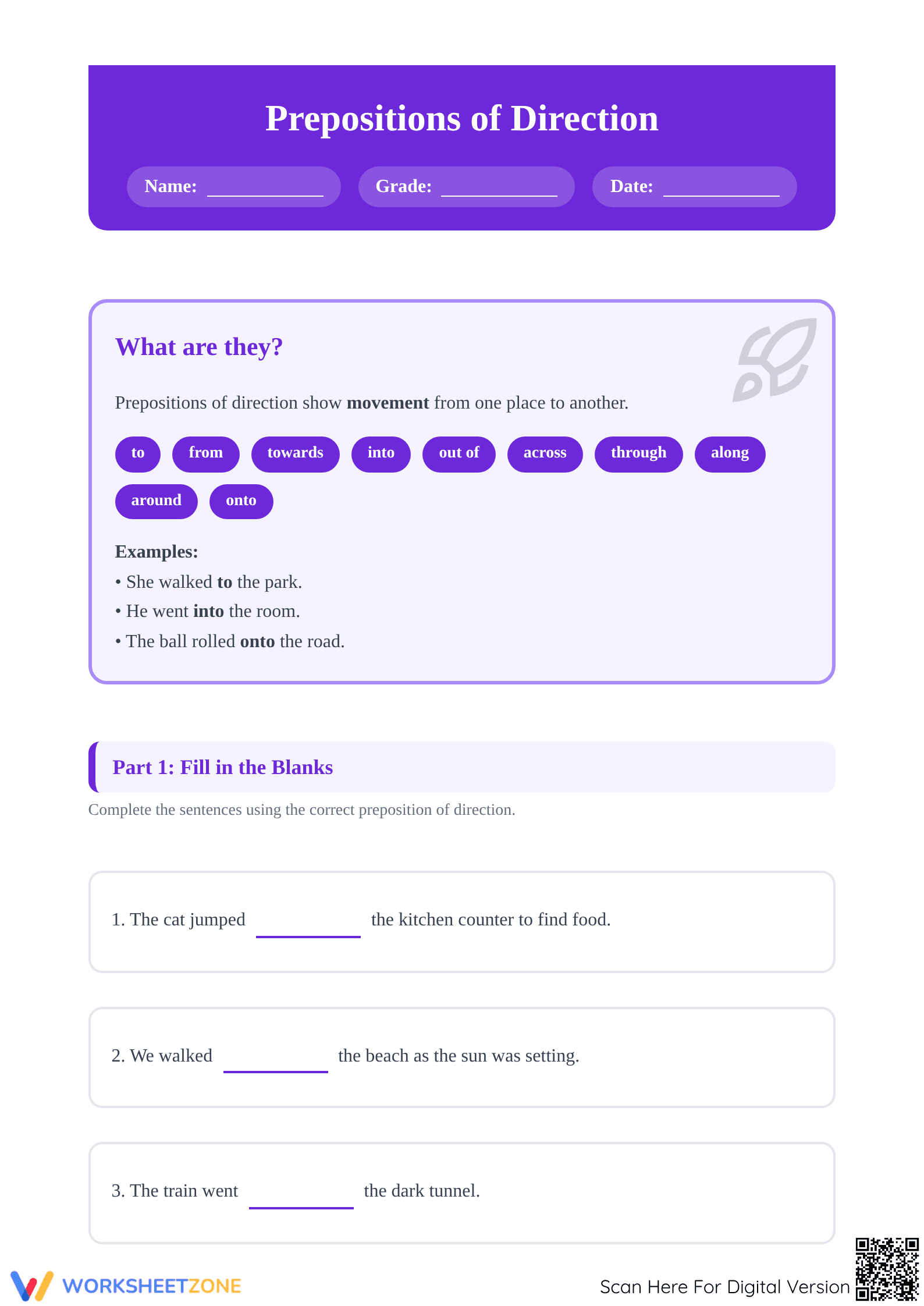
This Grade 4 prepositions of direction worksheet helps students identify and use words that show movement, such as across, through, and towards. By completing 15 targeted exercises, learners develop the ability to describe spatial relationships and motion accurately within their writing. It provides a clear path from recognition to independent application.
At a Glance
- Grade: 4 · Subject: ELA
- Standard:
CCSS.ELA-LITERACY.L.4.1.E— Use prepositional phrases to describe direction and movement in sentences- Skill Focus: Prepositions of Direction
- Format: 3 pages · 15 problems · Answer key included · PDF
- Best For: Independent practice or grammar centers
- Time: 20–30 minutes
What's Inside
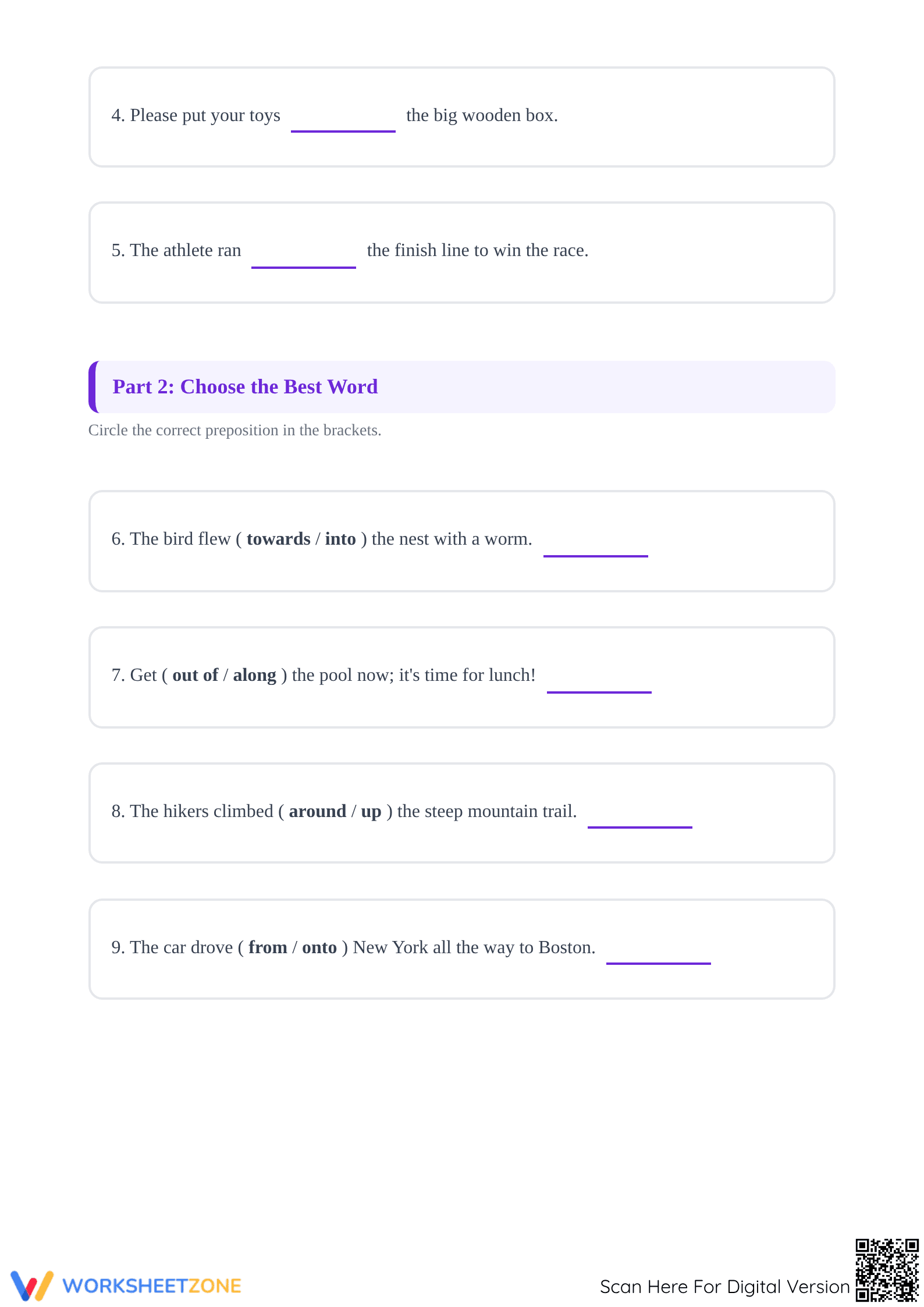
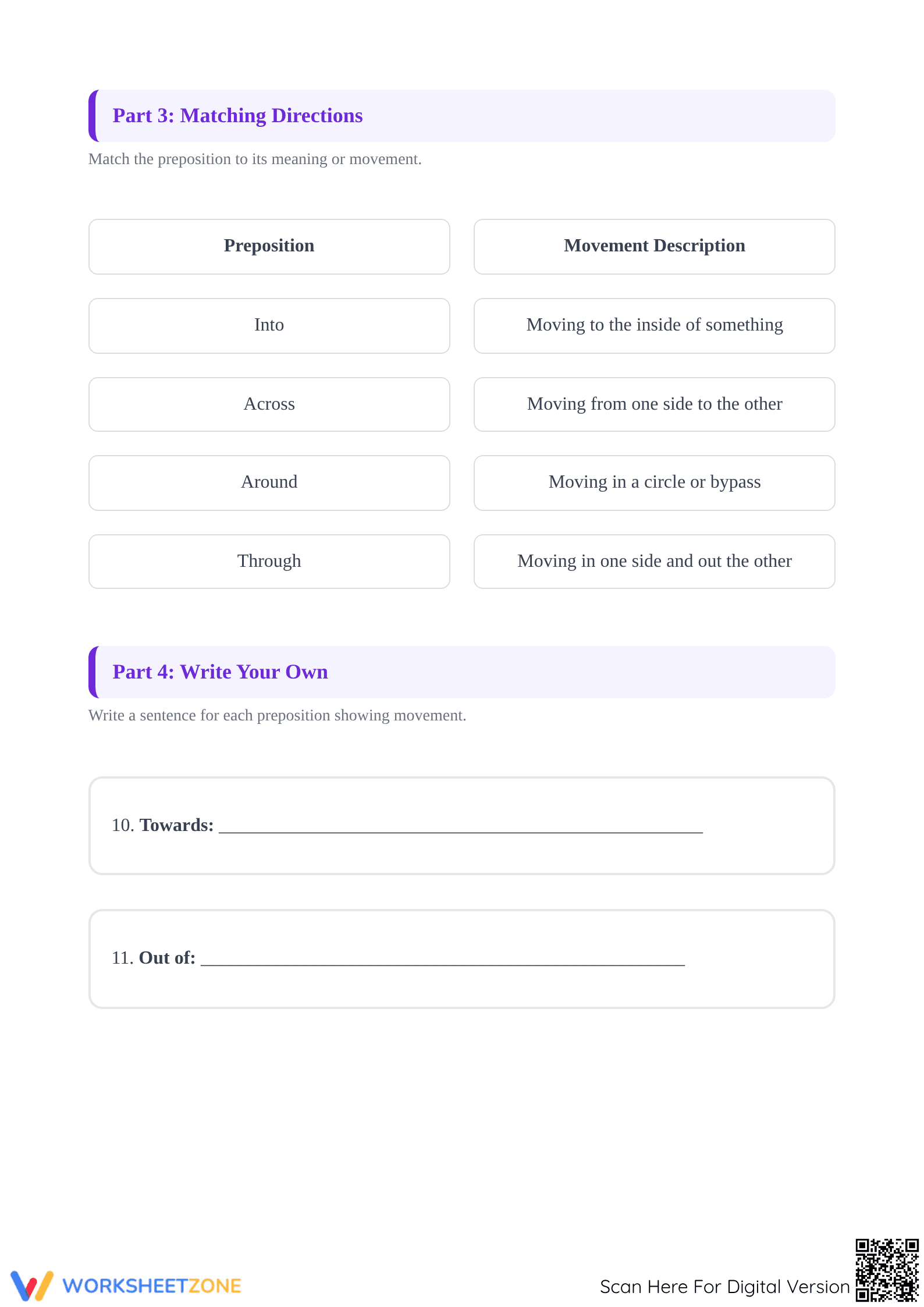
The 3-page PDF includes a comprehensive word bank of 10 directional prepositions, clear definitions, and illustrative examples. Students engage with four distinct sections: fill-in-the-blank sentences, multiple-choice selection, matching prepositions to their physical meanings, and original sentence construction. A complete answer key is provided for immediate feedback and grading.
Zero-Prep Workflow
Teachers can implement this resource in under 2 minutes. Simply print the three-page set for each student (1 minute), distribute the packets during your grammar block (30 seconds), and use the included answer key for a rapid whole-class review or self-grading session (30 seconds). This streamlined design makes it an ideal choice for emergency sub plans or morning work.
Standards Alignment
This resource aligns with `CCSS.ELA-LITERACY.L.4.1.E`, which requires students to use prepositional phrases correctly. By focusing specifically on direction, it supports the broader goal of expanding sentence complexity and precision. Both standard codes can be copied directly into lesson plans, IEP goals, or district curriculum mapping tools.
How to Use It
Use this as a formative assessment after a direct instruction lesson on parts of speech. Observe if students can distinguish between "into" and "onto" during the matching phase to identify common misconceptions. The worksheet typically takes 20 to 30 minutes to complete, making it a perfect mid-week reinforcement activity.
Who It's For
This is designed for Grade 4 students, though it serves as an excellent challenge for Grade 3 or a review for Grade 5. It is particularly helpful for English Language Learners (ELLs) who need visual and contextual support to master directional vocabulary. Pair this with a physical movement activity for a multi-sensory experience.
According to Fisher & Frey (2014), the gradual release of responsibility is vital for linguistic mastery, moving from modeled examples to independent sentence generation. This worksheet follows that pedagogical framework by providing a clear word bank and definitions before requiring students to produce original work. By targeting CCSS.ELA-LITERACY.L.4.1.E, the resource ensures that Grade 4 students practice the specific mechanics of prepositional phrases required for college and career readiness. Research from the NAEP indicates that students who master these functional grammar elements demonstrate significantly higher proficiency in descriptive writing tasks. This 3-page resource provides the 15 structured repetitions necessary to move these directional terms from short-term recognition into a student's active writing vocabulary, ensuring they can accurately describe movement in any academic context.


