


























Views
Downloads


Printable Prepositional Phrases as Adjectives | Grade 4-5
Paste this activity's link or code into your existing LMS (Google Classroom, Canvas, Teams, Schoology, Moodle, etc.).
Students can open and work on the activity right away, with no student login required.
You'll still be able to track student progress and results from your teacher account.
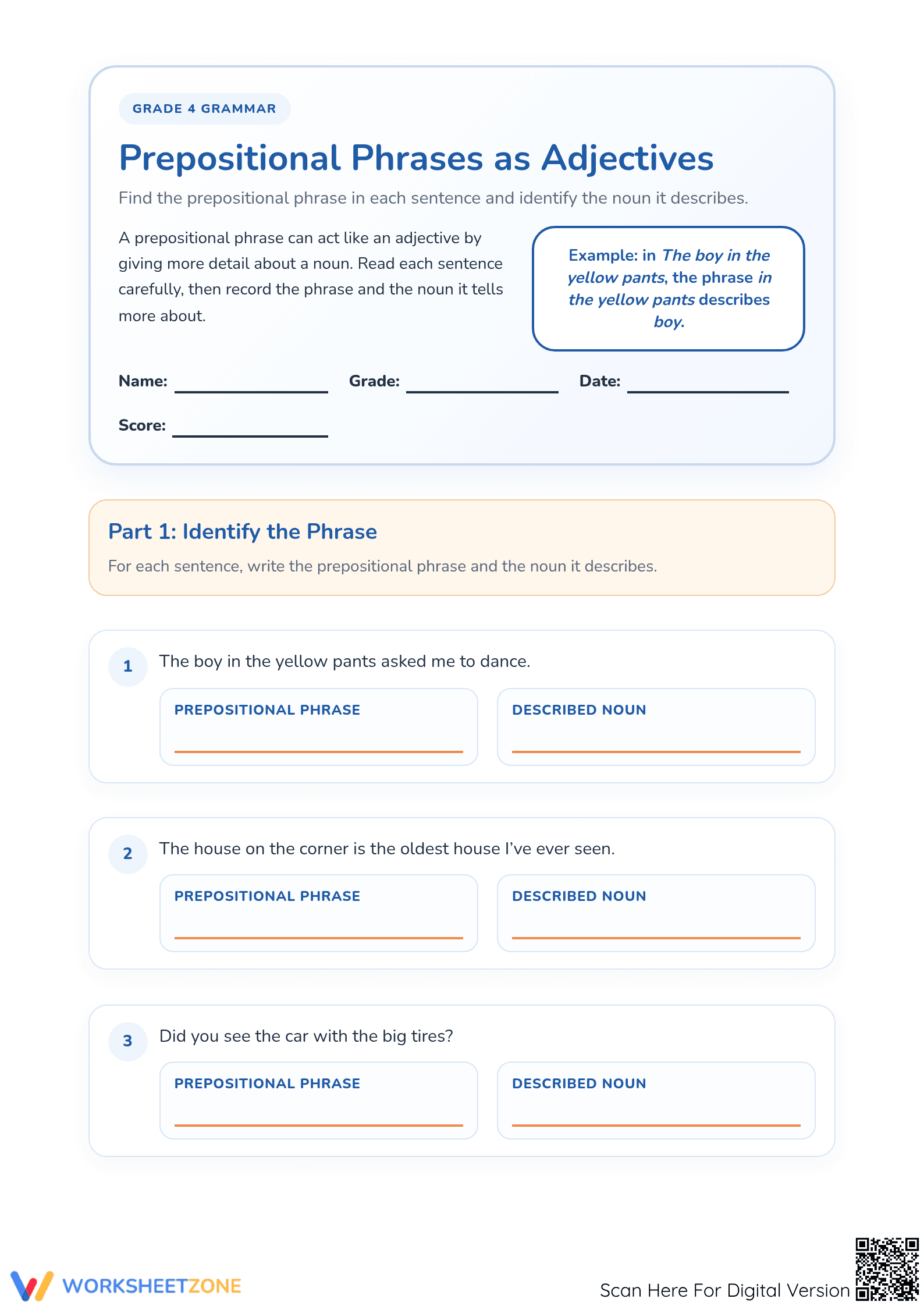
This Grade 4 and 5 ELA worksheet helps students master the functional use of prepositional phrases as adjectives. By identifying which noun a phrase modifies, learners develop a deeper understanding of sentence structure and descriptive language. Students will move beyond simple identification to recognizing how these phrases provide essential detail within a sentence.
At a Glance
- Grade: 4-5 · Subject: ELA
- Standard:
CCSS.ELA-LITERACY.L.4.1.E— Use prepositional phrases to modify nouns and provide descriptive detail in sentences.- Skill Focus: Prepositional phrases as adjectives
- Format: 3 pages · 12 problems · Answer key included · PDF
- Best For: Grammar practice and sentence analysis
- Time: 15–20 minutes
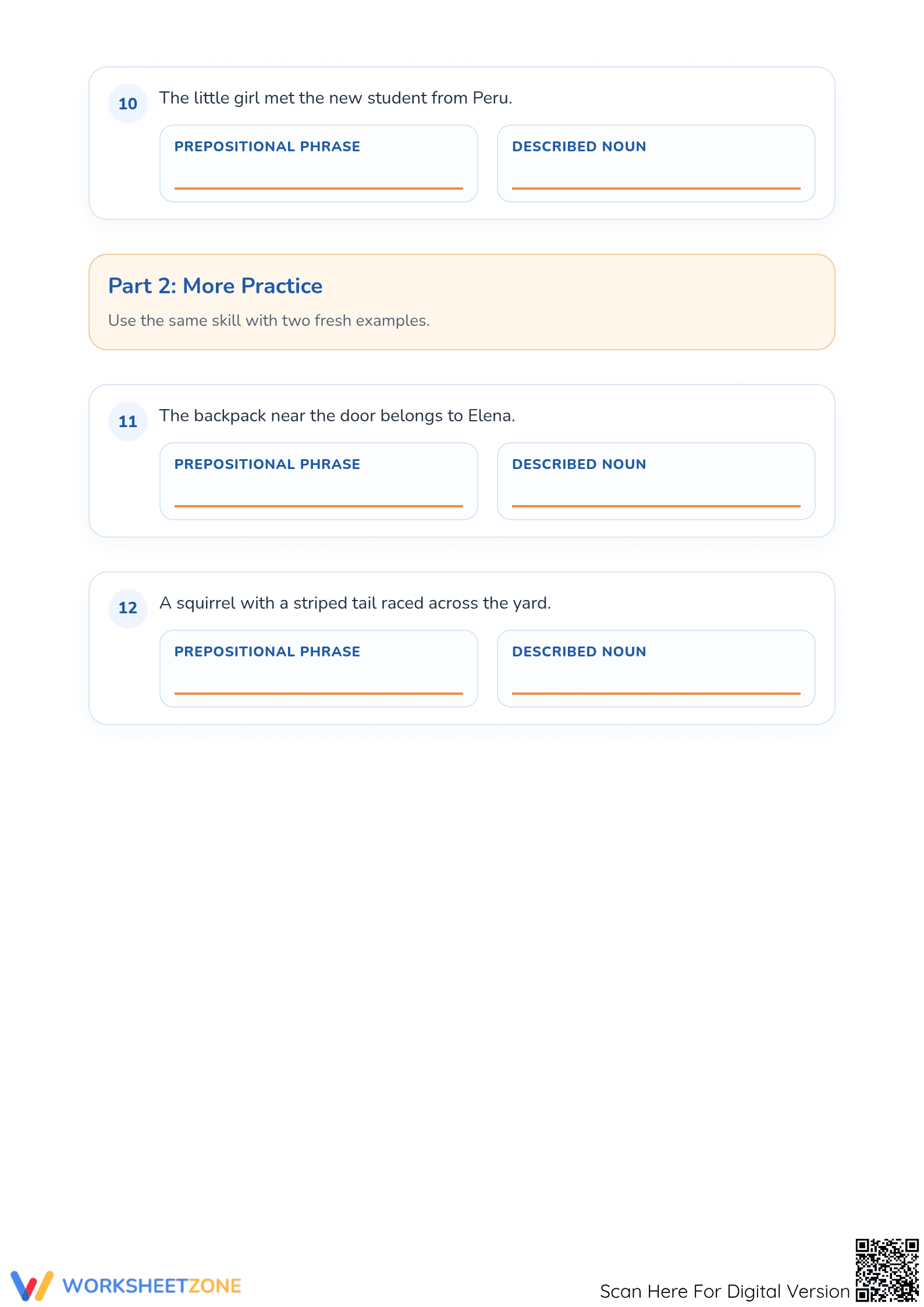
The resource contains three comprehensive pages featuring 12 structured exercises. Each task provides a complete sentence and two dedicated response boxes: one for the prepositional phrase and one for the described noun. A clear example is provided at the top of the first page to model the expected student response. A full answer key is included for rapid grading and immediate feedback.
Skill Progression
- Guided Practice: The initial example and first three items provide clear sentence structures to build student confidence and establish the pattern of identification.
- Supported Practice: Items 4 through 10 introduce varied sentence lengths and noun placements to challenge identification skills while maintaining a consistent format.
- Independent Practice: Part 2 offers "More Practice" with fresh examples to ensure students can apply the skill without immediate scaffolding or introductory prompts.
This structured approach ensures that learners internalize the relationship between the preposition and the noun it modifies through a gradual-release model.
This worksheet is specifically aligned with CCSS.ELA-LITERACY.L.4.1.E, which requires students to use prepositional phrases correctly. By focusing on the adjectival function, it also supports broader language standards regarding sentence patterns and grammar. Both standard codes can be copied directly into lesson plans, IEP goals, or district curriculum mapping tools.
Use this worksheet during the guided practice phase of a grammar lesson on modifiers. It works exceptionally well as a formative assessment after introducing common prepositions like "in," "on," and "with." Teachers can observe if students are correctly identifying the noun being described rather than just finding the prepositional phrase. Expected completion time ranges from 15 to 20 minutes depending on student familiarity.
This resource is designed for 4th and 5th-grade students who are transitioning from simple sentences to more complex descriptive writing. It is also an excellent tool for English Language Learners (ELLs) who need explicit practice with English syntax and word order. Natural pairings include a list of common prepositions or an anchor chart illustrating the difference between adjectival and adverbial phrases.
According to Fisher & Frey (2014), the gradual release of responsibility is vital for linguistic mastery, particularly when students are learning to navigate complex grammatical structures like prepositional phrases. This worksheet applies that research by providing clear modeling followed by 12 opportunities for student response. Mastery of CCSS.ELA-LITERACY.L.4.1.E is a prerequisite for more advanced middle school writing, where prepositional phrases are used to create variety and precision. By isolating the adjectival function, students learn to distinguish between phrases that tell "which one" (adjectives) and those that tell "where" or "when" (adverbs). This foundational skill is essential for meeting NAEP standards for writing clarity and syntactic variety in upper elementary grades. The inclusion of a clear answer key allows for immediate self-correction, which research suggests significantly improves retention of grammatical rules.


