




























Views
Downloads


Prepositions Practice Worksheet | Grade 4 ELA Printable

Paste this activity's link or code into your existing LMS (Google Classroom, Canvas, Teams, Schoology, Moodle, etc.).
Students can open and work on the activity right away, with no student login required.
You'll still be able to track student progress and results from your teacher account.
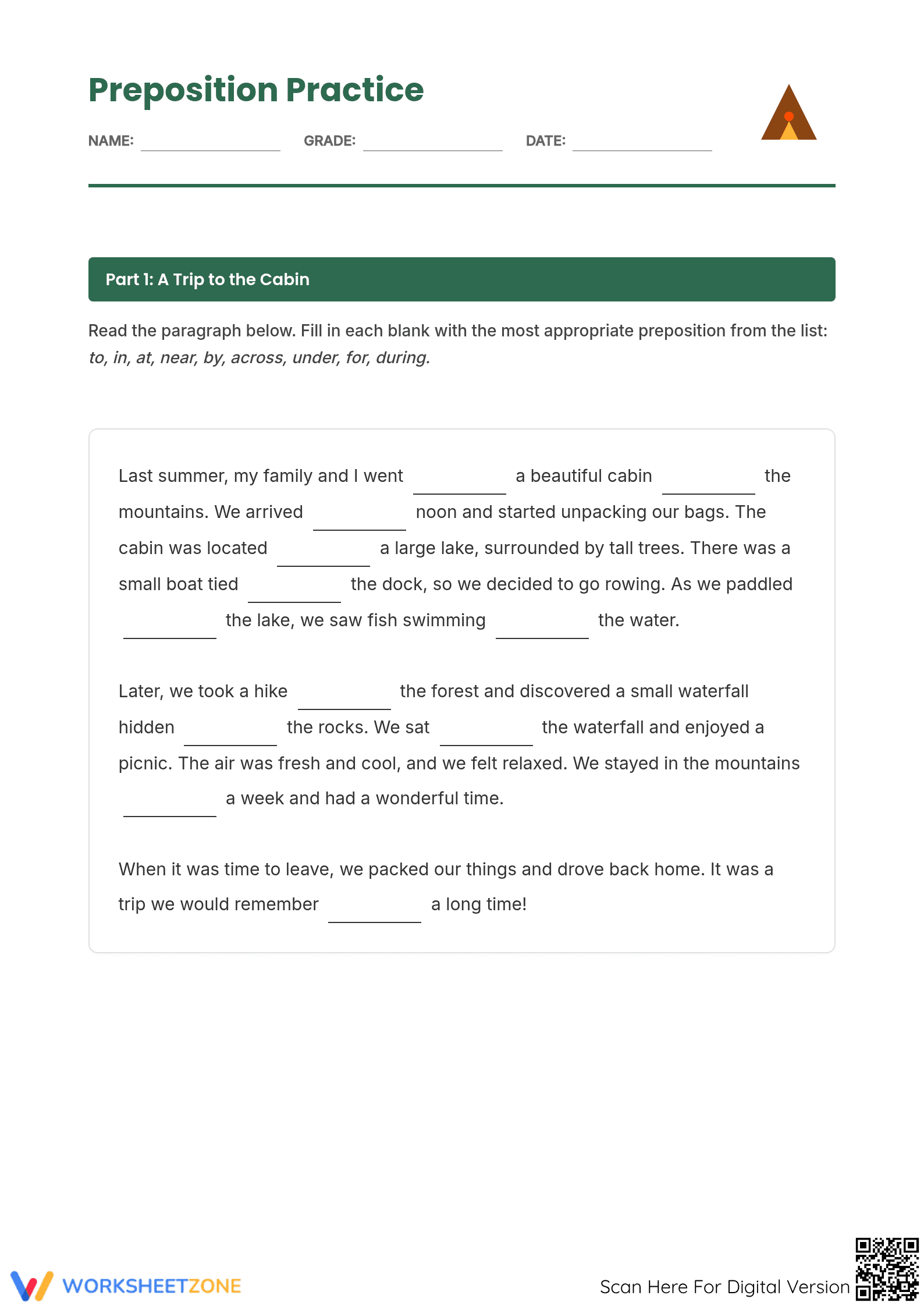
This printable grammar worksheet helps students master prepositions by applying them in context. Rather than just memorizing lists, learners will complete an engaging short story, select correct words for specific sentences, and write their own examples to demonstrate a clear understanding of spatial and temporal relationships.
At a Glance
- Grade: 4 · Subject: ELA
- Standard:
CCSS.ELA-LITERACY.L.4.1.E— Form and use prepositional phrases- Skill Focus: Prepositions
- Format: 2 pages · 17 problems · Answer key included · PDF
- Best For: Independent practice or homework
- Time: 15–20 minutes
This two-page PDF includes three distinct sections to build grammar proficiency. Part one features a word bank and an 11-blank cloze reading passage about a cabin trip. Part two provides four multiple-choice questions to isolate specific preposition usage. Finally, part three requires students to generate two original sentences. A complete answer key is provided for quick grading.
- Guided practice: The cloze passage provides a targeted word bank, limiting choices and helping students rely on context clues to place 11 prepositions correctly.
- Supported practice: The multiple-choice section removes the word bank but offers three specific options per sentence, isolating common usage errors across 4 problems.
- Independent practice: The final writing task removes all scaffolds, requiring students to generate 2 original sentences using multiple prepositions accurately.
This structured progression follows a proven gradual-release model, moving learners from recognition to independent application.
This resource is aligned to CCSS.ELA-LITERACY.L.4.1.E: Form and use prepositional phrases. It also supports general reading comprehension by reinforcing how connecting words shape meaning in a text. Both standard codes can be copied directly into lesson plans, IEP goals, or district curriculum mapping tools.
Deploy this worksheet during independent practice after direct instruction on parts of speech. It also serves as an excellent morning work activity or homework assignment. As students complete the short story section, observe whether they rely on the word bank or attempt to fill the blanks using natural language intuition—this serves as a quick formative assessment of their syntactic awareness. Expect completion to take 15 to 20 minutes.
This resource is ideal for 4th-grade ELA students, though it works well as a review for 5th and 6th graders. For learners needing extra support, cross out used words in the word bank to reduce cognitive load. Pair this activity with a classroom anchor chart detailing common prepositions of time and place.
Mastering grammar in context is essential for developing strong reading and writing skills across elementary and middle school grades. This worksheet specifically targets CCSS.ELA-LITERACY.L.4.1.E, helping students form and use prepositional phrases accurately within varied sentence structures. According to a 2024 report by EdReports, grammar instruction is most effective when integrated into authentic reading and writing tasks rather than taught in strict isolation. By embedding preposition practice within a narrative cloze passage and requiring original sentence generation, this resource aligns perfectly with evidence-based literacy practices. Students move beyond rote memorization to truly understand how spatial and temporal words connect ideas, establish settings, and clarify meaning. This contextualized approach ensures that learners can transfer their grammar knowledge directly to their own independent writing, ultimately improving overall syntactic variety, reading comprehension, and communication skills.


