




























Views
Downloads


Prepositional Phrases as Adjectives | Grade 4 Printable

Paste this activity's link or code into your existing LMS (Google Classroom, Canvas, Teams, Schoology, Moodle, etc.).
Students can open and work on the activity right away, with no student login required.
You'll still be able to track student progress and results from your teacher account.
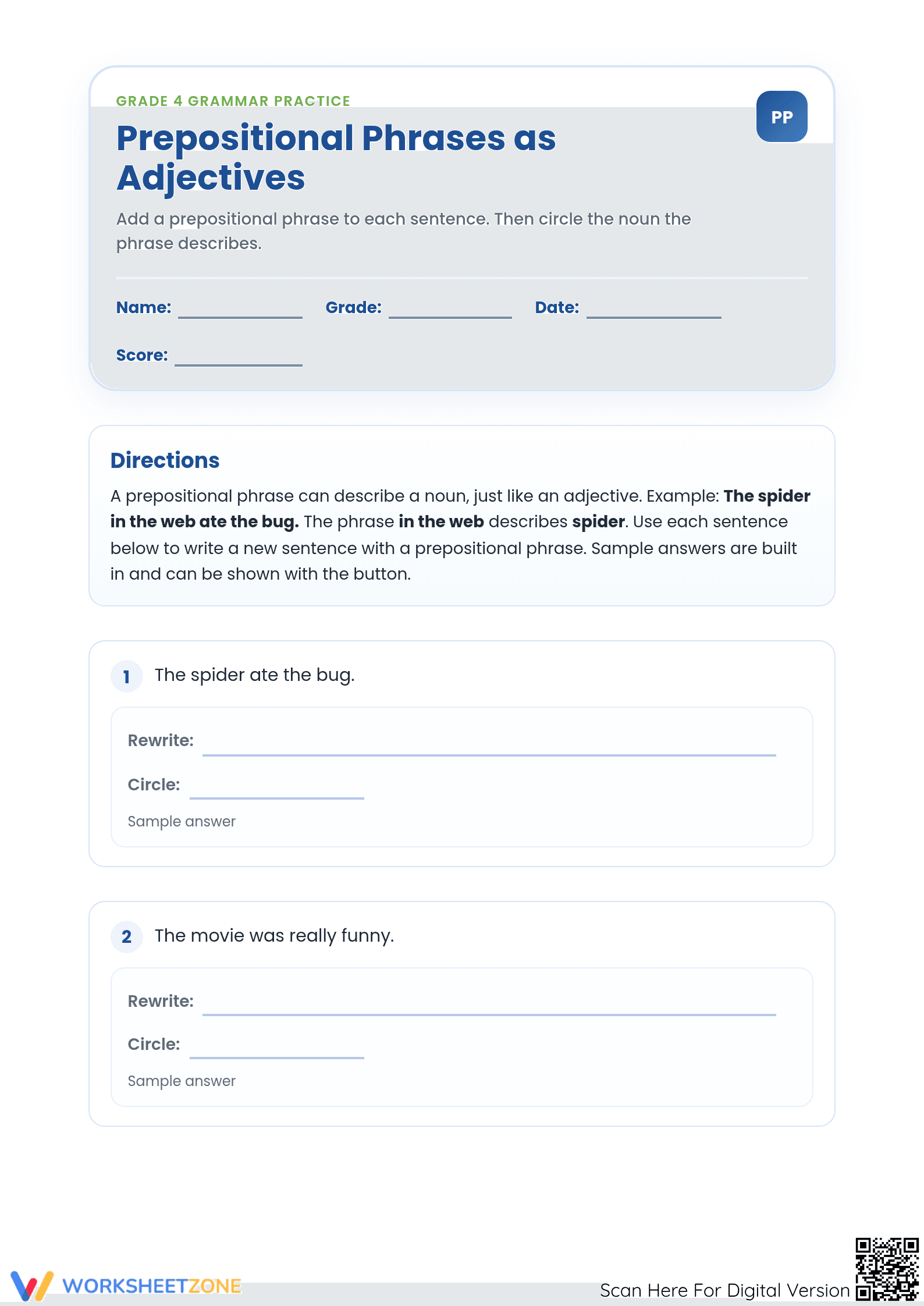
This Grade 4 ELA worksheet helps students master the functional use of prepositional phrases as adjectives. By rewriting sentences to include descriptive phrases, learners develop a deeper understanding of how to modify nouns and expand sentence complexity. It provides a clear path toward grammatical fluency and sophisticated writing outcomes.
At a Glance
- Grade: 4 · Subject: ELA
- Standard:
CCSS.ELA-LITERACY.L.4.1.E— Use prepositional phrases to convey specific meanings and describe nouns- Skill Focus: Prepositional phrases as adjectives
- Format: 3 pages · 10 problems · Answer key included · PDF
- Best For: Independent grammar practice and reinforcement
- Time: 20–30 minutes
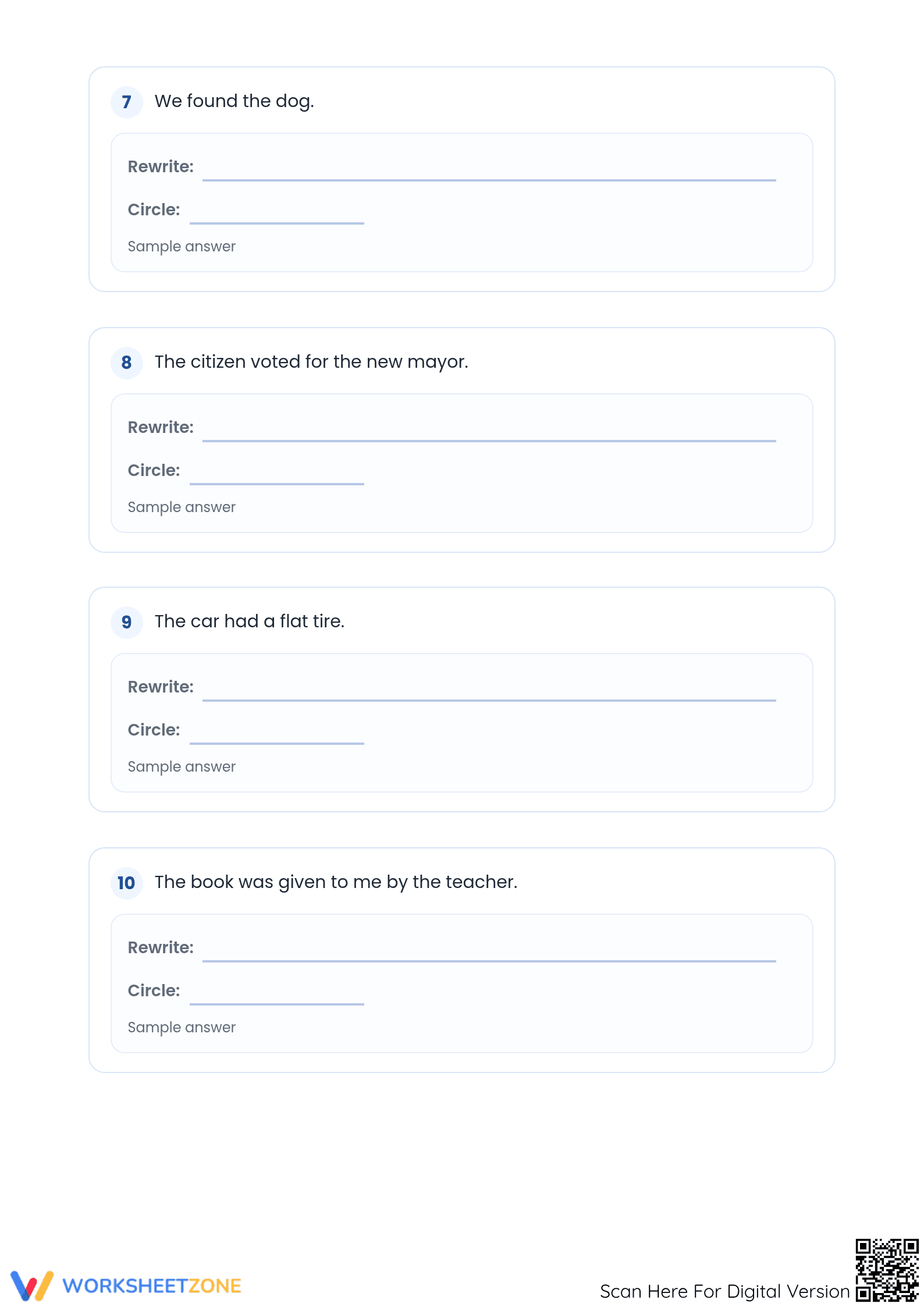
The resource contains three pages of structured practice featuring 10 unique sentence-transformation tasks. Each problem provides a base sentence, a dedicated "Rewrite" line for student input, and a "Circle" line to identify the modified noun. A comprehensive answer key with sample responses is included to facilitate quick grading or self-correction during independent work time.
Skill Progression
- Guided practice: The first page introduces the concept with a clear example and two initial problems to build confidence in identifying the target noun.
- Supported practice: Pages two and three offer eight additional sentences, allowing students to experiment with various prepositions in different sentence positions.
- Independent practice: Students must independently generate appropriate phrases that logically modify the subject or object of each sentence without word banks.
This sequence follows a gradual-release model, moving from modeled examples to independent application of adjectival modifiers.
Standards Alignment
This worksheet aligns with `CCSS.ELA-LITERACY.L.4.1.E`, which requires students to use prepositional phrases effectively. It specifically targets the ability to use these phrases as adjectival modifiers to provide detail and clarity. Both standard codes can be copied directly into lesson plans, IEP goals, or district curriculum mapping tools.
How to Use It
Assign this worksheet during the independent practice phase of a grammar lesson on modifiers. It works well as a formative assessment after teaching the difference between adjectival and adverbial phrases. Teachers should observe if students are circling the correct noun to ensure they understand the relationship between the phrase and the word it modifies. Completion typically takes 25 minutes.
Who It's For
Designed for fourth-grade students, this resource is also suitable for fifth graders needing a review of phrase functions. It pairs naturally with an anchor chart on common prepositions or a mentor text analysis where students hunt for descriptive phrases in literature to see grammar in action.
According to Fisher & Frey (2014), the gradual release of responsibility is essential for mastering complex grammatical structures like CCSS.ELA-LITERACY.L.4.1.E. This worksheet implements that research by providing a clear example before requiring students to generate their own prepositional phrases as adjectives. By engaging in 10 specific sentence transformations, students move beyond rote identification to active synthesis. Research from the NAEP suggests that students who can manipulate sentence parts, such as adding descriptive phrases to nouns, demonstrate higher overall writing proficiency. This 3-page resource provides the necessary volume of practice to move students toward mastery of functional word classes. The inclusion of an answer key ensures that feedback loops remain tight, which is a critical factor in student retention of linguistic rules and conventions.


