




























Views
Downloads

Prepositional Phrases Worksheet | Grade 4-5 Essential

Paste this activity's link or code into your existing LMS (Google Classroom, Canvas, Teams, Schoology, Moodle, etc.).
Students can open and work on the activity right away, with no student login required.
You'll still be able to track student progress and results from your teacher account.
Students master the mechanics of sentence structure by isolating prepositional phrases and their corresponding objects. This worksheet provides a clear framework for identifying how prepositions function within varied sentence contexts, ensuring learners can distinguish between the preposition itself and the noun or pronoun that completes the phrase.
At a Glance
- Grade: 4-5 · Subject: ELA
- Standard:
CCSS.ELA-LITERACY.L.4.1.E— Form and use prepositional phrases in sentences- Skill Focus: Prepositional phrases and objects
- Format: 3 pages · 13 problems · Answer key included · PDF
- Best For: Grammar reinforcement and sentence analysis
- Time: 20–30 minutes
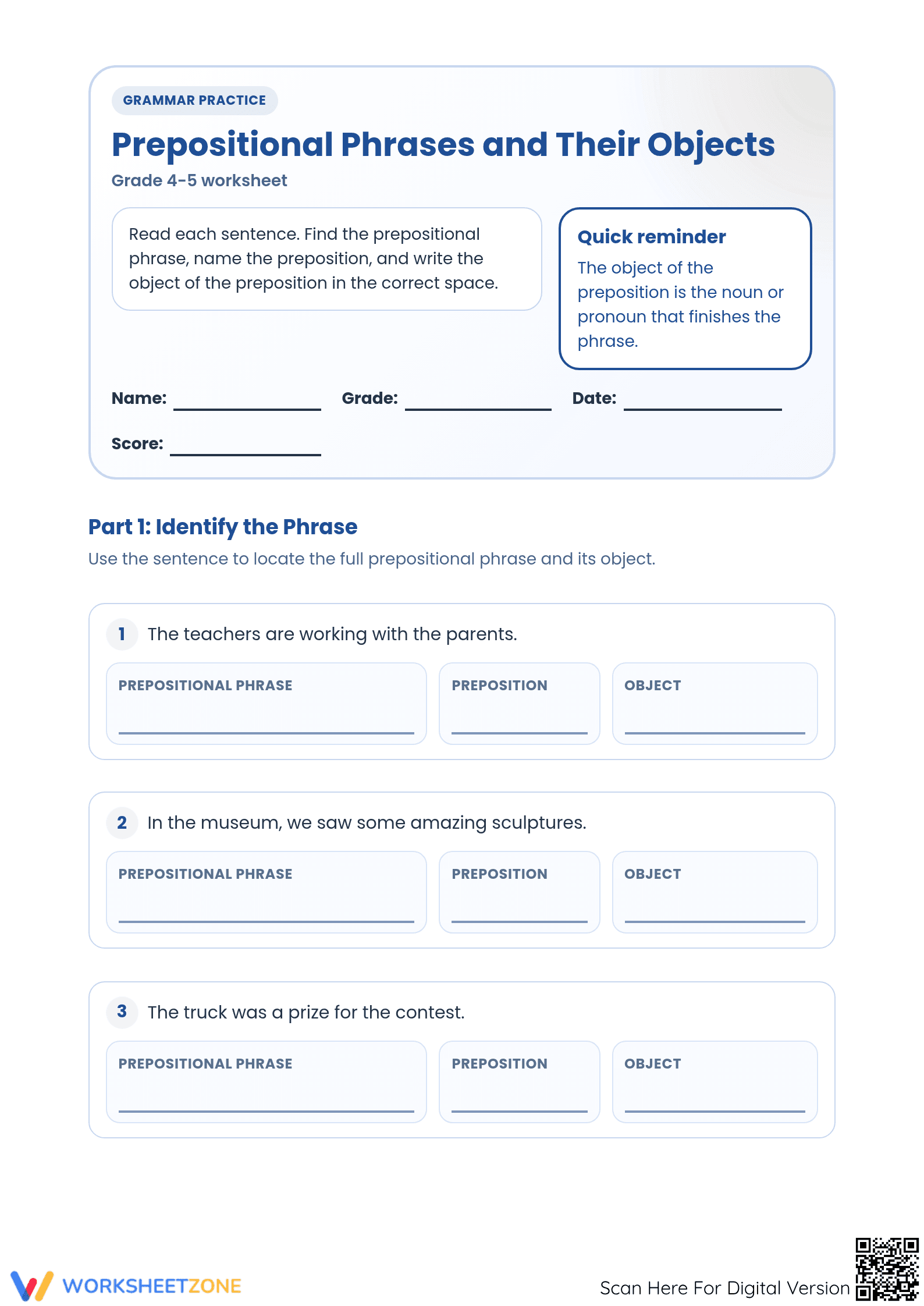
This 3-page PDF contains 13 structured exercises divided into two distinct parts. Each task provides a full sentence and three specific input fields: one for the complete prepositional phrase, one for the preposition, and one for the object. A "Quick Reminder" box on the first page defines the object of the preposition to support student independence and reduce teacher intervention during the activity.
Skill Progression
- Guided Practice: The first 3 problems use simple sentence structures to help students recognize basic spatial relationships and establish the pattern of identifying the phrase, preposition, and object.
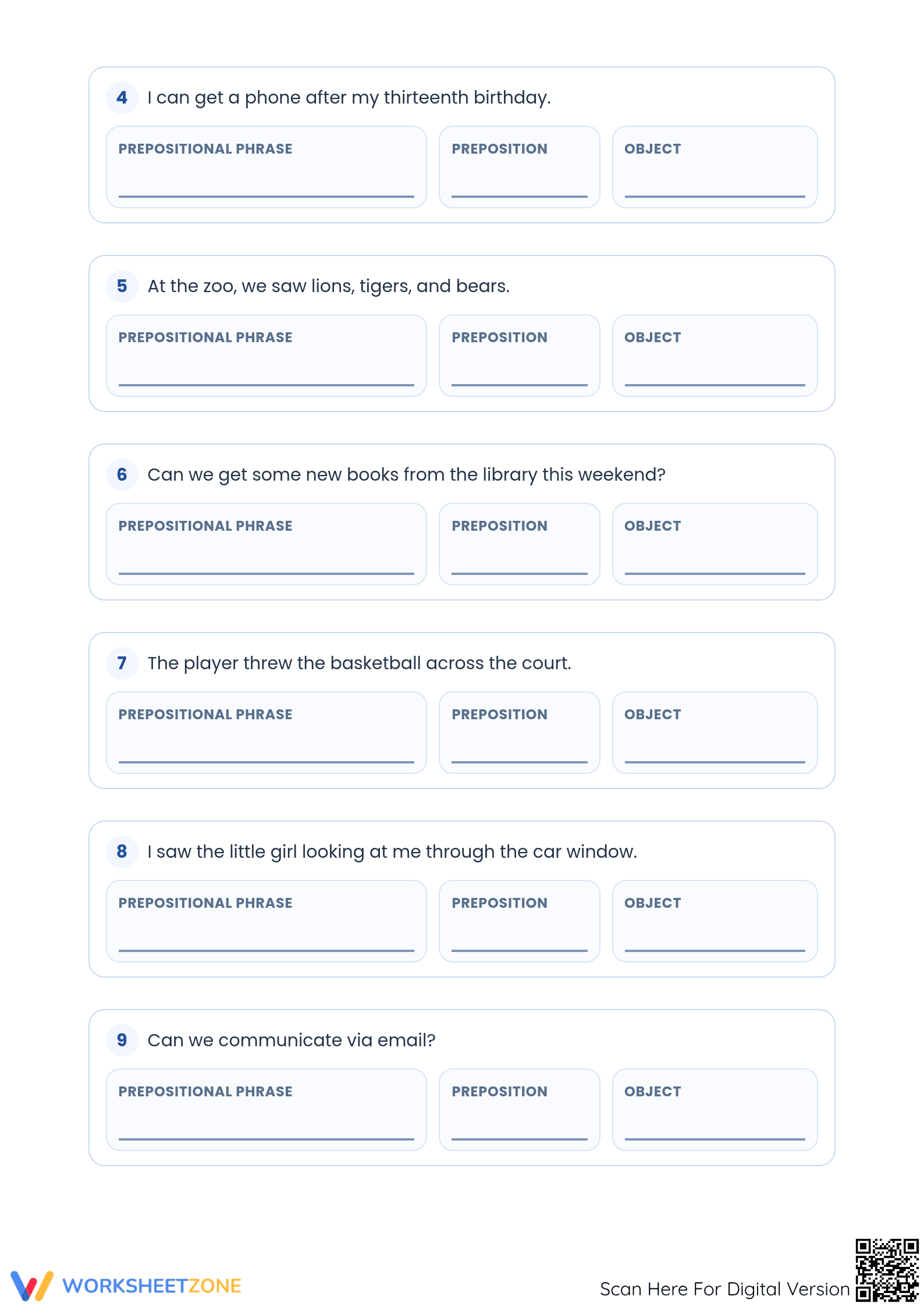
- Supported Practice: Problems 4 through 10 introduce more complex sentences, including those with multiple clauses or adjectives within the phrase, challenging students to maintain focus on the core grammatical structure.
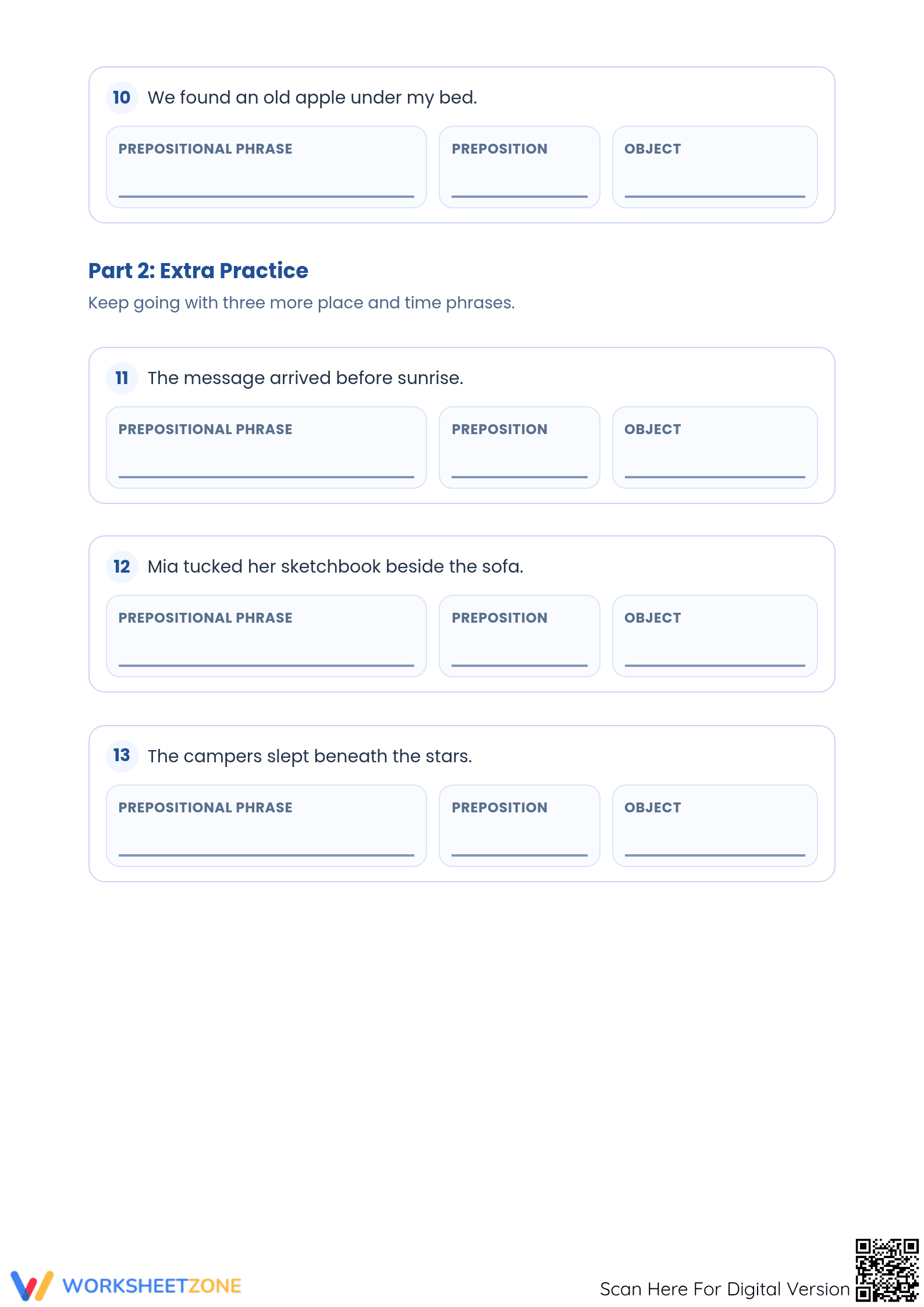
- Independent Practice: The final 3 problems in Part 2 focus specifically on place and time phrases, requiring students to apply their knowledge to specific functional categories without additional prompts.
This sequence follows a gradual-release model, moving from basic identification to more nuanced sentence analysis.
Standards Alignment
This resource is aligned to CCSS.ELA-LITERACY.L.4.1.E, which requires students to form and use prepositional phrases. It also supports CCSS.ELA-LITERACY.L.5.1 by reinforcing the function of prepositions in more sophisticated writing. Both standard codes can be copied directly into lesson plans, IEP goals, or district curriculum mapping tools.
How to Use It
Use this as a formative assessment after a direct instruction lesson on word classes. It works well as a "check for understanding" during the middle of a grammar unit. Teachers should observe if students include the object's modifiers in the "Prepositional Phrase" box but isolate only the noun in the "Object" box. Expected completion time is approximately 25 minutes.
Who It's For
This worksheet is designed for 4th and 5th-grade students who are transitioning from identifying single parts of speech to analyzing phrase-level functions. It is particularly helpful for English Language Learners (ELLs) who need to visualize the "formula" of a prepositional phrase. Pair this with a preposition anchor chart or a direct instruction lesson on sentence expansion.
According to the RAND AIRS 2024 report on literacy instruction, explicit practice in identifying functional word classes like prepositions significantly improves a student's ability to decode complex sentence structures. This worksheet addresses the specific requirements of CCSS.ELA-LITERACY.L.4.1.E by requiring students to deconstruct 13 unique sentences into their constituent grammatical parts. By isolating the preposition from its object, students build the syntactic awareness necessary for advanced writing and reading comprehension. Research from Fisher & Frey (2014) emphasizes that such scaffolded identification tasks serve as a bridge between basic grammar recognition and the application of these structures in original composition. This resource provides the necessary repetition to move students toward mastery of prepositional phrase usage, ensuring they can accurately identify the noun or pronoun that terminates a phrase in various contexts.


