




























Views
Downloads

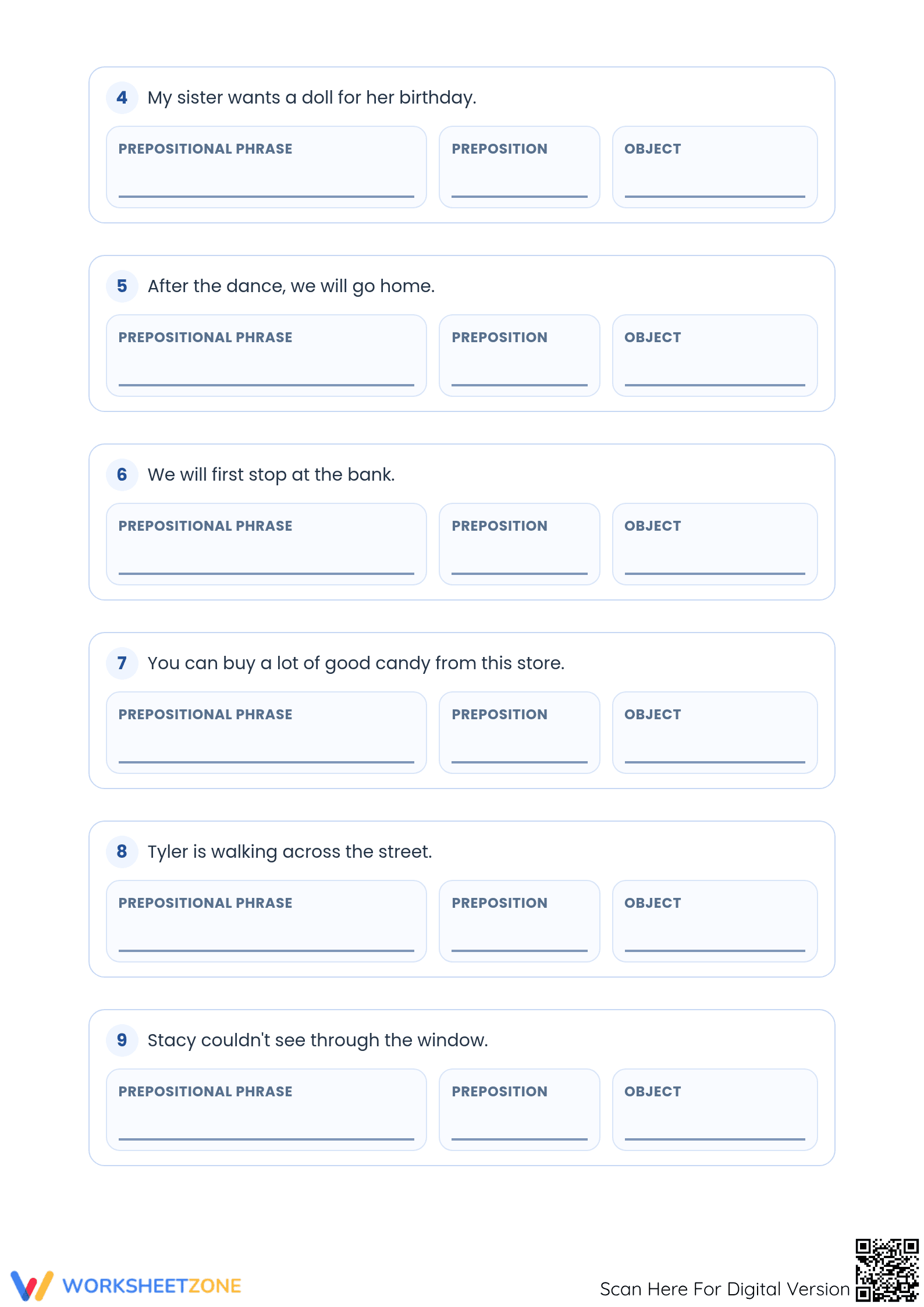


Essential Prepositional Phrases Worksheet | Grade 4-5

Paste this activity's link or code into your existing LMS (Google Classroom, Canvas, Teams, Schoology, Moodle, etc.).
Students can open and work on the activity right away, with no student login required.
You'll still be able to track student progress and results from your teacher account.
This Grade 4 and 5 grammar worksheet helps students master the mechanics of prepositional phrases. By breaking down sentences into their constituent parts, learners identify the preposition and its corresponding object. This targeted practice ensures students can accurately form and use prepositional phrases to add detail and variety to their writing.
At a Glance
- Grade: 4-5 · Subject: English Language Arts
- Standard:
CCSS.ELA-LITERACY.L.4.1.E— Form and use prepositional phrases in sentences to provide descriptive detail- Skill Focus: Identifying prepositions and their corresponding objects within sentences
- Format: 3 pages · 13 problems · Full answer key included · PDF
- Best For: Grammar reinforcement and sentence structure practice
- Time: 15–20 minutes
What's Inside
Inside this 3-page resource, you will find 13 structured exercises designed to isolate the components of a prepositional phrase. Each task provides dedicated space for students to write the full phrase, the specific preposition, and the object. A Quick Reminder box on the first page provides immediate support, and a comprehensive answer key is included for easy grading.
Skill Progression
- Guided practice: The first 3 problems use simple sentence structures to help students recognize basic spatial and temporal relationships.
- Supported practice: Problems 4 through 10 introduce more complex sentences, including those with adjectives modifying the object of the preposition.
- Independent practice: The final section challenges students to apply their knowledge to three additional sentences without the initial scaffolding.
This worksheet follows a gradual-release model, moving from identification to deeper analysis of how prepositions function within varied sentence contexts.
Standards Alignment
This resource is aligned with `CCSS.ELA-LITERACY.L.4.1.E`, which requires students to form and use prepositional phrases. It also supports L.5.1 by reinforcing the fundamental word classes necessary for advanced sentence manipulation. Both standard codes can be copied directly into lesson plans, IEP goals, or district curriculum mapping tools.
How to Use It
Use this worksheet as a formative assessment after a direct instruction lesson on prepositions. It works well as a quiet independent practice activity or a homework assignment to reinforce classroom learning. Teachers should observe if students struggle to distinguish between the object of the preposition and the subject of the sentence. Completion typically takes 15 to 20 minutes.
Who It's For
This practice is ideal for upper elementary students who are transitioning from simple to complex sentence structures. It is particularly helpful for English Language Learners (ELLs) who need explicit practice with English syntax. Pair this with a preposition anchor chart or a mentor text search for prepositional phrases to deepen student understanding.
According to the RAND AIRS 2024 report, explicit instruction in grammar mechanics, such as identifying prepositional phrases, significantly improves student writing clarity and syntactic complexity. This worksheet addresses CCSS.ELA-LITERACY.L.4.1.E by requiring students to deconstruct 13 sentences to find the preposition and its object. Research by Fisher & Frey (2014) emphasizes that the gradual release of responsibility—moving from guided identification to independent analysis—is crucial for long-term retention of linguistic structures. By isolating the object of the preposition, students develop a more sophisticated understanding of how nouns function within phrases rather than just as sentence subjects. This foundational skill is a prerequisite for mastering more advanced concepts like misplaced modifiers or complex clausal structures. Educational data from NAEP suggests that students who receive targeted practice in word classes demonstrate higher proficiency in reading comprehension and narrative writing.


