


























Views
Downloads

Printable House Vocab & Prepositions Worksheet | Grade 3
Paste this activity's link or code into your existing LMS (Google Classroom, Canvas, Teams, Schoology, Moodle, etc.).
Students can open and work on the activity right away, with no student login required.
You'll still be able to track student progress and results from your teacher account.
This comprehensive Grade 3 English Language Arts worksheet focuses on mastering prepositions of place and household vocabulary. Students identify spatial relationships between objects and label various rooms and common household items. By connecting visual cues with specific terminology, learners build the foundational linguistic skills necessary for descriptive writing and clear communication in everyday contexts.
At a Glance
- Grade: 3 · Subject: ELA
- Standard:
L.3.1.E— Use prepositional phrases to describe spatial relationships and locations accurately- Skill Focus: Prepositions and Household Vocabulary
- Format: 2 pages · 36 problems · Answer key included · PDF
- Best For: Vocabulary reinforcement and ESL/ELL support
- Time: 20–30 minutes
What's Inside
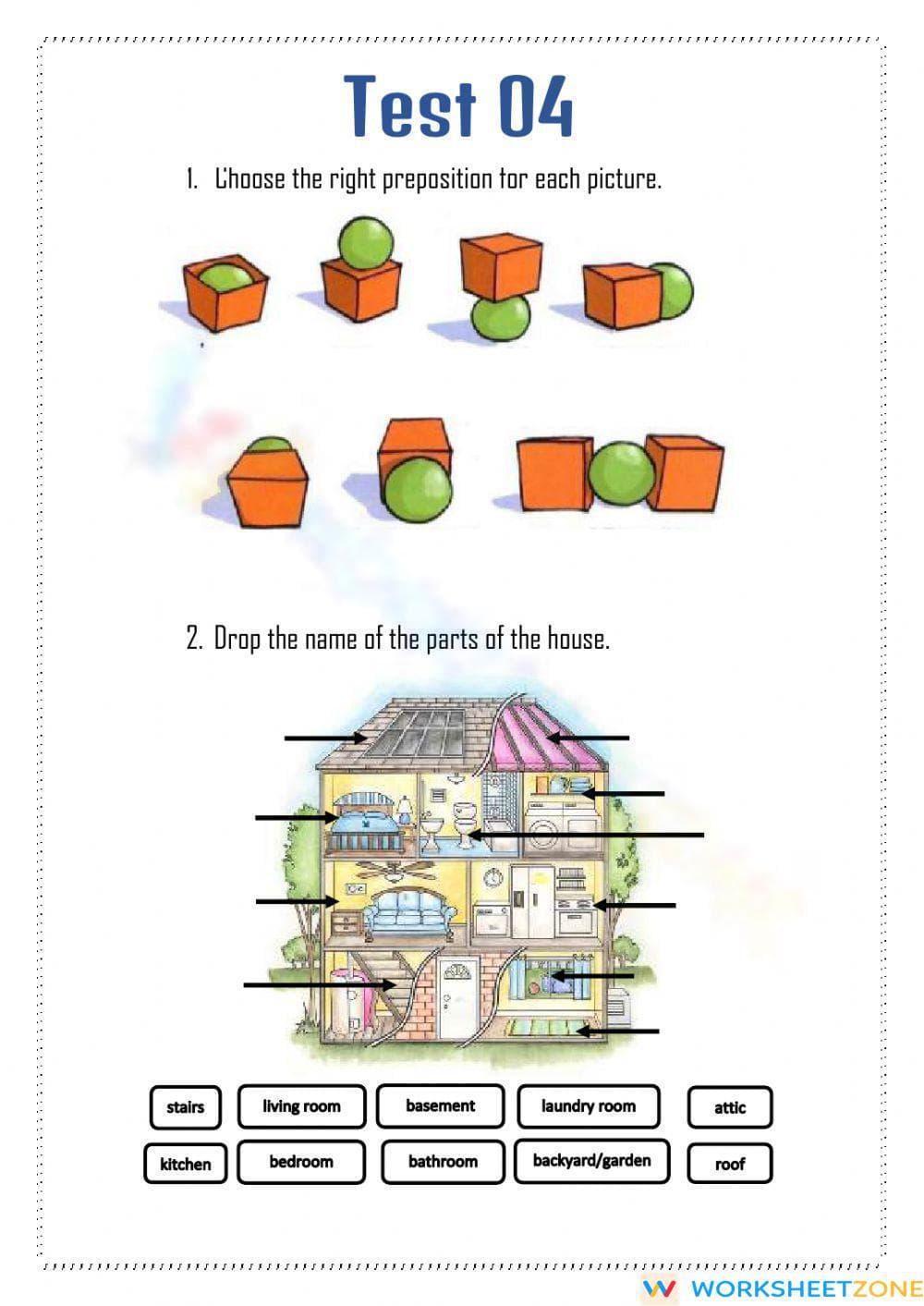
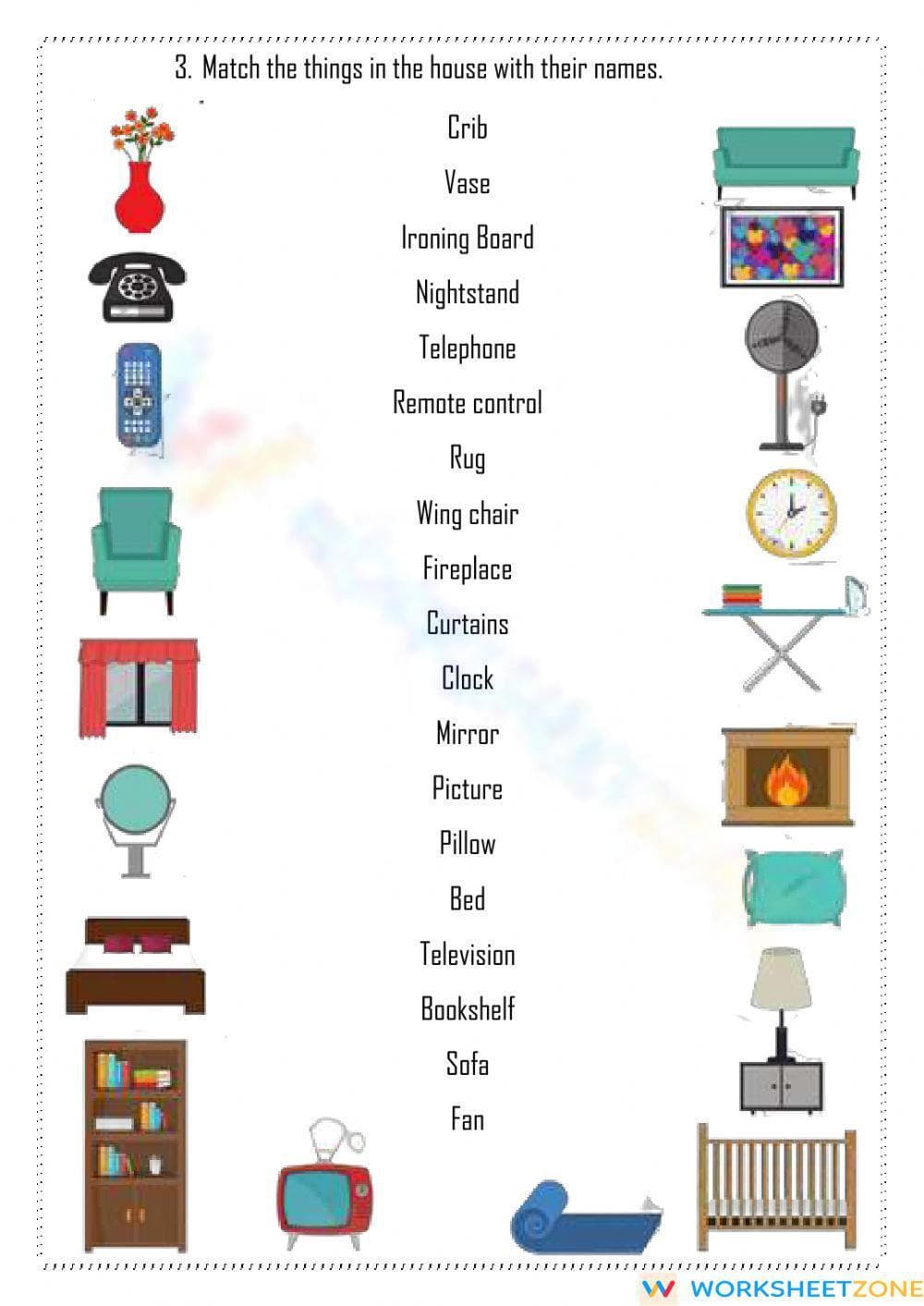
Inside this two-page PDF are three engaging activities. The first section uses illustrations of boxes and balls to challenge students to choose the correct preposition. The second task features a detailed house cross-section, requiring students to label rooms like the attic and basement. Finally, a matching exercise connects 19 everyday objects, including fireplaces and remote controls, with their names.
Zero-Prep Workflow
This resource offers a zero-prep classroom experience. Print the two-page document in seconds. Distribute the worksheets; the self-explanatory instructions allow students to begin immediately without teacher intervention. Finally, use the included answer key for a rapid five-minute review or individual grading. Total teacher preparation time is under two minutes, making this an ideal solution for sub plans.
Standards Alignment
This worksheet is primarily aligned with CCSS.ELA-LITERACY.L.3.1.E, requiring students to use prepositional phrases. It also supports CCSS.ELA-LITERACY.L.3.6 for domain-specific vocabulary acquisition. These activities ensure students can describe where items are located and name their environments. Both standard codes can be copied directly into lesson plans, IEP goals, or district curriculum mapping tools.
How to Use It
Use this worksheet during independent practice in a lesson on descriptive language. It serves as a formative assessment to observe if students distinguish between prepositions like "in front of" and "behind." Alternatively, assign it as a homework task after a classroom discussion about home environments. Expect completion within 25 minutes, providing data on vocabulary acquisition.
Who It's For
This resource is tailored for Grade 3 students and English Language Learners (ELL). The heavy reliance on visual aids makes it accessible for students needing extra scaffolding. It pairs naturally with a descriptive writing prompt or an anchor chart displaying common prepositions and household nouns.
Fisher & Frey (2014) emphasize that effective vocabulary instruction requires multiple exposures to words in varied contexts. This worksheet applies these principles by providing 36 structured opportunities to engage with L.3.1.E and household terminology. By moving from simple prepositional choices to complex room labeling and object matching, the resource ensures students move beyond rote memorization toward functional language use. Research from the RAND AIRS 2024 report highlights that high-quality, printable materials with clear visual scaffolding significantly improve the retention of domain-specific vocabulary in elementary learners. The inclusion of an answer key and self-contained instructions allows for immediate feedback, a critical component of the learning cycle. Educators can confidently integrate this standard-aligned tool into their ELA curriculum to support mastery of spatial relations and household nouns.


