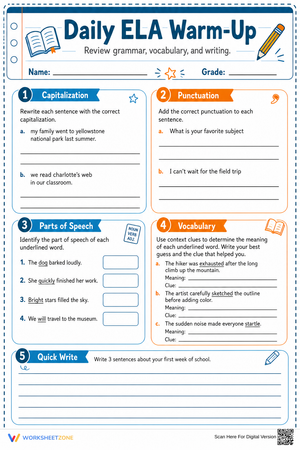
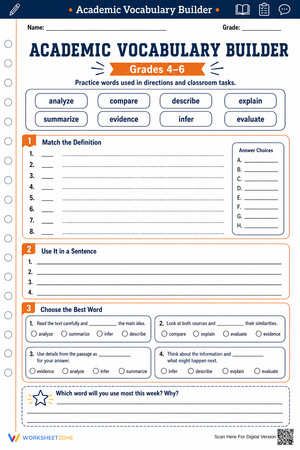
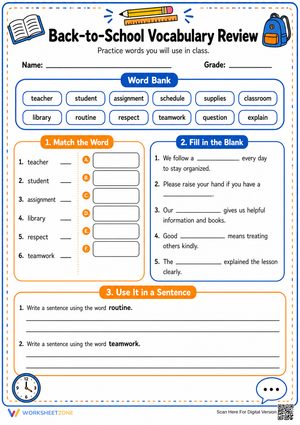
These grammar pdf worksheets for 4th grade put every major L.4 convention into focused, printable practice—relative pronouns, progressive verb tenses, modal auxiliaries, adjective order, commas in compound sentences, and quotation marks for direct speech. Teachers get a set of standalone resources that slot into morning warm-ups, small-group reteaching, or independent center work without requiring extra prep. The skills covered map to what fourth graders must produce independently in their writing by year's end.
The Specific Grammar Concepts Each Worksheet Covers
The first cluster of skills centers on the pronouns and adverbs students use to build relative clauses: who, whose, whom, which, that, where, when, and why. Students identify the relative pronoun or adverb in a sentence, then write their own sentences that embed subordinate information without losing the main clause. This is the point where fourth graders start sounding like writers rather than reporters of facts.
Verb tenses get substantial attention. Students form and use past, present, and future progressive tenses—the "-ing" forms paired with was/were, is/are, and will be. Several worksheets ask students to rewrite a paragraph, shifting it from simple past to past progressive, so they can feel how the tense change shifts the sense of ongoing action. That kind of sentence-level revision is harder than it looks; the exercise surfaces misconceptions that a multiple-choice question never would.
Modal auxiliaries—can, may, must, should, would—form their own set. Students read sentences in context and select the modal that best expresses the intended level of certainty or permission. The can/may distinction gets its own focused practice because it is the one most likely to transfer into writing conferences students have with their teachers.
One worksheet focuses entirely on conventional adjective order: number, opinion, size, age, shape, color, origin, material. Students read strings of randomly ordered adjectives, then rewrite the noun phrase correctly. Pairing this with a sentence-strip sorting activity—where students physically reorder adjective cards before recording the answer—helps students who lock up when they try to reason through the sequence in their heads alone.
Punctuation Work Across the Set
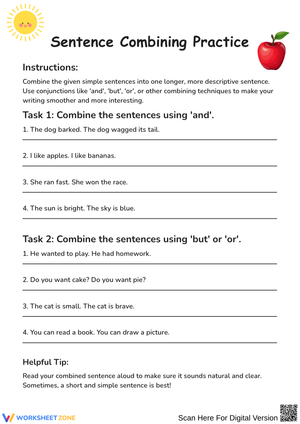
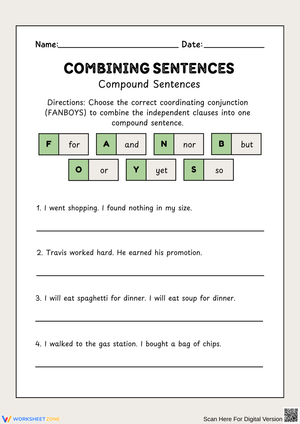
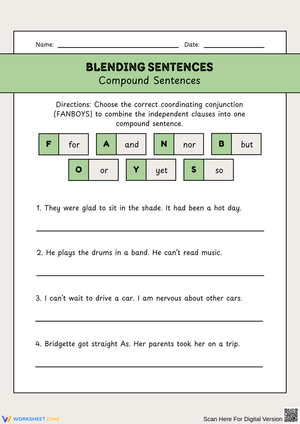
Commas in compound sentences are among the most reliably misunderstood skills at this grade level. The root confusion is between a compound sentence and a sentence with a compound predicate. Students know a comma goes "before the and," but they apply that rule to every and they encounter, including ones that join two verbs sharing a single subject. The worksheets here ask students to underline both subjects and both predicates before deciding whether a comma belongs—forcing them to test the structure rather than scan for a conjunction.
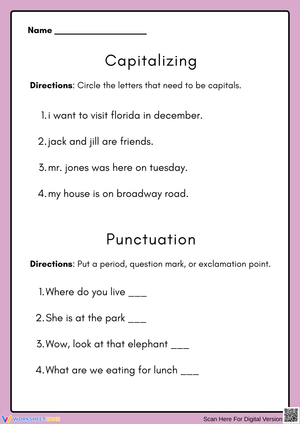
Quotation mark work addresses both dialogue and text citations. Students mark all missing punctuation in short narrative passages. The recurring error is end punctuation landing outside the closing quotation mark, which students justify by saying it "looks right" when the sentence continues after the dialogue tag. Seeing the corrected version alongside their own attempt builds the visual memory more reliably than a rule chart posted on the wall.
Student Mistakes Worth Anticipating Before You Teach
With relative pronouns, the who/whom decision stops fourth graders cold almost every time. Students who correctly identify an object in a simple sentence will still write "Who did she call?" when the intended sentence requires "Whom." The abstract explanation—substitute him and check whether it sounds right—is genuinely useful here, and several worksheets prompt students to apply exactly that substitution test rather than simply choose an answer from a list.
With progressive tenses, students frequently drop the helping verb in longer sentences. "She been running all morning" appears in student work far more often than teachers expect, especially among students who hear that construction in conversational speech. These grammar pdf worksheets for 4th grade include sentence-correction tasks that isolate the helping verb slot specifically, so students practice supplying it even when the sentence is longer and the helping verb lands farther from the participle.
Modal auxiliary errors tend to cluster around must and should. Students conflate obligation with recommendation, producing sentences where the strength of the modal undermines the intended meaning—"You must consider going to the dentist" when the writer clearly meant "You should." A worksheet that asks students to rewrite the same sentence using three different modals and then label the shift in meaning makes the distinction concrete in a way that a definition alone does not.
Fitting These Worksheets Into Your Instructional Week
The most consistent use pattern is the ten-minute bell-ringer. One worksheet targeting a single skill—relative adverbs, say, or adjective order—runs long enough to settle students after morning meeting but not so long that it eats into direct instruction time. The completed worksheet also becomes quick formative data: a glance at the first five student responses tells you whether Tuesday's lesson landed or whether it needs revisiting before Friday's writing block.
Literacy centers are the other natural home for this set. A grammar station stocked with three or four worksheets covering recent skills runs independently while the teacher works with a reading group. Laminate a few copies of the most-used worksheets and add dry-erase markers for students who need repeated practice with the same skill—particularly useful for the adjective-order and progressive-tense worksheets, which many students need to work through more than once before the pattern sticks.
For homework, match the worksheet to the exact skill taught that day. Sending home a worksheet that introduces new material without teacher support reliably produces frustrated students and parents writing notes asking what a relative adverb is. The goal is confident independent practice, not first exposure.
Standard Alignment
These grammar pdf worksheets for 4th grade address CCSS L.4.1 and L.4.2 directly. L.4.1 covers grammar and usage: relative pronouns and adverbs, progressive verb tenses, modal auxiliaries, and the conventional ordering of adjectives. L.4.2 governs punctuation conventions: commas before coordinating conjunctions in compound sentences and quotation marks for direct speech and quoted text. Teachers who use these resources for formative assessment get a natural record of progress against each standard without any separate tracking document—the worksheets themselves serve as the evidence file.
Adjusting the Set for a Range of Learners
Students still consolidating third-grade conventions benefit from having the reference rule printed at the top of the worksheet before they attempt the practice problems. For the modal auxiliary worksheets specifically, a simple two-column reference—one column showing the modal, the second showing the level of certainty it signals—removes the working-memory load so students can focus on applying the concept rather than retrieving the definition. This is a low-prep adjustment that does not reduce the rigor of the task itself.
For students who move through the work quickly, the most productive extension is generative rather than additive. Instead of completing another worksheet, they write a short paragraph that deliberately uses three specific grammar features and then annotates each one. The annotated paragraph becomes a self-assessment students can compare against their earlier writing to see the concrete difference the practice made.
Frequently Asked Questions
Which grammar skills do these worksheets actually cover?
The set addresses every L.4.1 and L.4.2 target: relative pronouns (who, whose, whom, which, that) and relative adverbs (where, when, why), past/present/future progressive tenses, modal auxiliaries (can, may, must, should, would), conventional adjective order, commas in compound sentences, and quotation marks for direct speech and text citations.
Can these be used as formative assessments rather than just practice?
These grammar pdf worksheets for 4th grade work well as both. A ten-question worksheet on modal auxiliaries or progressive tenses gives teachers a clear read on which students need a reteach and which are ready to move forward. The focused, single-skill format makes scoring fast and sorting students for small-group instruction the following day straightforward.
How should I handle students who finish early?
The extension that produces the most useful student work is asking early finishers to write two or three original sentences using the target construction, then swap papers with a classmate who identifies and labels the grammar feature. It keeps both students working with the concept rather than moving on to unrelated material.
Do these worksheets address sentence fragments and run-ons?
Yes. Several worksheets present flawed sentences for students to identify as fragments, run-ons, or correctly written, then revise the errors. This analytical work—reading a sentence against a structure check rather than scanning for surface features—directly strengthens the editing habits students need in their own writing.












 Interactive Worksheet Maker
 Quiz Maker
 Word Search Maker
 Crossword Puzzle Maker
 Word Scramble Generator
 Sentence Scramble Generator
 Handwriting Worksheet Generator
 Name Tracing Generator
 Fill In The Blank Generator