


























Views
Downloads
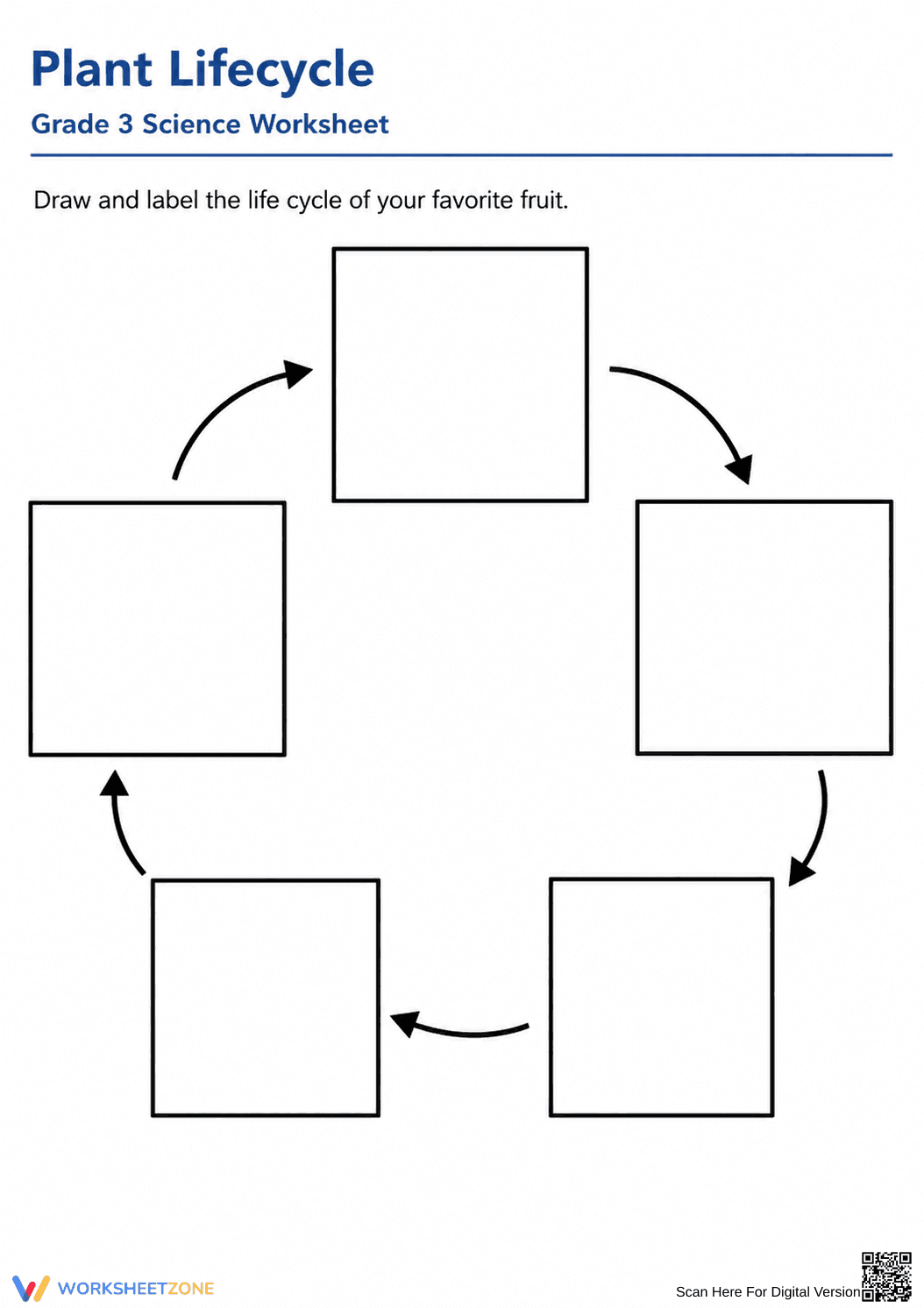

Grade 3 Plant Lifecycle — Printable No-Prep Worksheet
Paste this activity's link or code into your existing LMS (Google Classroom, Canvas, Teams, Schoology, Moodle, etc.).
Students can open and work on the activity right away, with no student login required.
You'll still be able to track student progress and results from your teacher account.
This Grade 3 science worksheet provides a structured visual model for students to illustrate and label the essential stages of botanical growth. By focusing on a fruit of their choice, learners personalize the scientific process, transforming abstract biological concepts into a concrete, memorable diagram.
At a Glance
- Grade: 3 · Subject: Science
- Standard:
3-LS1-1— Develop models to describe diverse life cycles- Skill Focus: Plant lifecycle sequencing and modeling
- Format: 1 page · 5 problems · Answer key included · PDF
- Best For: Independent practice or quick science centers
- Time: 15–20 minutes
The worksheet features a single-page circular flow diagram with five distinct entry points, encouraging students to think about the continuous loop of reproduction and growth. Each blank box serves as a canvas for drawing specific stages such as seed, germination, seedling, adult plant, and fruit. An answer key is included to help educators verify the logical progression of the chosen fruit's life cycle.
This resource is designed for a zero-prep workflow in the modern classroom. First, print the single-page PDF (30 seconds). Second, distribute to students with the instruction to choose a familiar fruit like an apple or pumpkin (1 minute). Finally, review the completed diagrams as a whole group to check for logical sequencing (5 minutes). Total teacher preparation time is under two minutes, making it an ideal candidate for emergency sub plans or transition activities.
Alignment is centered on the Next Generation Science Standard 3-LS1-1: Develop models to describe that organisms have unique and diverse life cycles but all have in common birth, growth, reproduction, and death. By requiring students to draw and label, the worksheet moves beyond rote memorization into the domain of developing and using models. Both standard codes can be copied directly into lesson plans, IEP goals, or district curriculum mapping tools.
Incorporate this worksheet during the elaboration phase of a 5E lesson plan, or use it as an independent science center activity. It works best after students have observed real seeds or watched a time-lapse video of plant growth. As a formative assessment tip, observe whether students include seeds in the final fruit stage; this reveals their understanding of how the cycle restarts. Expect most third graders to complete the drawing and labeling within a 15 to 20-minute window.
This resource is built for Grade 3 learners but is easily adaptable for Grade 2 review or Grade 4 remedial support. It pairs naturally with a reading passage about plant adaptations or a garden-based hands-on lesson. For students requiring extra support, providing a small word bank with terms like germination and pollination can help bridge the gap between visual understanding and scientific vocabulary.
Scientific modeling in early elementary education is a critical predictor of success in complex systems thinking. According to EdReports 2024, students engaging in regular diagramming of biological cycles have higher retention of core scientific vocabulary. This worksheet addresses the 3-LS1-1 standard by asking students to construct a visual representation of a plant's life stages, from seed to mature organism, effectively developing models to describe diverse life cycles. Choosing a favorite fruit allows them to apply biological principles to specific examples, reinforcing that diverse life cycles share commonalities in birth, growth, and reproduction. This evidence-based approach supports spatial reasoning and observational skills for higher-level inquiry. The five distinct stages provide a balanced framework for Grade 3 mastery without overwhelming the learner, ensuring foundational concepts are firmly established before moving to more complex ecosystems.


