


























Views
Downloads

Essential Grade 3 Orange Tree Lifecycle Worksheet
Paste this activity's link or code into your existing LMS (Google Classroom, Canvas, Teams, Schoology, Moodle, etc.).
Students can open and work on the activity right away, with no student login required.
You'll still be able to track student progress and results from your teacher account.
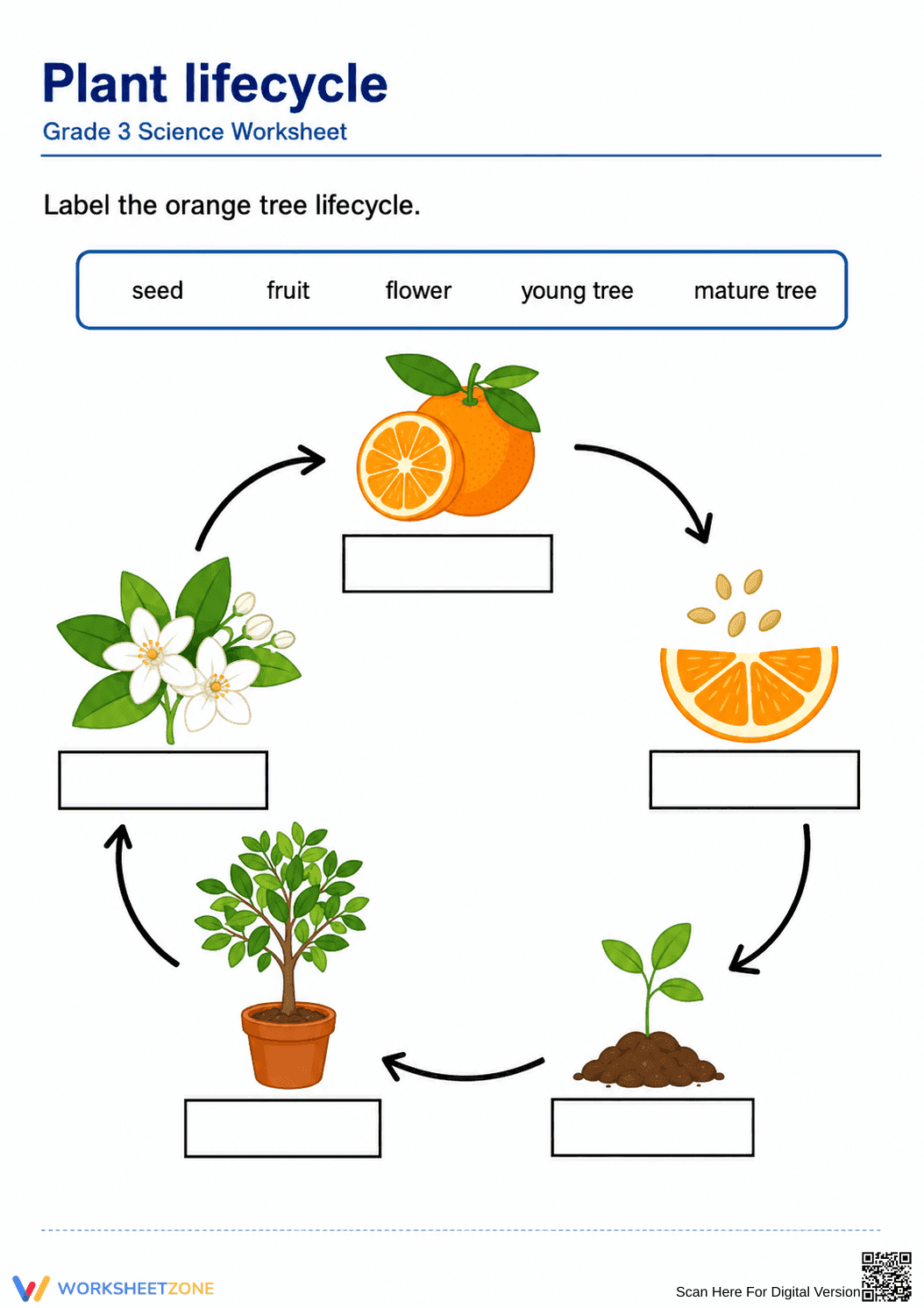
This Grade 3 plant lifecycle worksheet provides a clear, visual model for students to identify and label the five essential stages of an orange tree's development. By mapping the progression from seed to fruit, learners gain a concrete understanding of biological growth and reproduction. This resource is designed for immediate classroom implementation with zero teacher preparation required.
At a Glance
- Grade: 3 · Subject: Science
- Standard:
3-LS1-1— Develop models to describe that organisms have unique and diverse life cycles- Skill Focus: Plant life cycle stages and sequencing
- Format: 2 pages · 5 problems · Answer key included · PDF
- Best For: Independent science centers or quick formative checks
- Time: 10–15 minutes
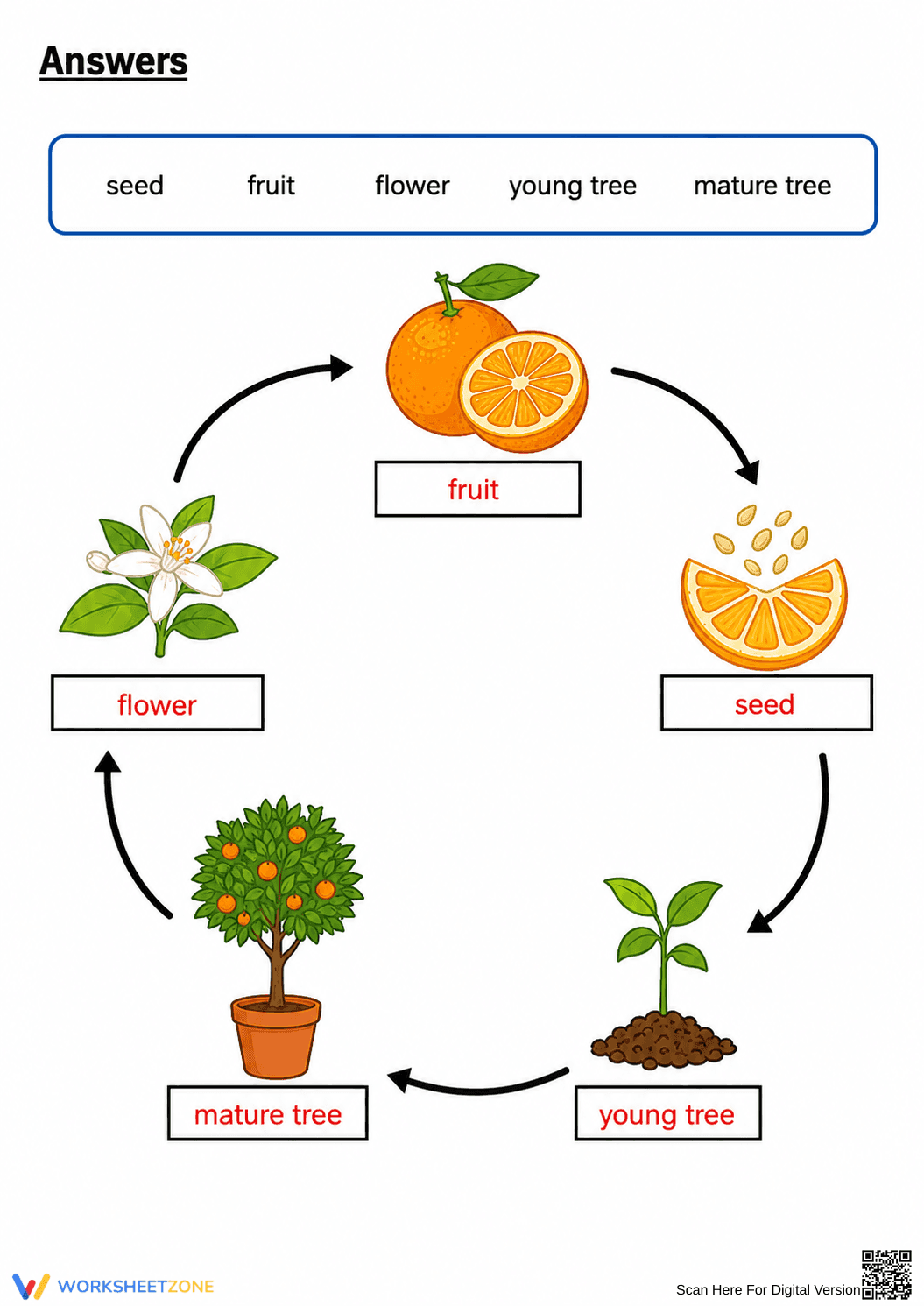
Inside this two-page PDF, you will find a primary worksheet featuring a circular diagram with five detailed illustrations representing the orange tree life cycle. A clear word bank containing essential terms—seed, fruit, flower, young tree, and mature tree—is provided to support vocabulary acquisition. The second page contains a full-size answer key, allowing for rapid grading or student self-correction during independent study sessions.
The zero-prep workflow for this resource allows teachers to integrate it into their science block in under two minutes. First, print the single-page worksheet for your class. Second, distribute the sheets; the visual cues and word bank are self-explanatory, requiring no lengthy direct instruction. Third, review the completed diagrams using the included answer key to provide students with immediate feedback on their sequencing accuracy.
This activity is directly aligned with NGSS `3-LS1-1`, which requires students to develop models to describe that organisms have unique and diverse life cycles. It specifically targets the growth and reproduction components of the standard by illustrating how an orange tree matures from a seed into a fruit-bearing plant. Both standard codes can be copied directly into lesson plans, IEP goals, or district curriculum mapping tools.
Use this worksheet as a concluding activity after a lesson on botany to assess if students can correctly sequence the stages of plant growth. It also serves as an excellent bell-ringer activity to activate prior knowledge before a lab. While students work, observe if they can logically link the flower stage to the fruit stage, as this represents a key conceptual milestone in understanding plant reproduction.
This resource is tailored for third-grade students but is also suitable for second-grade enrichment or fourth-grade review. The visual nature of the diagram provides essential scaffolding for English Language Learners who benefit from concrete representations. It pairs naturally with a classroom seed-planting project or a read-aloud about fruit production and agricultural science in the local community.
According to the RAND AIRS 2024 report, visual models in primary science education significantly enhance the retention of complex biological sequences by reducing cognitive load during the initial learning phase. This worksheet leverages that research by providing a structured circular model that emphasizes the continuous nature of life cycles rather than a linear progression. By requiring students to actively label stages using a provided word bank, the resource reinforces scientific vocabulary while ensuring that cognitive effort is directed toward understanding the relationship between the different growth phases. This evidence-based approach aligns with current instructional standards that prioritize the development of student-constructed models to explain natural phenomena. Teachers can confidently use this printable as a reliable tool for both skill acquisition and formative assessment, knowing that it meets the rigorous demands of modern science curricula while remaining accessible to diverse student populations.


