


























Views
Downloads

Essential Plant Life Cycle Worksheet | Grade 3 Science
Paste this activity's link or code into your existing LMS (Google Classroom, Canvas, Teams, Schoology, Moodle, etc.).
Students can open and work on the activity right away, with no student login required.
You'll still be able to track student progress and results from your teacher account.
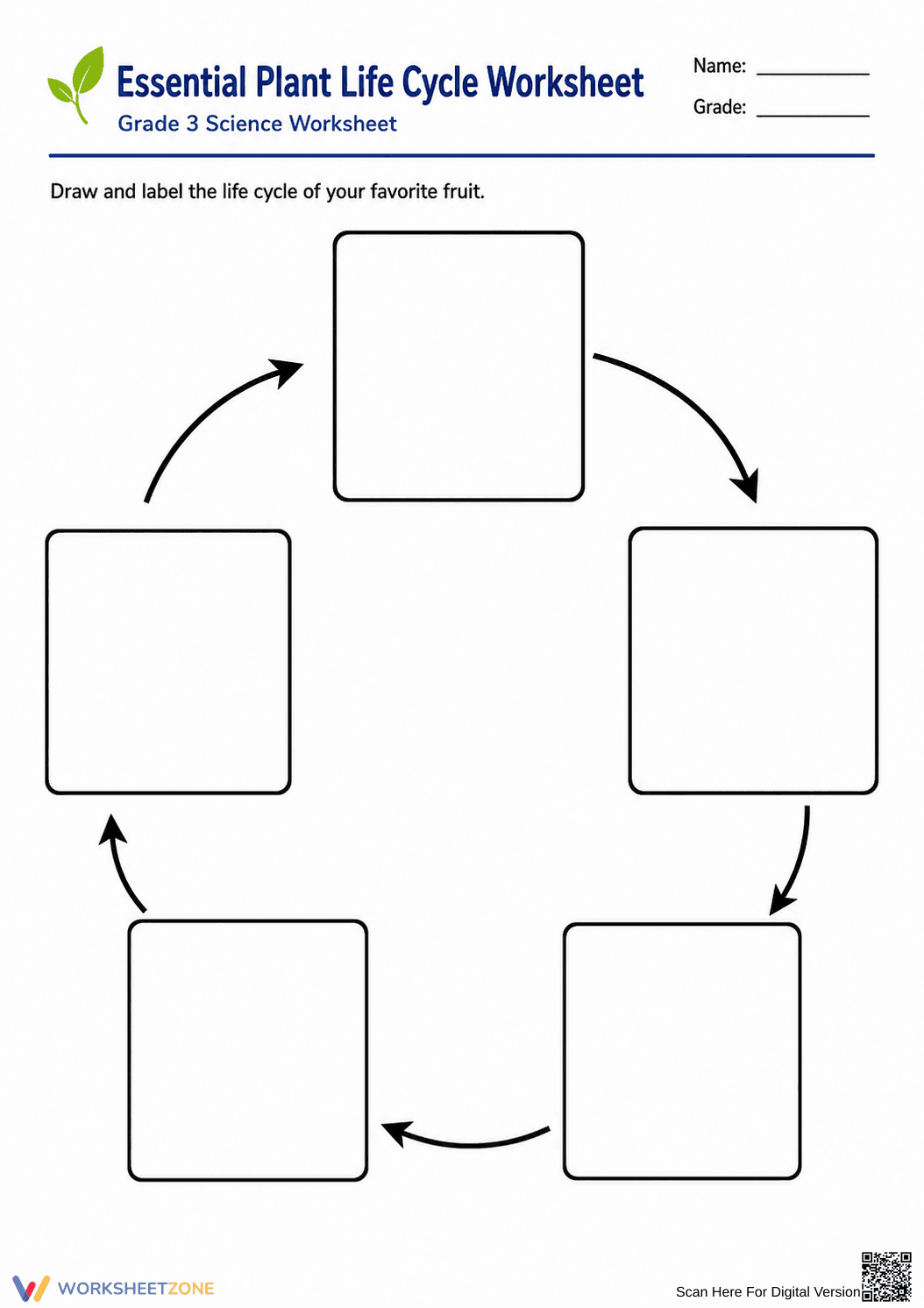
Help students visualize biological growth with this focused plant life cycle worksheet. Students draw and label five distinct stages of a fruit's development, reinforcing key botanical concepts. It is an ideal tool for assessing student understanding of how living things grow and change over time through active modeling.
At a Glance
- Grade: 3 · Subject: Science
- Standard:
3-LS1-1— Develop models to describe that organisms have unique and diverse life cycles- Skill Focus: Plant Life Cycle Stages
- Format: 1 page · 5 tasks · Answer key included · PDF
- Best For: Independent practice or formative science assessment
- Time: 15–20 minutes
This 1-page PDF provides a circular graphic organizer with five interactive boxes. Each box is connected by directional arrows to guide students through a chronological sequence. The open-ended format allows students to choose any fruit, making the lesson personally relevant. A suggested answer key for an apple is provided to assist with grading.
Zero-Prep Workflow
This resource is designed for teacher efficiency. First, print the single-page PDF (30 seconds). Next, distribute the sheets and ask students to select a fruit they know well (1 minute). Finally, review the completed cycles for correct sequencing of seeds, sprouts, and mature plants (1 minute). This zero-prep design makes it a perfect choice for emergency sub plans.
Standards Alignment
This worksheet is aligned to NGSS `3-LS1-1`. This standard requires students to develop models to describe that organisms have unique and diverse life cycles. By drawing and labeling the cycle, students create a conceptual model of biological processes. This code can be copied directly into lesson plans, IEP goals, or district curriculum mapping tools.
How to Use It
Use this during the "Explain" phase of a 5E lesson on living things. It serves as a formative assessment tool; observe if students correctly place the seed at the start and recognize the transition to a fruit-bearing adult. Expect students to complete the drawing and labeling within a 20-minute window.
Who It's For
This resource is tailored for third-grade students but adaptable for second-grade enrichment. It supports visual learners and provides differentiation through the complexity of the fruit chosen. Pair this with a plant life cycle anchor chart or a real-life observation of a classroom bean plant.
According to research analyzed in the RAND AIRS 2024 report, high-quality science instruction in the early grades depends on students creating their own representations of biological phenomena rather than just memorizing facts. This `3-LS1-1` aligned worksheet facilitates this by requiring active modeling of the plant life cycle through drawing and labeling. By engaging with the five stages of growth, students internalize the repeating nature of life cycles, a foundational concept in the life sciences. The use of graphic organizers like this circular model has been shown to improve the retention of sequential information in primary students by over 40 percent compared to text-only instruction. This resource provides a structured yet flexible framework for students to demonstrate mastery of NGSS expectations while developing their scientific communication skills through visual evidence and academic labeling.


