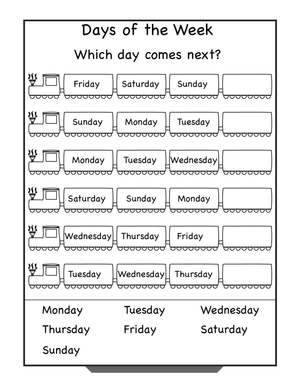
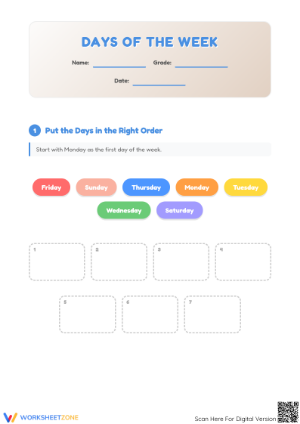
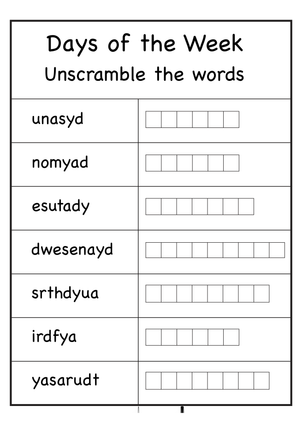
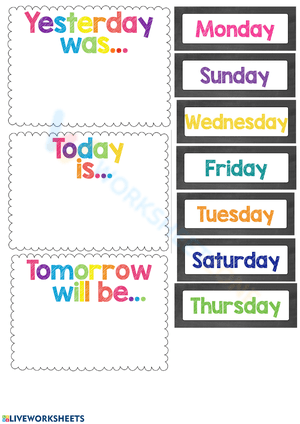
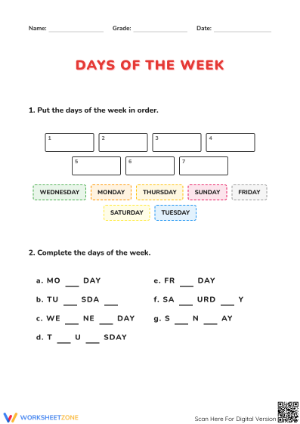
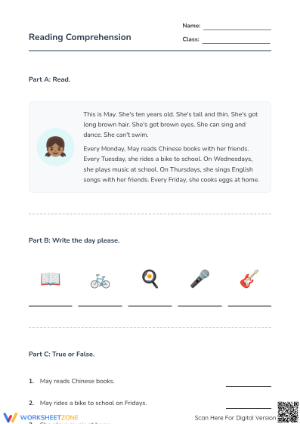
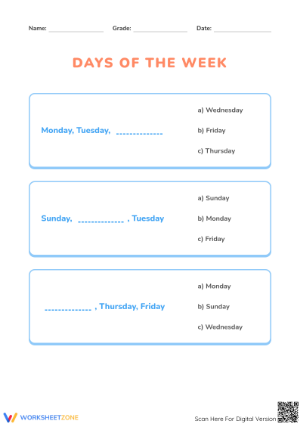
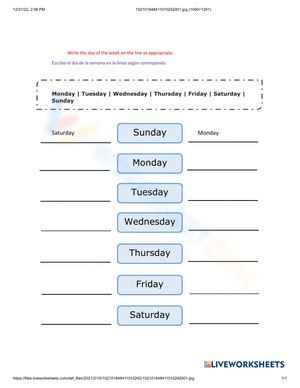
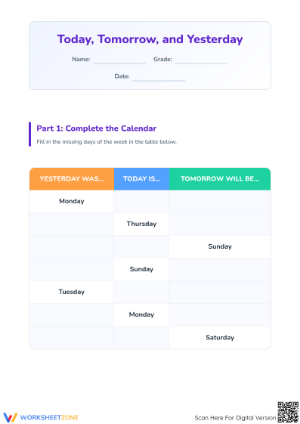
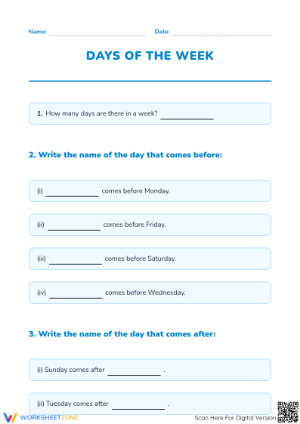
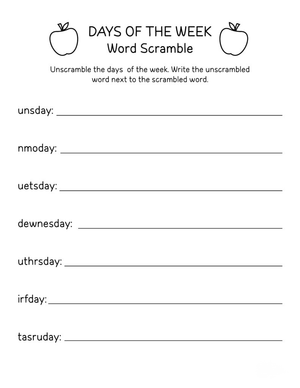
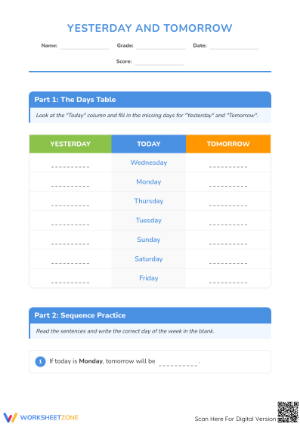
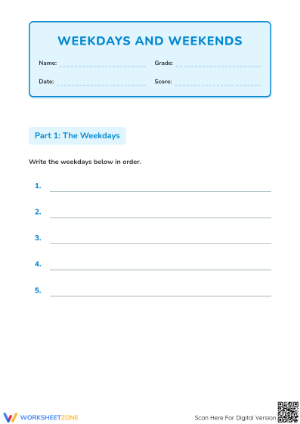
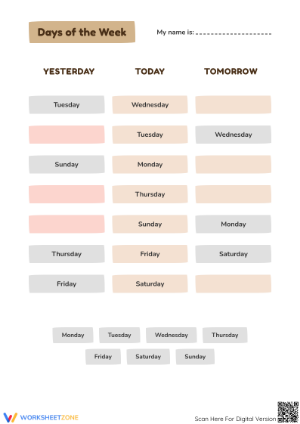
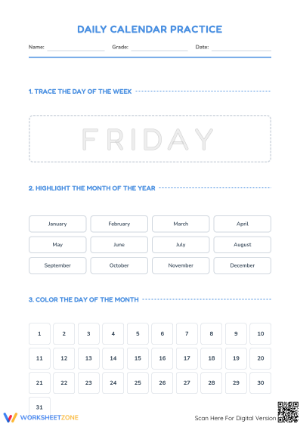
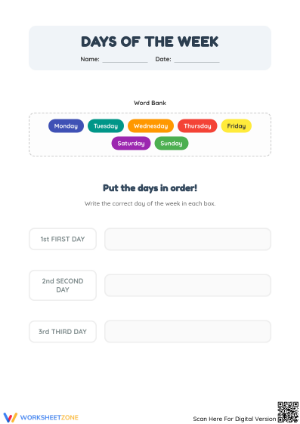
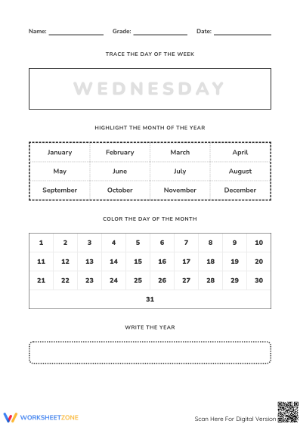
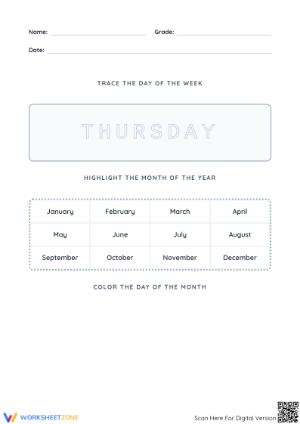
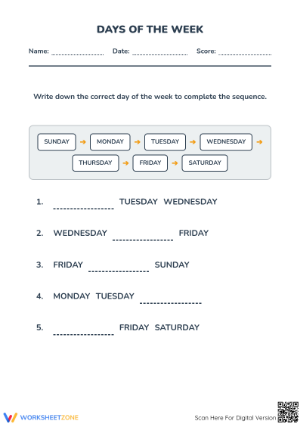
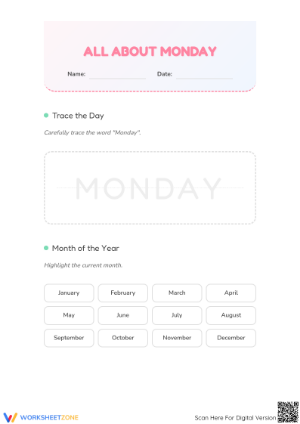
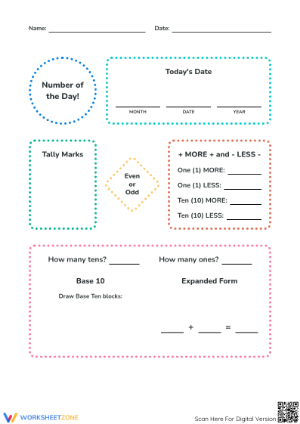
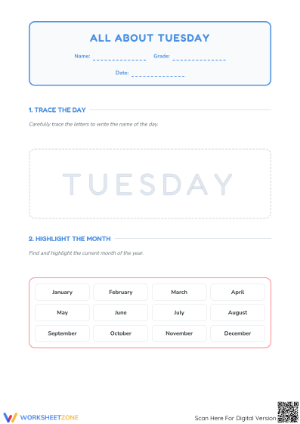
These on weekdays worksheets for 3rd grade give teachers a focused set of practice resources addressing three mechanics skills that converge at this grade level: selecting the correct preposition with days of the week, capitalizing the days as proper nouns, and reading schedule-based passages for specific "when" details. Each worksheet stands on its own — pull one for a morning bell-ringer, run several across an ELA center rotation, or send the set home over a week of homework.
The Specific Skills Targeted
The tasks distribute across the worksheets so each one zeroes in on one or two areas rather than trying to cover all of them at once:
- Choosing on correctly when naming a specific day or group of days — on Monday, on weekdays, on Thursday afternoon — and distinguishing it from in and at
- Capitalizing Monday through Friday as proper nouns, including when the day falls mid-sentence rather than at the start
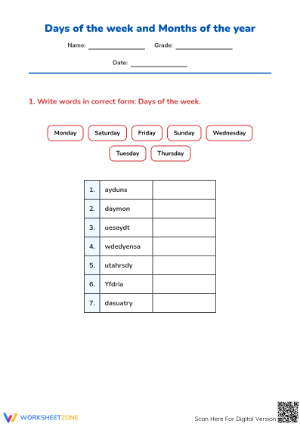
- Spelling Wednesday and Thursday accurately, both of which generate consistent errors in 3rd-grade writing
- Reading a short schedule or daily-routine passage and answering "when" questions by locating specific days in the text
- Writing original sentences or a short paragraph using days of the week with correct capitalization and preposition choice
Mistakes Students Make That These Worksheets Help Teachers Catch
The capitalization error is more specific than it first appears. Students who write "On Monday we had PE" correctly — the day opens the sentence, so the capital is almost automatic — will still write "I have music on wednesday" when the day falls mid-sentence and their attention is on what they're trying to express. That mid-sentence drop is where the error lives, and it persists into 4th grade for students who only ever practiced capitalizing days in the leading position. The editing tasks in this set deliberately bury errors inside longer, content-rich sentences to catch exactly this pattern.
Preposition errors divide into two predictable types. Some students drop the preposition entirely — "I go to soccer Fridays" — and some substitute in, overgeneralizing from "in the morning" or "in the afternoon." Both patterns show up in free writing even when a student looks clean on an isolated fill-in-the-blank. Several worksheets address this by presenting "in," "at," and "on" as explicit answer choices rather than leaving an open blank, which forces students to compare the options actively instead of writing whatever they already expect.
Wednesday and Thursday spelling errors are consistent enough to anticipate. "Wendsday" and "Thurdsday" appear most often — students insert consonant clusters that track the pronunciation more closely than the actual spelling. A few worksheets include a targeted editing task focused specifically on these two days.
Standard Alignment
L.3.2 — Language: Conventions of Standard English — is the primary anchor here. Each on weekdays worksheets for 3rd grade resource addresses this standard from two angles: recognition tasks where students locate and correct capitalization errors, and production tasks where they apply the rule inside their own writing without a model in front of them. Both formats matter, because students who can spot an error in someone else's sentence don't always catch the same error in their own.
Several worksheets also connect to RI.3.1, which asks students to ask and answer questions using explicit textual evidence. The schedule-reading passages in the set — short, clearly organized texts about a character's weekly routine — give students low-stakes practice locating specific details before they encounter that standard in longer, more complex informational texts where the same skill is higher stakes.
Fitting These Worksheets Into Your Weekly Lesson Plan
Morning entry is the most practical placement. Most on weekdays worksheets for 3rd grade tasks take 8 to 12 minutes for an average third grader working independently, which fits cleanly into the gap between the first bell and morning meeting. Classrooms that already run a daily calendar routine get an extra alignment benefit — handing out the worksheet right after the group writes the date on the board gives students a warm-up connected directly to what they just discussed together.
During small-group rotation, the set works at an independent station without ongoing teacher support. That matters when you're with a guided reading group and cannot circulate. Each worksheet carries directions specific enough that students can manage the task on their own and reach a clear endpoint, so no one sits with a blank page wondering what comes next.
Later in the unit, the open-ended writing prompts work well as a formative check. A prompt like "Write about your Wednesday after school" requires students to use correct capitalization and preposition choice inside their own prose — and that's where you see whether the mechanics actually transferred. Students who revert to "on wednesday" or drop the preposition entirely in a narrative reveal that the rule hasn't stuck yet, even when their isolated worksheet work looked clean.
Adjusting the Set Across a Range of Learners
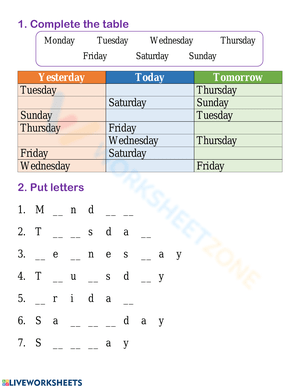
For students still working on basic decoding or spelling, the matching and fill-in-the-blank worksheets reduce the writing load and keep the focus on recognition and choice. These students can demonstrate understanding of "on Monday" versus "in Monday" without also having to produce complete sentences from scratch.
Students who have already internalized capitalization rules don't gain much from another editing hunt through a paragraph of predictable errors. Move them toward the reading comprehension worksheets and the narrative writing prompts. A student who consistently writes "On Fridays, I..." automatically doesn't need another mechanics drill — they need to sustain that correct grammar across longer, more demanding writing where content and organization are competing for attention.
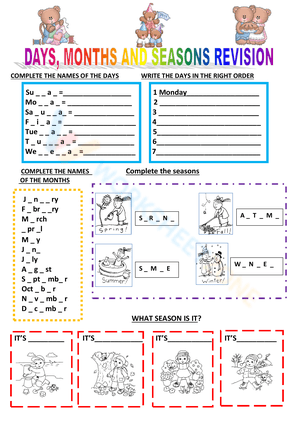
For ELL students, the preposition question is harder than it looks because prepositions of time don't transfer from most home languages. In Spanish, no preposition is used with days of the week — "los lunes voy al parque" covers "on Mondays I go to the park" without any equivalent of "on." Mandarin uses a different construction as well. The worksheets that include a small calendar graphic next to each day name give these students a visual anchor for the concept. Some teachers extend this by keeping a physical classroom calendar accessible during on weekdays worksheets for 3rd grade practice — pointing to the actual day's square as students write "on Monday" reinforces the spatial logic behind English preposition choice in a way a written rule on the board cannot replicate.
Frequently Asked Questions
Do these worksheets work for ELL students still building basic calendar vocabulary?
The worksheets with visual supports — calendar icons, pictures of activities paired with day names — work better for beginners than the text-heavy reading passages. Starting with matching tasks and fill-in-the-blank exercises gives new English learners a manageable entry point before asking them to read and interpret a full paragraph.
What if my students already know to capitalize days of the week?
The preposition choice exercises and the reading comprehension worksheets still offer real practice. Students who capitalize correctly often still drop the preposition in free writing — "I go Fridays" instead of "I go on Fridays" — or struggle to locate specific "when" information in a schedule passage. Those worksheets remain useful for students who are ready to work past the basic capitalization drill.
Can these be sent home for homework without extra teacher explanation?
The editing and fill-in-the-blank worksheets travel well independently — directions are specific enough that most 3rd graders can work through them without guidance. The narrative writing prompts benefit from a short classroom launch first, since open-ended prompts can stall without some initial discussion about what to write and how to start.












 Interactive Worksheet Maker
 Quiz Maker
 Word Search Maker
 Crossword Puzzle Maker
 Word Scramble Generator
 Sentence Scramble Generator
 Handwriting Worksheet Generator
 Name Tracing Generator
 Fill In The Blank Generator