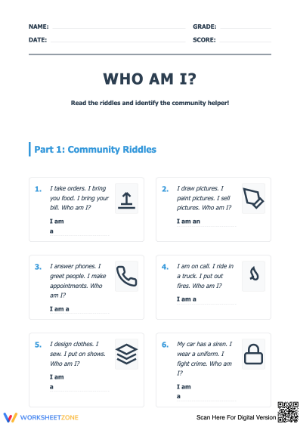
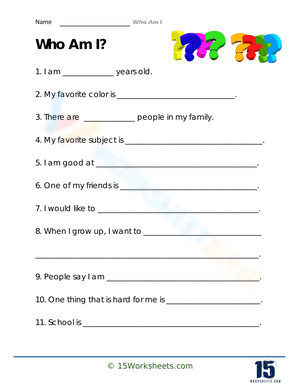
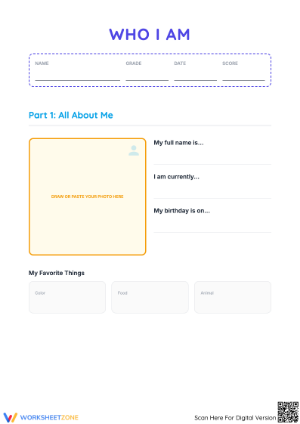
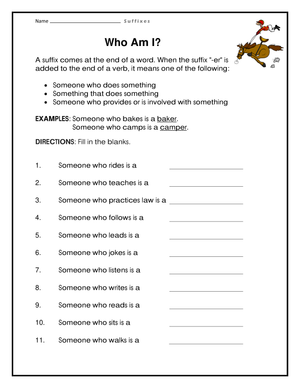
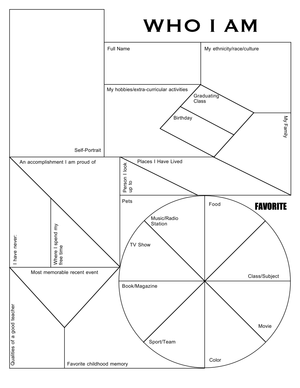
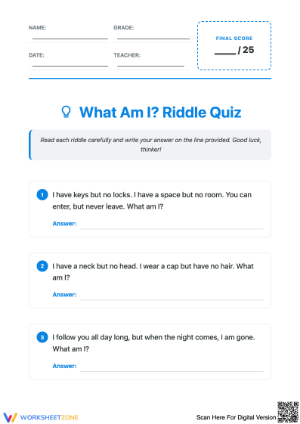
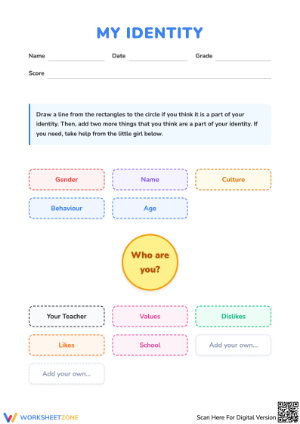
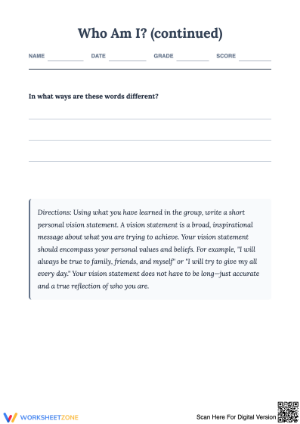
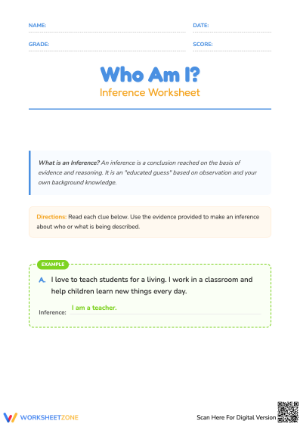
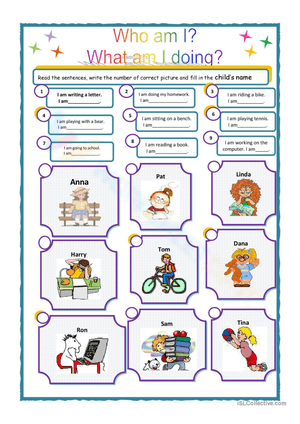
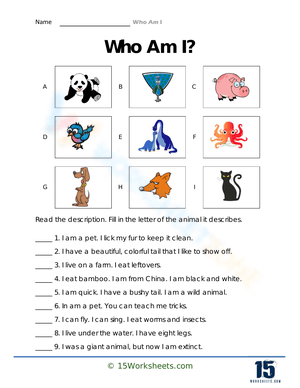
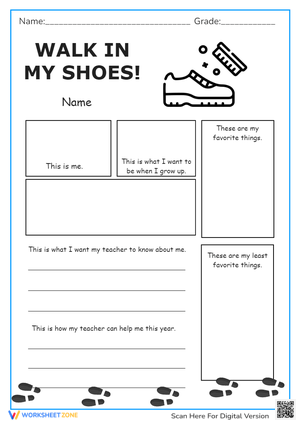
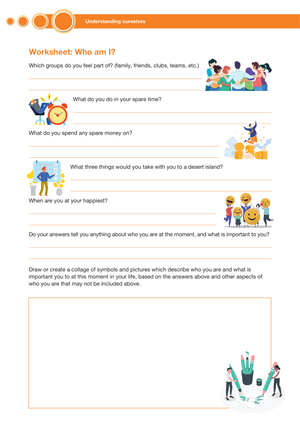
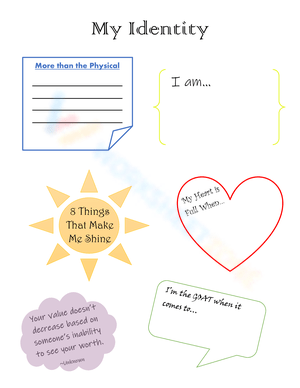
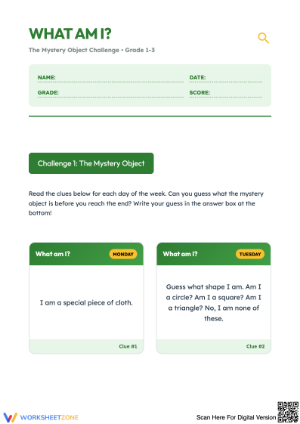
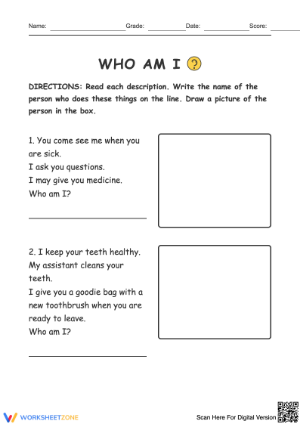
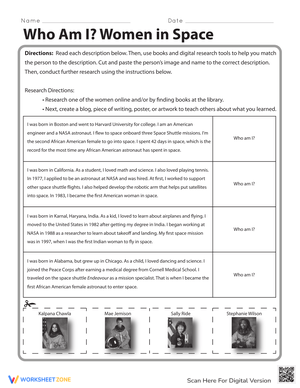
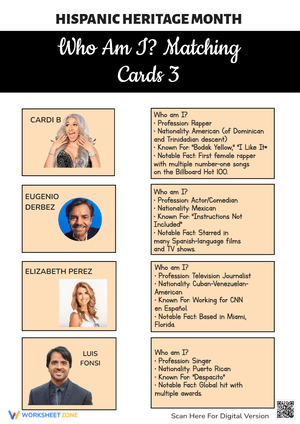
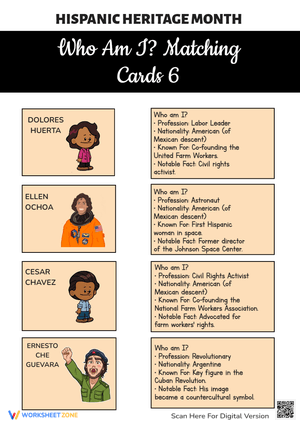
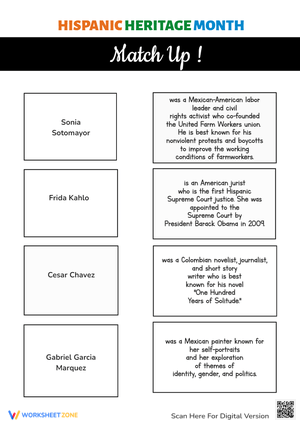
These 3rd grade who am i worksheets put inference at the center of the lesson without making it feel like a formal skill drill — students are just solving a riddle. Each worksheet presents a sequence of clues about an animal, community helper, historical figure, or natural phenomenon, and students weigh those clues against each other to arrive at a single answer. The cognitive process behind that — holding each clue in memory, reconsidering a first guess when the next clue doesn't fit — is exactly the kind of deliberate reading third-grade teachers are trying to build.
What Students Practice Across the Set
Third grade is the year inference instruction shifts from incidental to explicit. Students are now expected to reason from textual evidence rather than recall surface details, and the riddle format makes that expectation concrete. There's no main-idea sentence to copy, no literal recall question to fall back on — every answer requires reasoning from the clues given.
Students work through each worksheet by:
- reading clues in sequence while holding earlier ones in working memory
- narrowing a field of possible answers as new clues accumulate
- distinguishing between physical traits, behavioral characteristics, and habitat or contextual clues as distinct categories of evidence
- committing to an answer and identifying which specific clue clinched it
That last step matters most. Students who can name the tipping clue — "It was the echolocation part that ruled everything else out, not just the flying" — have internalized inference as a reasoning strategy rather than a lucky guess.
Frequent Errors Worth Watching For
The most consistent error is premature closure. A student reads the first clue, forms an answer, and then treats every clue that follows as confirmation rather than new evidence. In practice: "I have a hard shell and I move very slowly" earns the answer turtle. Then the student reads "I carry my home on my back and leave a trail of slime" — and still writes turtle, because that answer is already locked in. The slime clue should have triggered a revision to snail, but students who've stopped actively reading don't catch it. The error is invisible to them.
A second pattern worth anticipating: students over-weight physical description clues. They tend to trust "I am large and brown" more than "I hibernate through winter and survive mostly on berries," even though the behavioral clue is far more specific. A quick think-aloud helps here — ask students to count how many animals could match clue one versus how many could match clue three. Seeing the numbers forces the point better than any explanation of what makes a clue "strong."
Standard Alignment
The primary standard at work is CCSS.ELA-LITERACY.RL.3.1: asking and answering questions to demonstrate understanding of a text, with explicit textual support. A riddle frames "Who am I?" as the comprehension question, and every clue is the text students must cite. In classroom terms, this standard surfaces most directly during reading conferences, when teachers ask students to point to evidence for a claim — the riddle format builds that reflex in a setting where students are willing to revise their thinking out loud rather than defend a wrong answer in writing.
Vocabulary standards L.3.4 and L.3.6 apply when riddles introduce domain-specific or academic vocabulary in context — "nocturnal," "legislature," "metamorphosis," "camouflage." Students encounter those terms as clues, which gives them a functional reason to decode the word rather than skip past it. RI.3.1 applies when riddle subjects are drawn from science or social studies content, which most animal and community-helper sets naturally do.
How to Work These Worksheets Into Your Teaching Week
Monday morning work is the most dependable entry point. Students arrive with varying readiness, and a riddle asks them to think without demanding a writing output. That warm-up also gives teachers an early read — before the lesson begins — on which students are reasoning from evidence and which are still committing to answers after the first clue alone.
For small-group instruction, 3rd grade who am i worksheets give teachers a short, controlled text for modeling the think-aloud process. Reading each clue aloud and pausing to name what gets ruled out — "This clue says it lives in cold ocean water, so I can eliminate the desert tortoise and the barn owl" — shows students what inference looks like as it happens. That kind of live demonstration is harder to pull off inside a two-page informational passage where too many variables are moving at once.
Exit tickets are another reliable spot. After a science unit on animal adaptations, a riddle about a specific organism quickly checks whether students retained the vocabulary and conceptual knowledge from instruction — and the format is fast to score before the next group walks in. One variation worth trying when engagement is low: post riddle cards around the room and give students a numbered recording sheet. They move from station to station, record each answer, and write one supporting clue next to it. The one-clue justification keeps students accountable for their reasoning rather than just moving around the room.
Adapting the Set for Mixed-Ability Classrooms
For students working below grade level, the most effective adjustment is limiting the answer field rather than simplifying the clues. Give three possible answers at the top of the worksheet — "Is it an owl, a penguin, or a butterfly?" — so students use process of elimination without having to generate an answer from open recall. This keeps the inferential thinking intact while reducing the retrieval demand that often stops struggling students before they've begun to reason. Visual supports alongside the clues help as well, particularly for English Language Learners who may know the concept but not yet the specific English term.
For advanced students, riddle-writing is the extension that genuinely tests depth of understanding. To write a working riddle, a student must identify the subject's most distinctive characteristics, sequence clues from general to specific, and anticipate which wrong answers their wording might accidentally support. That last step — revising a clue because it applies to too many things — requires real precision. Students who write riddles that are either too obvious or too obscure learn more from hearing classmates struggle with them than from any direct lesson on word choice.
When 3rd grade who am i worksheets are used across ability groups in the same room, the most sustainable approach keeps the content topic consistent — same animal family, same social studies unit theme — while adjusting clue specificity across versions. That way the whole class can debrief together even if the individual worksheets differed in difficulty.
Frequently Asked Questions
Do these worksheets work in science and social studies, or only during the literacy block?
They work across content areas, and often most effectively outside ELA. Science riddles about animal adaptations, biomes, or the water cycle give students a reason to retrieve and apply vocabulary from earlier unit instruction. Social studies sets covering community helpers, landforms, or historical figures work the same way. The format doesn't require a reading lesson — it requires content knowledge, which makes it a natural review tool after any unit. Teachers who use these as post-unit formative checks often find that students who seemed disengaged during direct instruction will work hard on a riddle covering the same material.
How much class time does each worksheet take?
Most students finish in five to eight minutes — enough for a focused warm-up or transition without cutting into instructional time. If a student regularly takes much longer, it's worth looking at why. It usually signals either unfamiliar vocabulary in the clues or the premature-closure pattern described above, both of which are worth addressing directly rather than just moving on.
Are these appropriate for English Language Learners?
The format is genuinely useful for ELL students because each clue is short, self-contained, and connected to a real-world referent students can often picture even when the English term is new. Pairing 3rd grade who am i worksheets with a visual word bank — pictures of possible answer choices, each labeled — gives students enough language support to stay in the reasoning task without removing the thinking challenge. The predictable structure also lowers the anxiety that comes with open-ended comprehension questions, which helps ELL students participate more confidently in both individual and partner work.












 Interactive Worksheet Maker
 Quiz Maker
 Word Search Maker
 Crossword Puzzle Maker
 Word Scramble Generator
 Sentence Scramble Generator
 Handwriting Worksheet Generator
 Name Tracing Generator
 Fill In The Blank Generator