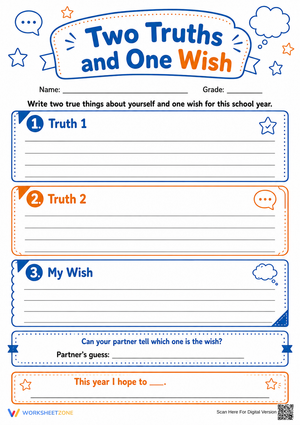
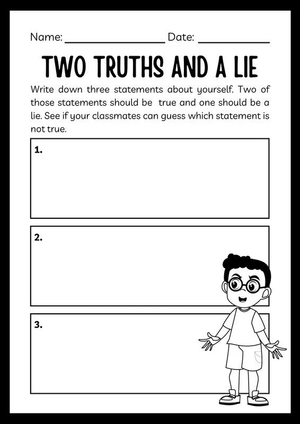
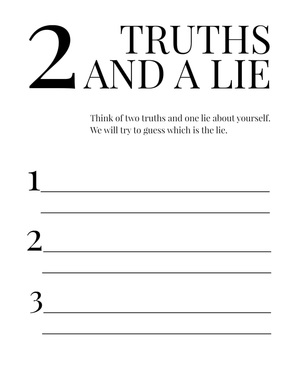
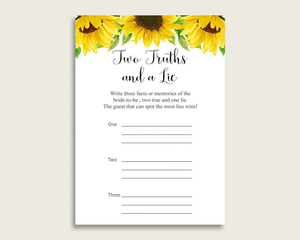
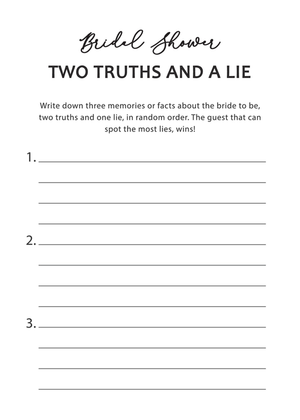
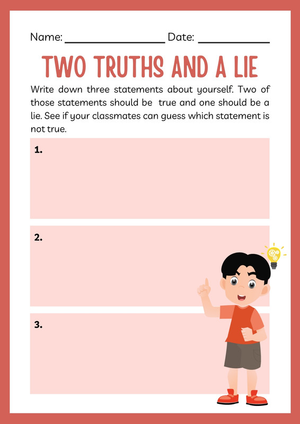
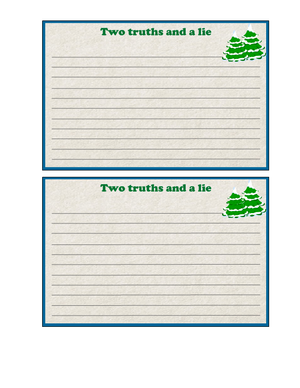
These 3rd grade two truths and a lie printable worksheets reframe a familiar speaking game as a structured writing task — one where the audience is real, the stakes feel genuine to eight-year-olds, and the writing has to do actual persuasive work. Each worksheet gives students a framework for composing three declarative sentences: two accurate personal statements and one convincingly false one. The writing is the point. The game is what makes students care enough to revise until the sentences hold up.
Skills These Worksheets Build
The task looks deceptively simple and turns out to be genuinely demanding. Students can't write vague sentences and expect the game to work — "I like animals" tells nobody anything and any statement could be the lie. The worksheet format pushes toward specificity: each statement has to be particular enough to sound true and plausible enough that the false one could be hiding anywhere in the set of three. In practice, students are working on:
- Writing complete declarative sentences with correct end punctuation
- Choosing concrete details over general claims — not "I have a pet" but "I have a pet iguana named Carl"
- Drafting with audience awareness, asking whether a classmate could actually believe each statement
- Distinguishing factual from invented content, a skill that transfers directly into reading comprehension tasks
- Revising for clarity before a public share — one of the harder writing habits to establish in third grade
The oral component adds a sustained layer of speaking and listening work. When students read their statements aloud and the class debates which is false, that conversation develops collaborative discussion skills that carry over into science labs and small-group reading work later in the year.
Student Mistakes Worth Catching Before Sharing Begins
The most consistent error: students write a lie that is physically impossible rather than merely false. "I have a pet dragon" defeats the purpose entirely — nobody deliberates, nobody learns anything about the writer, and the game collapses into a joke. Eight-year-olds often hear "lie" and think "fantasy," which is a reasonable interpretation that needs direct correction through modeling before worksheets go out. The clearest fix is a teacher-generated counterexample on the board. Show what it looks like when the lie is something like "I have two older sisters" — an ordinary, entirely believable claim that requires real thought to disprove. That comparison clicks faster than any explanation.
A second pattern shows up in the truths column: students write statements so private that classmates have no basis for guessing. "My cousin's middle name is James" is technically a truth, but it gives the class nothing to work with. Good truths have some chance of being known or estimated — things about pets, favorite foods, sports, and places tend to generate the right level of deliberation. Name this explicitly during the teacher model so students understand that audience awareness applies to the truthful statements, not just the lie.
Fitting These Worksheets Into Your Instructional Week
The obvious placement is morning meeting in late August or early September, but these 3rd grade two truths and a lie printable worksheets stretch well beyond the first week. Limiting sharing to two or three students per morning extends the activity across two to three weeks, which turns it into a consistent low-pressure speaking routine rather than a one-time event. That pacing also helps quieter students: they watch several rounds before their own turn, which is meaningfully different from being asked to stand up and speak on day one when the room is still unfamiliar.
Small-group literacy centers offer a genuinely different context worth using deliberately. With four or five peers instead of twenty-four, sharing feels less exposed. While one group works at the center, a teacher pulling a guided reading group can listen to the statements being shared nearby and note which students write fragments versus complete sentences, and which students chose details with enough specificity to carry real persuasive weight. That's a formative snapshot that's difficult to collect during whole-class instruction.
One addition that earns its time: require students to write a brief reveal paragraph — two or three sentences — explaining why the lie is false and adding more detail about the two truths. Most third graders write minimal sentences that are technically correct but say very little. The reveal paragraph forces them to keep writing after the period, which is exactly where elaboration practice needs to happen for this age group.
Standard Alignment
CCSS.ELA-Literacy.SL.3.1 asks students to engage effectively in collaborative discussions, building on others' ideas and expressing their own clearly. The guessing phase of this activity is a sustained exercise in exactly that standard — students listen, evaluate, and argue their reasoning before a decision is made. It is not performative collaboration; the outcome is genuinely unknown to everyone except the presenter, which gives the discussion real purpose and keeps the room attentive.
CCSS.ELA-Literacy.W.3.3 covers narrative writing, specifically the ability to use details, description, and craft to convey real or imagined experiences. The false statement is an act of narrative invention: students must construct a claim that sounds true, which means attending to the same specificity and plausibility that any narrative writer uses. Higher-performing writers can be asked to apply W.3.3 criteria explicitly to how they build the lie. Collected after sharing, the worksheets function as an early-year writing sample — check sentence completeness, capitalization, punctuation, and specificity of detail as a low-pressure formative measure from the first two weeks of school.
Taking the Format Into Subject-Area Review
The personal icebreaker version is the natural entry point, but these 3rd grade two truths and a lie printable worksheets repeat well across the year when applied to academic content. Students write statements about a current science or social studies unit instead of personal facts. A student reviewing animal adaptations might write: 1. Desert tortoises store water in their bladder. 2. Arctic foxes grow white fur in winter. 3. Camels store water in their humps as liquid. Identifying statement 3 as misleading requires understanding the concept — camels store fat, not liquid water — which is far more demanding than simple recall. Students have to know the material well enough to construct a plausible-sounding error, and that is a different cognitive load than answering a worksheet question.
In math, the format works cleanly for multiplication fact review. Two correct equations and one incorrect one from the same fact family — say, the sevens — forces students to compute carefully before writing, because the false equation has to look reasonable. That computation is retrieval practice wearing the costume of a game, and the stakes of the guessing phase make students check their work in a way that a standard drill does not.
Adjusting the Worksheets for Writers at Different Levels
Students who struggle with writing often freeze when asked to generate content from nothing. Before they work independently, provide a short word bank of specific nouns — pet names, food names, activity names — that they can draw from when building their sentences. The three-line structure of each worksheet is simple enough that students working below grade level in writing can produce a complete attempt without the blank-stare paralysis that kills the first ten minutes of writing time. Keep the expectation fixed — three complete sentences — but support the idea-generation step.
Students who move through the basic task quickly can go further in a few different directions. Ask them to write a fourth statement — also a truth — so that a partner has to identify the lie across four options instead of three. Alternatively, have them write a paragraph defending the lie before the reveal: why did they choose it, what details did they include to make it convincing, and what does the true version look like? That metacognitive writing task is genuinely challenging and builds the kind of craft awareness that carries into persuasive and narrative writing across the rest of third grade.
Frequently Asked Questions
How do I introduce this activity to students who have never encountered it?
Model it yourself before anything is distributed. Write three statements about your own life on the board — two accurate, one false — and let the class vote. The voting process teaches the concept faster than any verbal explanation because students experience the deliberation firsthand. After the reveal, tell them they will be doing the same thing using their own worksheets. Students who see the teacher stumped when the class picks the wrong statement immediately understand the goal: make the lie hard to spot.
What makes a lie work well at this grade level?
The best lies are specific and mundane — the kind of fact a classmate might plausibly know. "I have a dog named Biscuit" works as a lie; "I can run a four-minute mile" does not, because no third grader believes it. During the teacher model, explicitly contrast a statement that creates real doubt with one that anyone can eliminate immediately. Encourage students to base their lie on something that almost happened or something they wish were true — that proximity to real experience is what makes it genuinely convincing.
How can these worksheets double as a formative writing assessment?
Collecting each worksheet after sharing gives you a first writing sample for the year with essentially no test anxiety attached. Look for sentence completeness, correct capitalization at the start of each statement, and appropriate end punctuation. Notice whether students chose general or specific details — that distinction reveals something about their sentence-level writing maturity that shows up again in every writing unit through June. The 3rd grade two truths and a lie printable worksheets function as a quiet diagnostic without ever feeling like one to students.
Does this format hold up for content-area review later in the year, or does it get old?
The constraint of writing a plausible misconception rather than a random false statement is what gives the format lasting academic value. When students have to construct a lie that sounds scientifically or mathematically reasonable, they reveal what they actually understand about the content — and where their understanding has gaps. That diagnostic value appears on the teacher's side of the activity, not the student's, which is why it keeps working in October the same way it worked in August.












 Interactive Worksheet Maker
 Quiz Maker
 Word Search Maker
 Crossword Puzzle Maker
 Word Scramble Generator
 Sentence Scramble Generator
 Handwriting Worksheet Generator
 Name Tracing Generator
 Fill In The Blank Generator