


























Views
Downloads

Number of the Day Worksheet | Grade 3 Printable
Paste this activity's link or code into your existing LMS (Google Classroom, Canvas, Teams, Schoology, Moodle, etc.).
Students can open and work on the activity right away, with no student login required.
You'll still be able to track student progress and results from your teacher account.
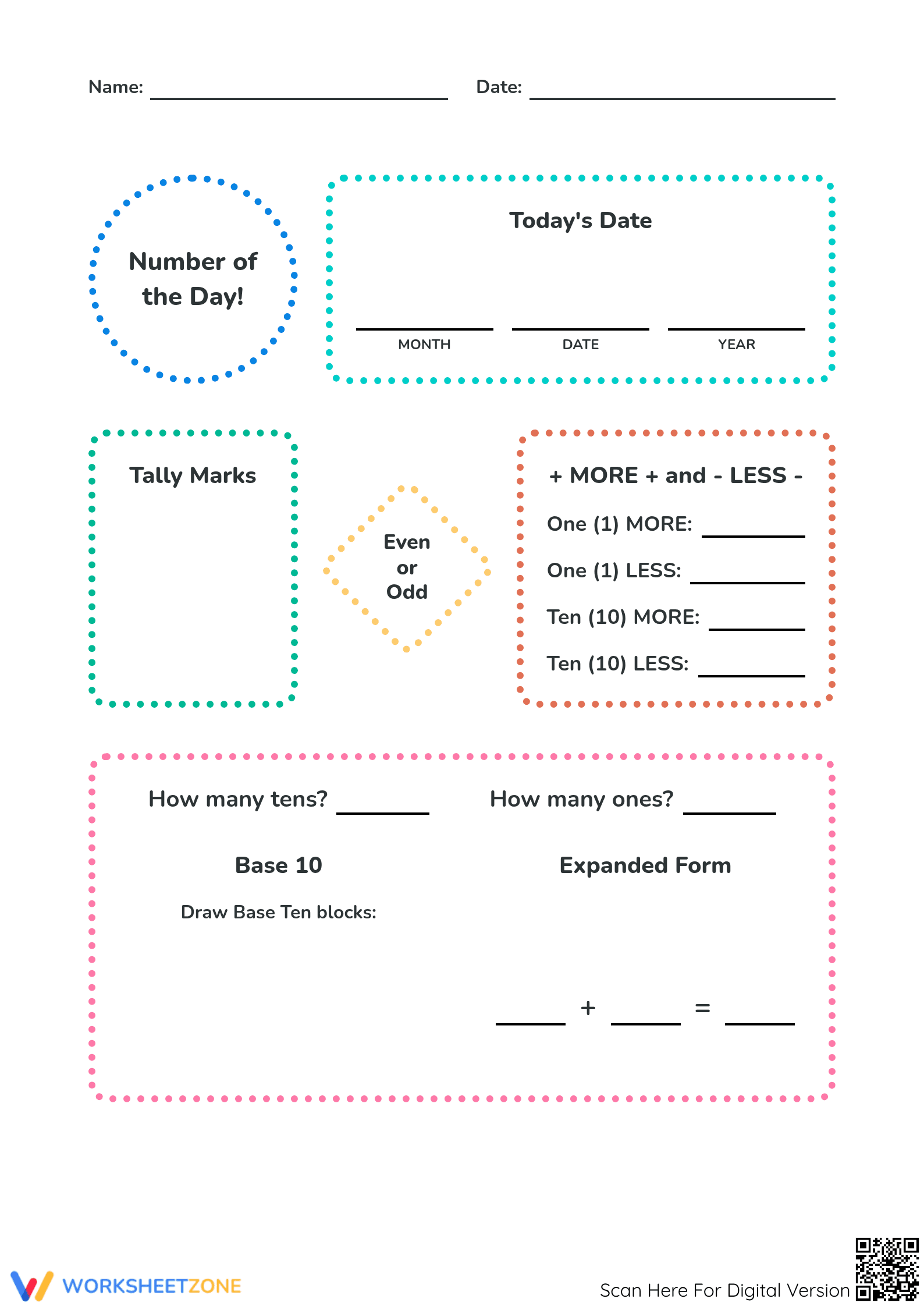
This printable Number of the Day worksheet gives students a structured daily routine to build foundational number sense and place value skills. By breaking down a single number into tally marks, expanded form, and base-ten representations, learners develop deep mathematical fluency and confidence before moving into complex operations.
At a Glance
- Grade: 3 · Subject: Math
- Standard:
CCSS.MATH.CONTENT.3.NBT.A.2— Add and subtract using place value strategies- Skill Focus: Place Value and Number Sense
- Format: 1 page · 8 problems · No answer key · PDF
- Best For: Morning work or math warm-ups
- Time: 10–15 minutes
This single-page resource features eight task areas designed to analyze a chosen number. Students record the date, draw tally marks, determine even or odd, and calculate ten more, ten less, one more, and one less. The bottom section requires students to identify tens and ones, sketch base-ten blocks, and write the number in expanded form.
Zero-Prep Workflow
- Print (1 minute): Select a target number and print a class set of this single-page PDF.
- Distribute (1 minute): Hand out as students enter for an immediate, independent morning routine.
- Review (3 minutes): Quickly go over answers as a whole group. Total teacher prep time is under two minutes, making this an excellent option for sub plans.
Aligned to CCSS.MATH.CONTENT.3.NBT.A.2, this worksheet supports students as they fluently add and subtract within 1000 using strategies and algorithms based on place value. It also reinforces foundational skills from earlier grades, such as mentally finding ten more or ten less. Both standard codes can be copied directly into lesson plans, IEP goals, or district curriculum mapping tools.
Use this resource as a daily morning bell-ringer to settle students into the math block. Write a two- or three-digit number on the board and have students complete the sheet independently before direct instruction begins. As a formative assessment tip, walk the room while students draw their base-ten blocks; this quickly reveals which learners are still struggling with grouping tens and ones. Expect students to complete the tasks in 10 to 15 minutes.
This worksheet is primarily designed for third-grade students solidifying their place value understanding, but it serves as an excellent intervention tool for fourth and fifth graders who need foundational review. Teachers can easily differentiate by assigning larger, more complex numbers to advanced students while keeping struggling learners focused on two-digit numbers. It pairs perfectly with physical base-ten manipulatives or a classroom hundreds chart.
Consistent daily practice with place value routines significantly impacts long-term mathematical proficiency and student confidence. According to EdReports 2024, instructional materials that provide repeated, structured opportunities to decompose numbers build the necessary cognitive framework for advanced arithmetic and complex problem-solving. By aligning with CCSS.MATH.CONTENT.3.NBT.A.2, this resource ensures students actively add and subtract using place value strategies rather than relying solely on rote memorization or standard algorithms before they are developmentally ready. Engaging with multiple mathematical representations—such as expanded form equations, visual base-ten drawings, and mental math calculations like ten more or ten less—strengthens the neural pathways associated with quantitative reasoning. This specific daily routine transforms abstract numerical concepts into concrete, manageable tasks for young learners, fostering a deeper, more resilient understanding of base-ten systems that is absolutely essential for future algebraic thinking and higher-level mathematics.


