


























Views
Downloads

Grade 1 Days of the Week — Printable No-Prep Worksheet
Paste this activity's link or code into your existing LMS (Google Classroom, Canvas, Teams, Schoology, Moodle, etc.).
Students can open and work on the activity right away, with no student login required.
You'll still be able to track student progress and results from your teacher account.
This printable Grade 1 English Language Arts worksheet helps students master the days of the week through engaging vocabulary and spelling activities. By completing these targeted exercises, young learners will confidently sequence, spell, and write the days of the week, building essential foundational literacy and calendar skills.
At a Glance
- Grade: 1 · Subject: English
- Standard:
CCSS.ELA-LITERACY.L.1.2.A— Capitalize dates and names of people.- Skill Focus: Days of the week vocabulary and spelling
- Format: 2 pages · 3 tasks · Answer key included · PDF
- Best For: Independent practice and morning work
- Time: 15–20 minutes
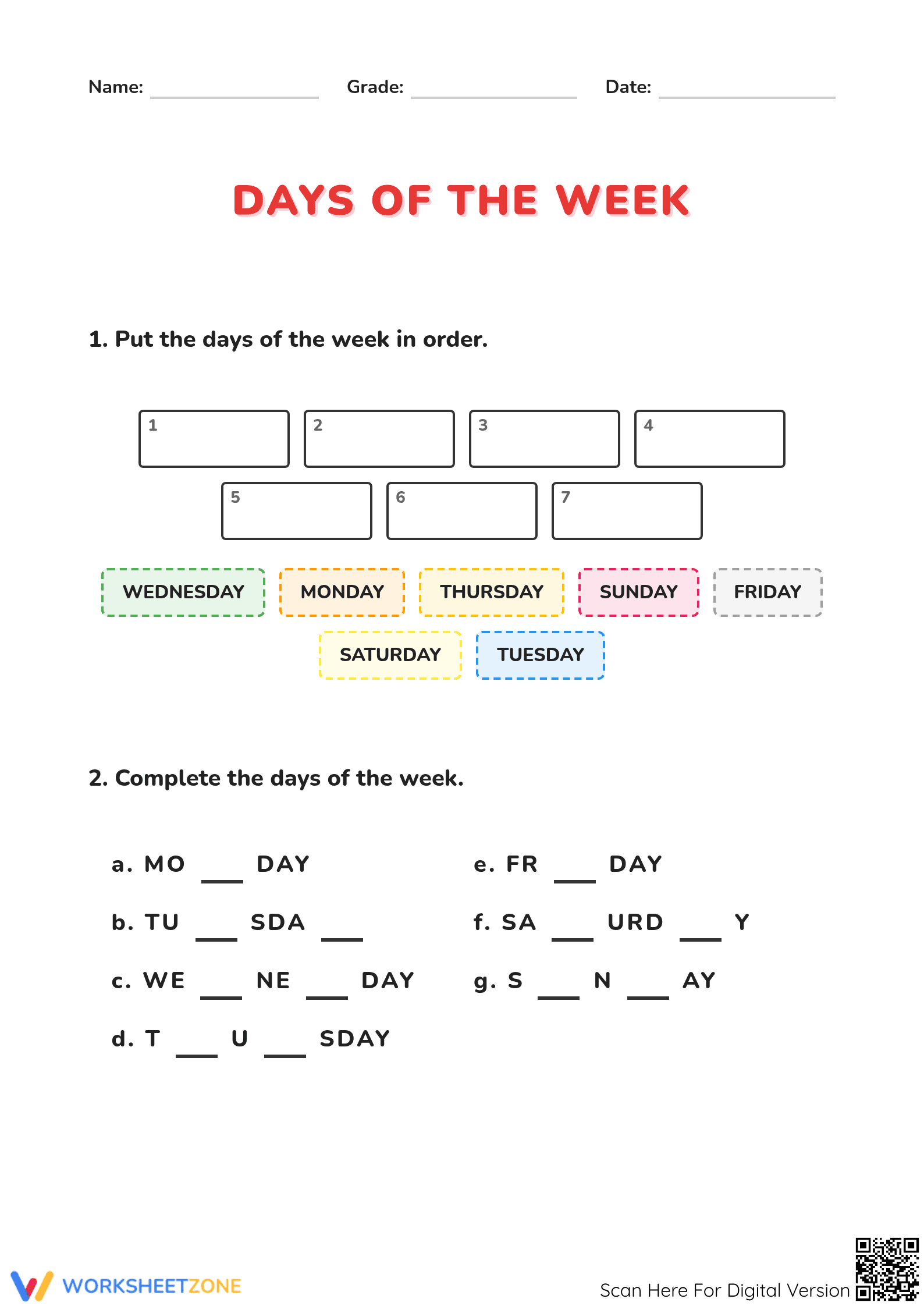
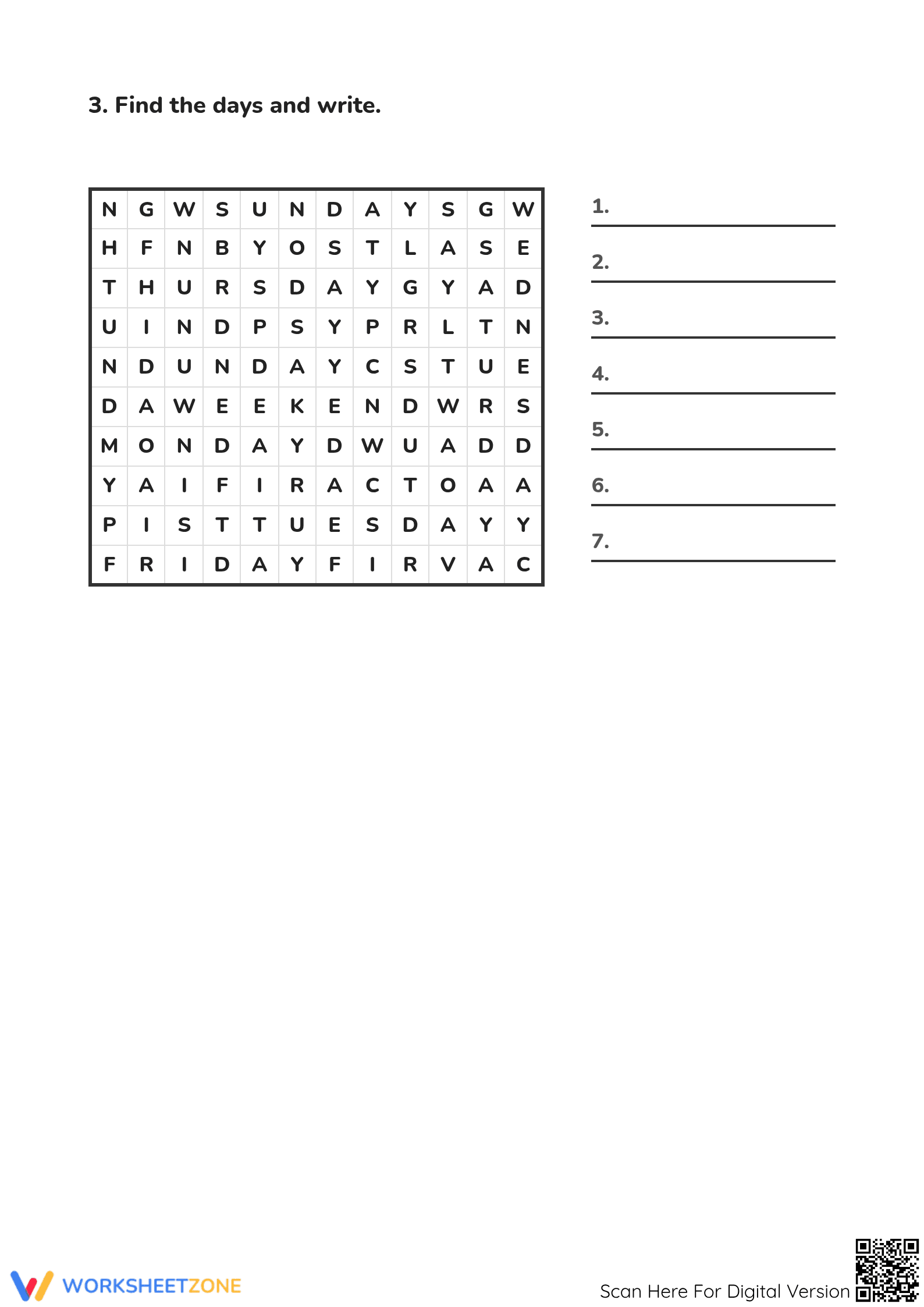
This two-page resource features three task types to reinforce calendar vocabulary. Students begin by sequencing the seven days in chronological order using a word bank. Next, a fill-in-the-blank section challenges learners to supply missing letters. Finally, a word search puzzle reinforces visual recognition, paired with a writing section. A complete answer key is included.
Zero-Prep Workflow
This resource requires minimal teacher preparation:
- Print (1 minute): Simply download the PDF and print the two-page student worksheet. The answer key is on a separate page for easy reference.
- Distribute (1 minute): Hand out during morning work or literacy centers. No extra materials needed.
- Review (3 minutes): Use the included answer key to quickly check student work or project it on the board for self-correction.
With prep time under two minutes, this is perfect for sub plans.
Standards Alignment
Aligned to CCSS.ELA-LITERACY.L.1.2.A, this worksheet requires students to capitalize dates and names of people. By practicing the spelling and capitalization of the days of the week, students build foundational skills for calendar writing. Both standard codes can be copied directly into lesson plans, IEP goals, or district curriculum mapping tools.
How to Use It
This versatile worksheet fits perfectly into morning routines or literacy centers. Assign it as independent practice after a whole-group calendar math session or direct instruction on the days of the week. It typically takes students 15 to 20 minutes to complete all three sections. For a quick formative assessment, observe how students tackle the fill-in-the-blank spelling section; this will reveal whether they are relying on phonetic spelling or have memorized the conventional spelling patterns of these frequently occurring irregular words.
Who It's For
This resource is primarily designed for Grade 1 students, but it also serves as an excellent review tool for Grade 2 and Grade 3 learners who need extra support with calendar vocabulary and spelling conventions. For students requiring accommodations, the word bank in the first activity provides a helpful scaffold. Pair this worksheet with a classroom calendar anchor chart or a daily morning meeting routine to reinforce the concepts in a real-world context.
Mastering calendar vocabulary, including the days of the week, is a critical component of early literacy and temporal awareness. Aligned with CCSS.ELA-LITERACY.L.1.2.A, this resource helps students capitalize dates and names of people while practicing conventional spelling. According to Fisher & Frey (2014), providing students with structured, repeated exposures to high-frequency vocabulary in varied contexts significantly improves both word recognition and spelling accuracy. By combining sequencing, fill-in-the-blank spelling, and word search activities, this worksheet offers the multiple modalities necessary for young learners to internalize these essential words. The gradual shift from using a word bank to independent spelling ensures that students build confidence and competence. Integrating these targeted exercises into daily routines supports long-term retention and prepares students for more complex writing tasks involving dates and scheduling.


