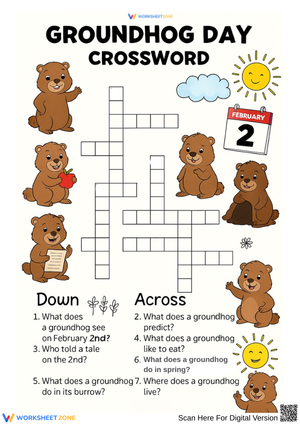
Groundhog Day printable worksheets for 3rd Grade
These groundhog day printable worksheets for 3rd grade give teachers a focused set of ELA resources that use Punxsutawney Phil, hibernation science, and the Pennsylvania Dutch folklore tradition to do real reading and writing work. Each worksheet targets a specific skill — informational reading, vocabulary in context, opinion writing, or narrative development — rather than wrapping a seasonal theme around busywork. The set runs well across a full week of literacy instruction without pulling from multiple other sources.
What's Inside the Set
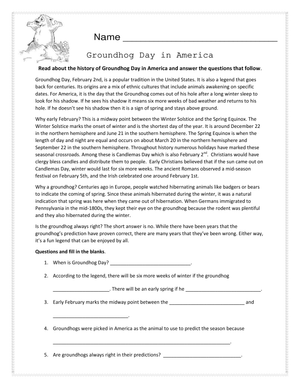
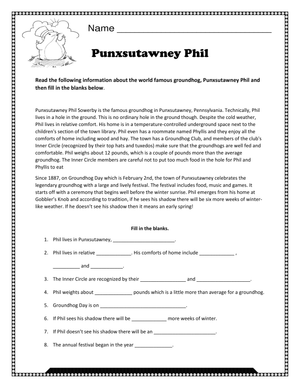
Reading comprehension worksheets draw on informational passages about the origin of Groundhog Day — the German Candlemas custom, the Pennsylvania Dutch adaptation, and the annual ceremony at Gobbler's Knob — to practice text-based questioning, sequencing historical events, and distinguishing fact from legend. Students identify the main idea and support it with evidence from the text, which is harder than it sounds when the content blends scientific information and cultural myth in the same passage without always signaling which is which.
Vocabulary work centers on domain-specific terms: burrow, hibernation, prediction, folklore, and tradition. Students use context clues within the passages rather than dictionary lookups — the skill the L standards actually require at this level. One vocabulary worksheet also presents groundhog, woodchuck, and whistle-pig as three names for Marmota monax, a memorable entry point into regional vocabulary variation that third graders genuinely find surprising.
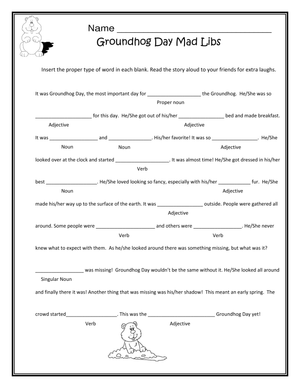
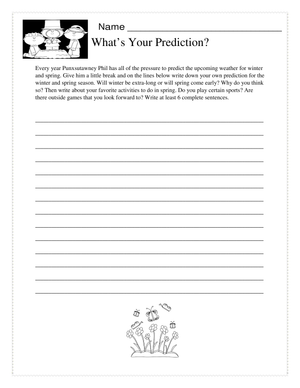
Writing worksheets cover both opinion and narrative formats. In the opinion task, students take a position on whether they want six more weeks of winter or an early spring, then build a structured paragraph with a clear claim, two supporting reasons, and a closing sentence. The narrative task asks students to write from a groundhog's perspective — stepping out of the burrow, adjusting to February light, reacting to a shadow or its absence. That perspective-taking prompt consistently pulls out the most vivid descriptive writing third-grade teachers see all year.
Fitting These Worksheets Into the Week Before February 2nd
The most effective sequence runs the vocabulary worksheet first, on Monday or Tuesday, so students already know burrow and hibernation before encountering those words mid-passage. Pre-teaching two or three terms reduces the cognitive friction that causes students to stall and lose the thread of an informational text. Run the reading comprehension work mid-week, then move to writing on Thursday and Friday when students have enough background to write with specific detail rather than vague summary.
For teachers who need to fit everything into a single lesson block, the reading and opinion writing worksheets work together in about 45 minutes: read and annotate the passage as a class, work through the comprehension questions, then move directly into the opinion prompt while the material is still active in students' minds. The narrative worksheet holds better as its own lesson the following day — students who try to complete all the writing in one sitting tend to rush the perspective-taking section, and that prompt deserves the time it takes to build a real scene.
Errors That Show Up Consistently in Student Work
The most predictable comprehension mistake is reversing the shadow logic. Students read that Punxsutawney Phil sees his shadow and predicts six more weeks of winter, then write in their answers that "the shadow means spring is coming." The two-step inference — shadow frightens the groundhog back inside, meaning winter continues — is a genuine challenge for eight-year-olds, and it is worth walking through on the board before students attempt the comprehension questions independently.
In the narrative writing worksheet, students frequently write that the groundhog "wakes up from sleep" rather than from hibernation, which signals they have not internalized the scientific distinction. During hibernation, a groundhog's heart rate drops to fewer than ten beats per minute and its body temperature falls to near-freezing — that is not sleep, and drawing that contrast briefly before the writing task produces noticeably more precise language in student drafts. Without that conversation, most students treat hibernation as a synonym for napping.
Standard Alignment
The reading comprehension worksheets address CCSS.ELA-LITERACY.RI.3.1 (asking and answering questions to demonstrate understanding of informational text) and CCSS.ELA-LITERACY.RI.3.3 (describing the connection between a series of historical events). Vocabulary work aligns with CCSS.ELA-LITERACY.L.3.4.A, which asks students to use context clues to determine the meaning of unknown words — a standard the passages reinforce by surrounding domain-specific terms with explanatory language rather than dropping them in cold.
The writing worksheets connect to CCSS.ELA-LITERACY.W.3.1 for the opinion piece and CCSS.ELA-LITERACY.W.3.3 for the narrative task. Most third-grade pacing guides introduce both writing types in the fall and reinforce them through spring. Using groundhog day printable worksheets for 3rd grade in early February fits that reinforcement window — students apply writing structures they already know to content-rich material that actually holds their interest.
Adjusting the Work for a Range of Learners
When a mixed-ability class works through groundhog day printable worksheets for 3rd grade, the two clearest adjustment points are decoding support on the reading passages and the complexity required in written responses. For students reading below grade level, a brief read-aloud before independent work removes the pressure in sections where Candlemas, Gobbler's Knob, and Marmota monax appear in quick succession. With the language barrier lowered, the comprehension questions become genuine formative data rather than a frustrating exercise where students are blocked by unfamiliar proper nouns.
Advanced readers are ready for more analytical work. Ask them to write a paragraph comparing what the passage says about groundhog biology with the cultural tradition of shadow prediction, identifying where science and folklore diverge. That compare-contrast task uses the same reading but requires a higher order of thinking than the comprehension questions alone. On the opinion writing worksheet, hold these students to a three-reason structure and ask them to address a counterargument in the closing sentence — a technique that previews fourth-grade writing expectations without requiring a different worksheet entirely.
Frequently Asked Questions
Do students need prior knowledge about Groundhog Day before starting, or does the set provide enough context on its own?
The reading passages explain the German Candlemas origin, the Pennsylvania Dutch adaptation, and the shadow legend in enough detail that students who have never heard of the holiday can follow along. That said, five minutes of open discussion before distributing the worksheets — asking what students already know or have heard — activates background knowledge for students familiar with the tradition and lowers the barrier for those who are not. It also surfaces any students who believe the shadow prediction is scientific fact, which is worth addressing before the comprehension work begins.
How long does each worksheet take a typical third grader to complete?
Reading comprehension worksheets take most students 20 to 25 minutes working independently. Vocabulary worksheets run 10 to 15 minutes. The writing worksheets take longer: the opinion piece averages 25 to 30 minutes for students genuinely drafting rather than copying a model, and the narrative task can run 35 to 40 minutes when students are building a full scene. These are real working-time estimates, not figures based on watching the fastest finishers.
Can a teacher use these worksheets if they only find out about them on February 1st?
Yes — because each worksheet stands alone, there is no required sequence before handing one out. A teacher who downloads the set the night before February 2nd can select the reading comprehension worksheet and the opinion writing prompt and run a complete, standards-aligned lesson the next morning with no additional preparation. For those using groundhog day printable worksheets for 3rd grade as last-minute lesson fill, the vocabulary worksheet also works well as morning work because it needs no teacher introduction to get students started.
Clear All