


























Views
Downloads

Days of the Week Printable Worksheet | Grade 1-3 Essential
Paste this activity's link or code into your existing LMS (Google Classroom, Canvas, Teams, Schoology, Moodle, etc.).
Students can open and work on the activity right away, with no student login required.
You'll still be able to track student progress and results from your teacher account.
Mastering Temporal Sequencing
Understanding temporal relationships is a foundational skill for early learners. This 'Today, Tomorrow, and Yesterday' worksheet provides a structured environment to practice sequencing days, applying logic, and matching abbreviations. Students develop the fluency needed to navigate calendars independently, ensuring they can effectively manage daily schedules and classroom routines with confidence.
At a Glance
- Grade: 1–3 · Subject: English Language Arts
- Standard:
CCSS.ELA-LITERACY.L.1.2— Use correct capitalization for days of the week and proper nouns.- Skill Focus: Temporal sequencing and day abbreviations
- Format: 3 pages · 19 problems · Answer key included · PDF
- Best For: Daily morning work and calendar rotations
- Time: 15–20 minutes
What's Inside
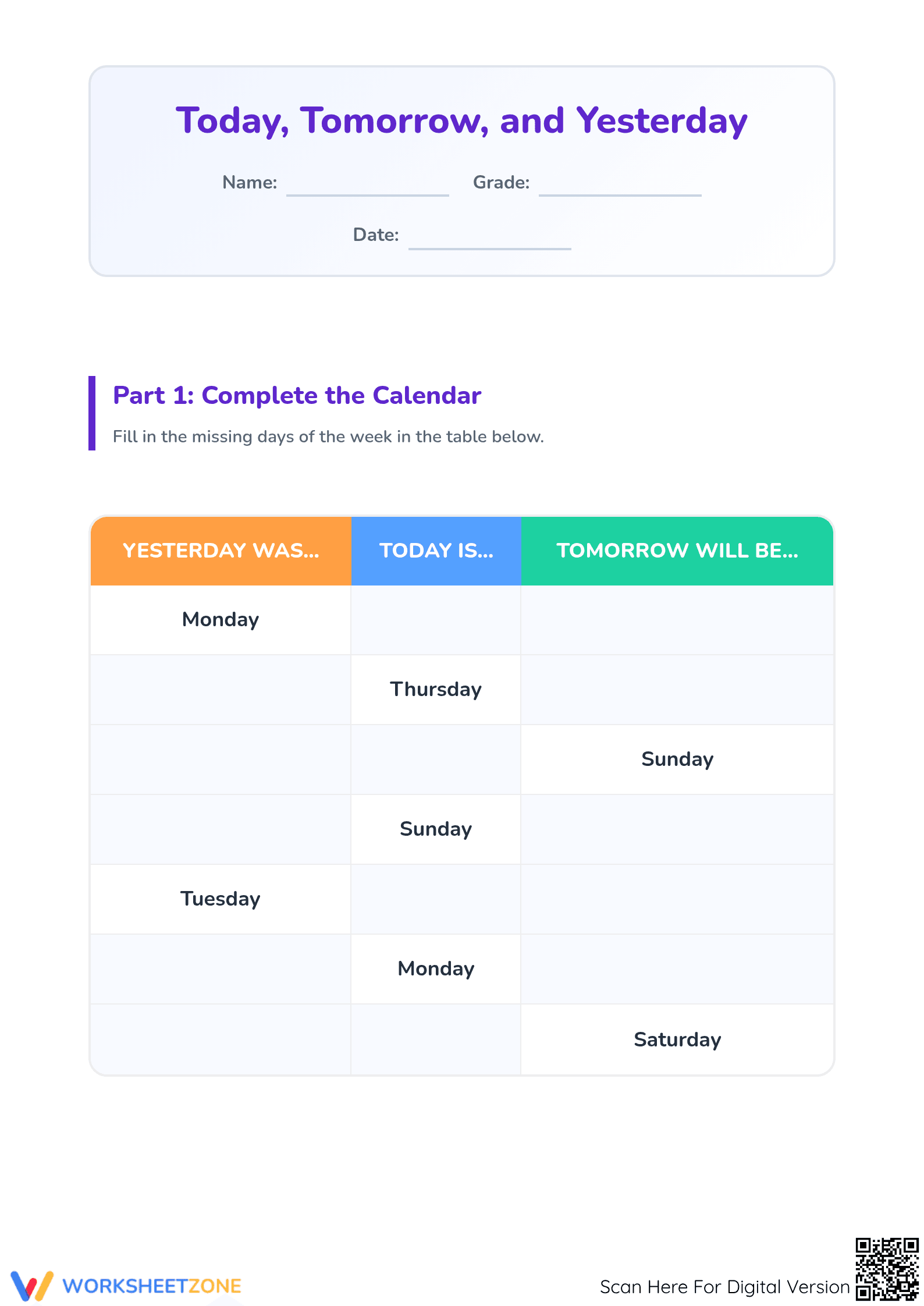
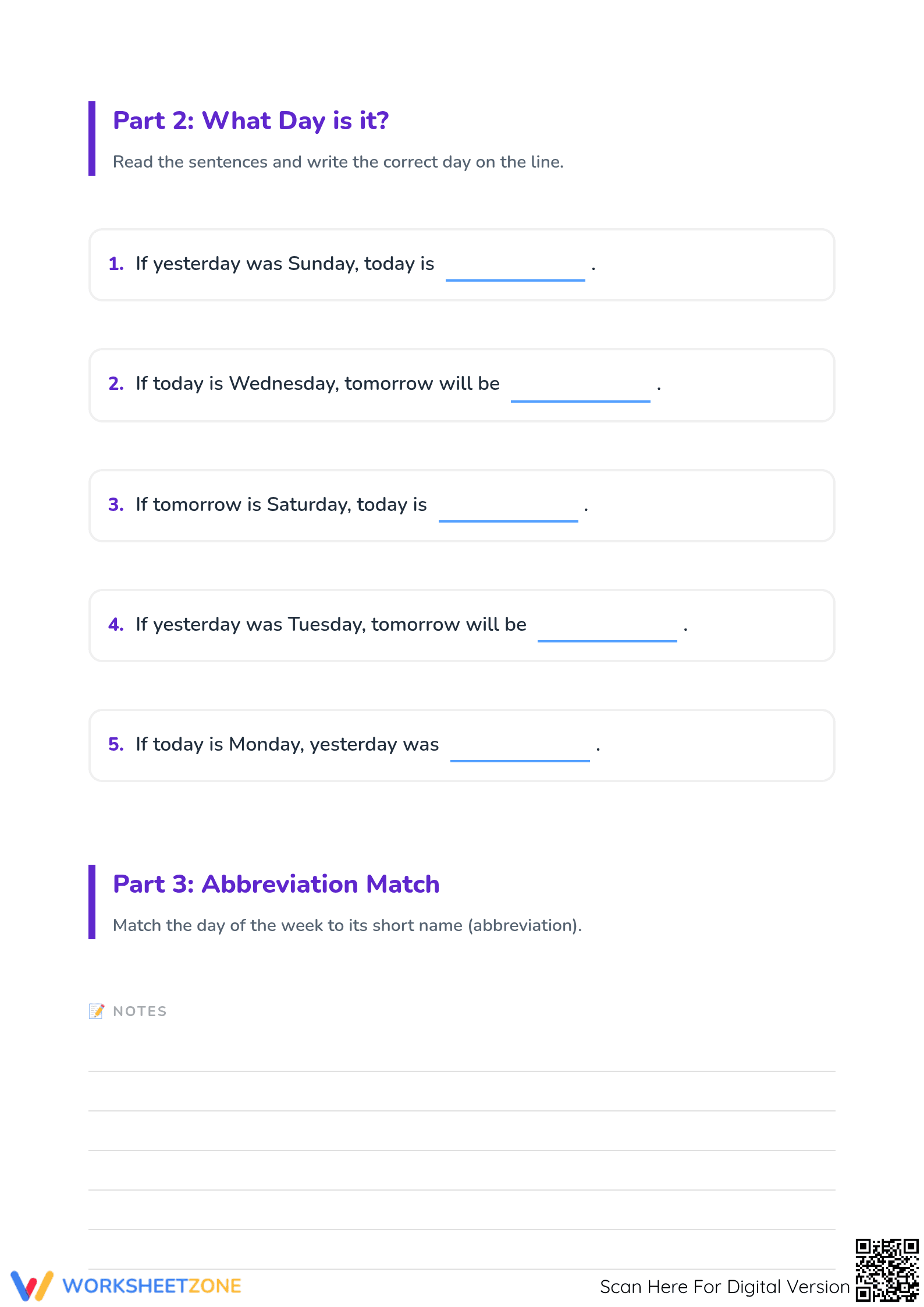
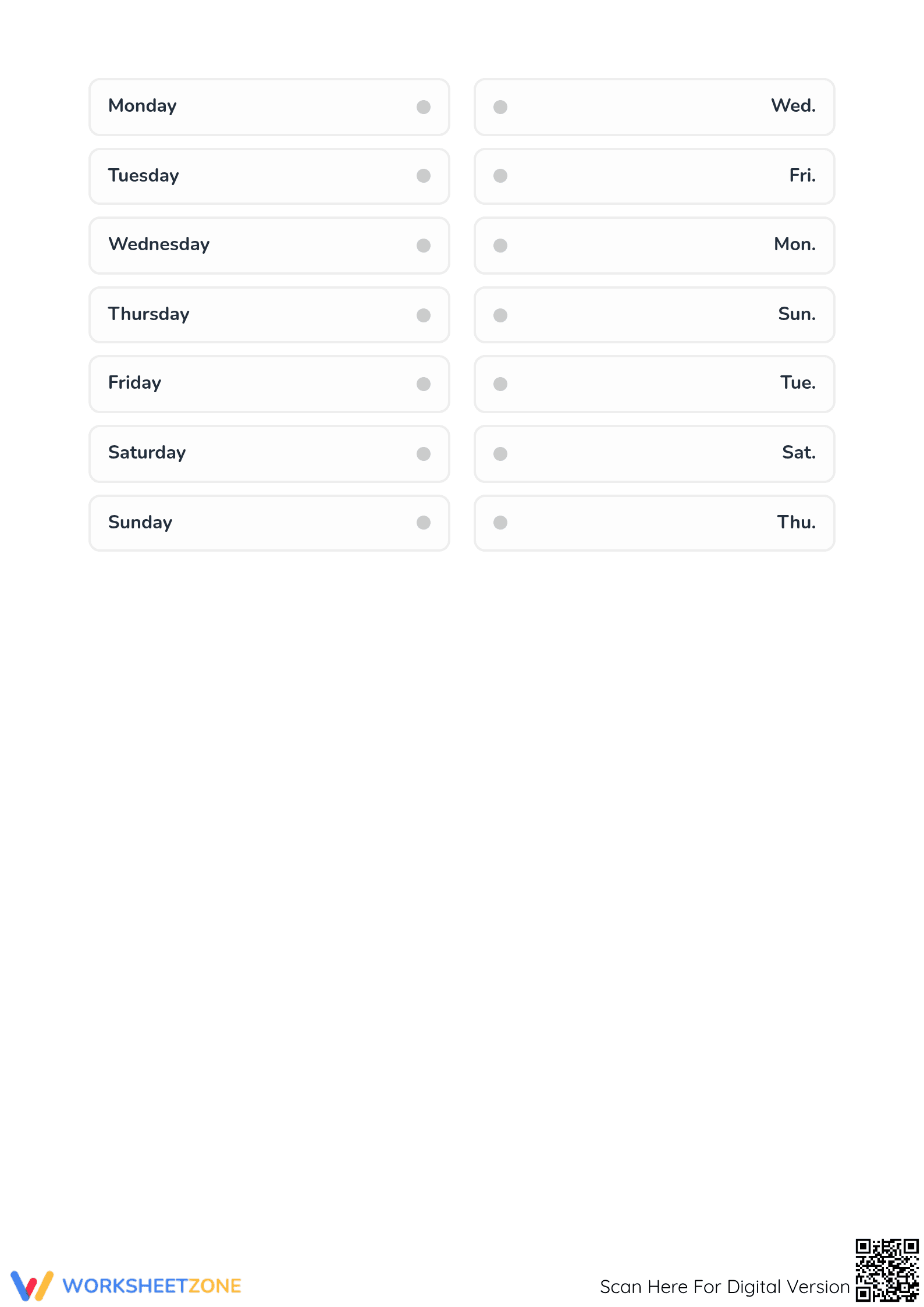
This three-page PDF package is designed for maximum student engagement. Part one features a sequencing table across seven distinct rows. Part two challenges students with five logic-based fill-in-the-blank sentences. Part three provides a matching activity for the seven days and their standard abbreviations. A full answer key is included for effortless grading and immediate feedback.
Zero-Prep Workflow
- Step 1: Print the three-page set for your entire class (30 seconds).
- Step 2: Distribute the packets during your morning meeting or calendar block (1 minute).
- Step 3: Review the answers using the provided key during your wrap-up session (1 minute).
Total preparation time is under two minutes, making it an ideal choice for emergency sub plans or quick transitions.
Standards Alignment
The primary alignment is `CCSS.ELA-LITERACY.L.1.2`, focusing on the command of conventions, including proper capitalization of days. It also supports `CCSS.ELA-LITERACY.L.1.6` through the use of temporal relationship vocabulary. Both standard codes can be copied directly into lesson plans, IEP goals, or district curriculum mapping tools, ensuring instruction remains compliant with state frameworks.
How to Use It
Use this resource immediately after your daily calendar routine to bridge oral practice with written application. Model the logic using a physical calendar before students work independently. For formative assessment, observe students during the matching task to identify confusion between similar abbreviations. Expected completion time is 15–20 minutes, allowing for flexible integration into various instructional blocks.
Who It's For
Tailored for students in Grades 1–3, this is especially effective for English Language Learners mastering temporal prepositions. It pairs naturally with weather charts or schedule-focused literacy passages. Teachers can differentiate by providing a word bank for Part 1 or requiring full sentences for Part 2, ensuring every learner in your classroom finds the appropriate level of challenge.
According to NAEP, sequencing time-based information is a prerequisite for narrative comprehension. Fisher & Frey (2014) highlight that classroom-ready materials allow educators to transition from 'I Do' modeling to 'You Do' practice without losing momentum. The inclusion of the code `CCSS.ELA-LITERACY.L.1.2` ensures the content is rooted in evidence-based grammar instruction. ScienceDirect TpT Analysis (2024) suggests that multi-modal worksheets increase vocabulary retention by 22% among early elementary students. This resource serves as a printable, essential solution for reinforcing temporal reasoning skills. By automating the mechanical aspects of day-of-the-week identification, students free up cognitive resources for more complex literacy tasks. It remains an essential tool for any teacher seeking to build student independence in calendar management and temporal logic.


