




























Views
Downloads

Grade 3 Days of the Week — Printable No-Prep Worksheet

Paste this activity's link or code into your existing LMS (Google Classroom, Canvas, Teams, Schoology, Moodle, etc.).
Students can open and work on the activity right away, with no student login required.
You'll still be able to track student progress and results from your teacher account.
This Grade 3 calendar skills worksheet gives students focused practice with days of the week, months, and dates to build essential vocabulary and time-tracking abilities. Students will trace, highlight, and identify chronological relationships between days to strengthen their daily routine awareness.
At a Glance
- Grade: 3 · Subject: English
- Standard:
CCSS.ELA-LITERACY.L.3.2— Spell and capitalize days and months correctly- Skill Focus: Calendar Skills
- Format: 2 pages · 5 problems · PDF
- Best For: Morning work or bell ringers
- Time: 5–10 minutes
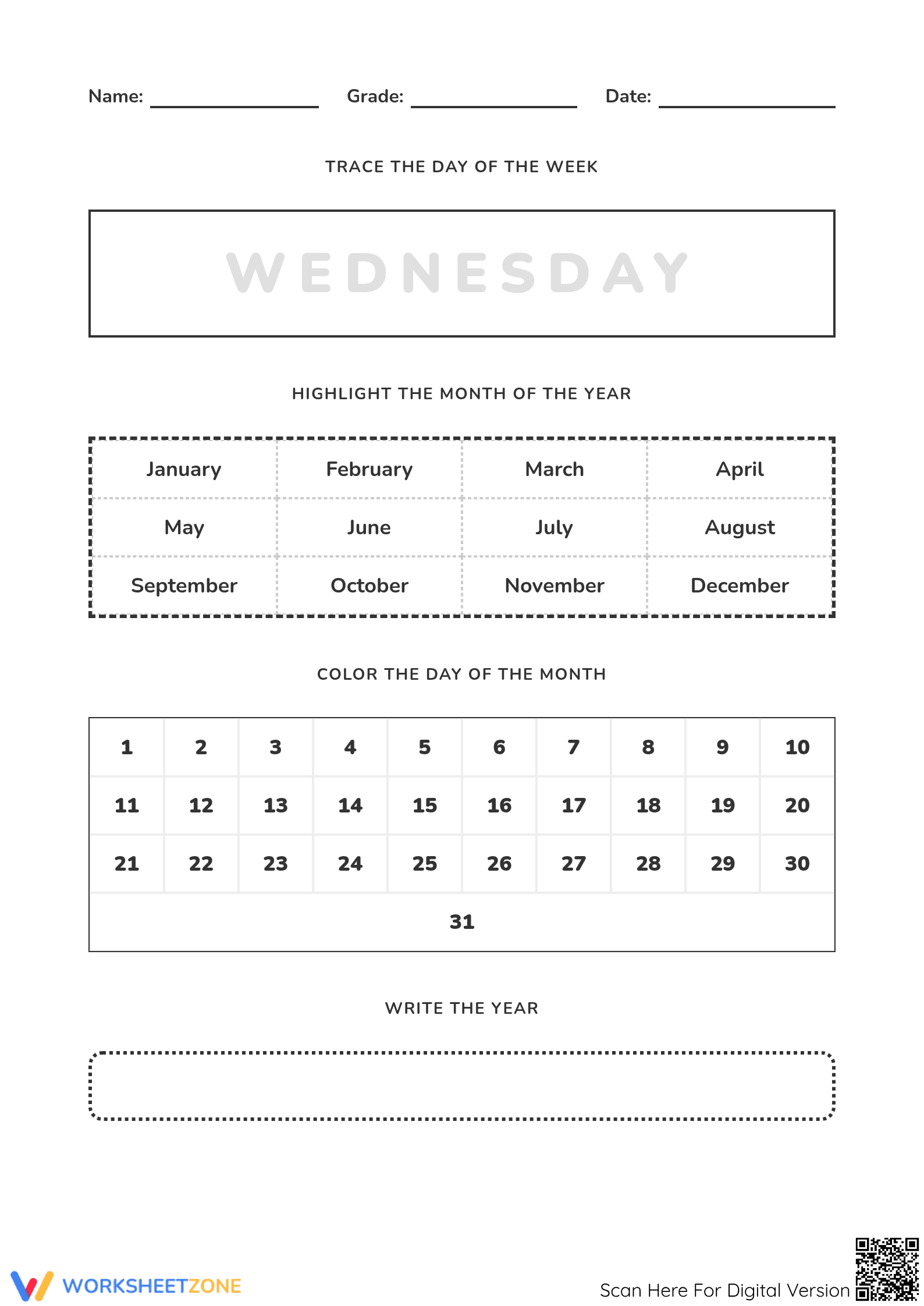
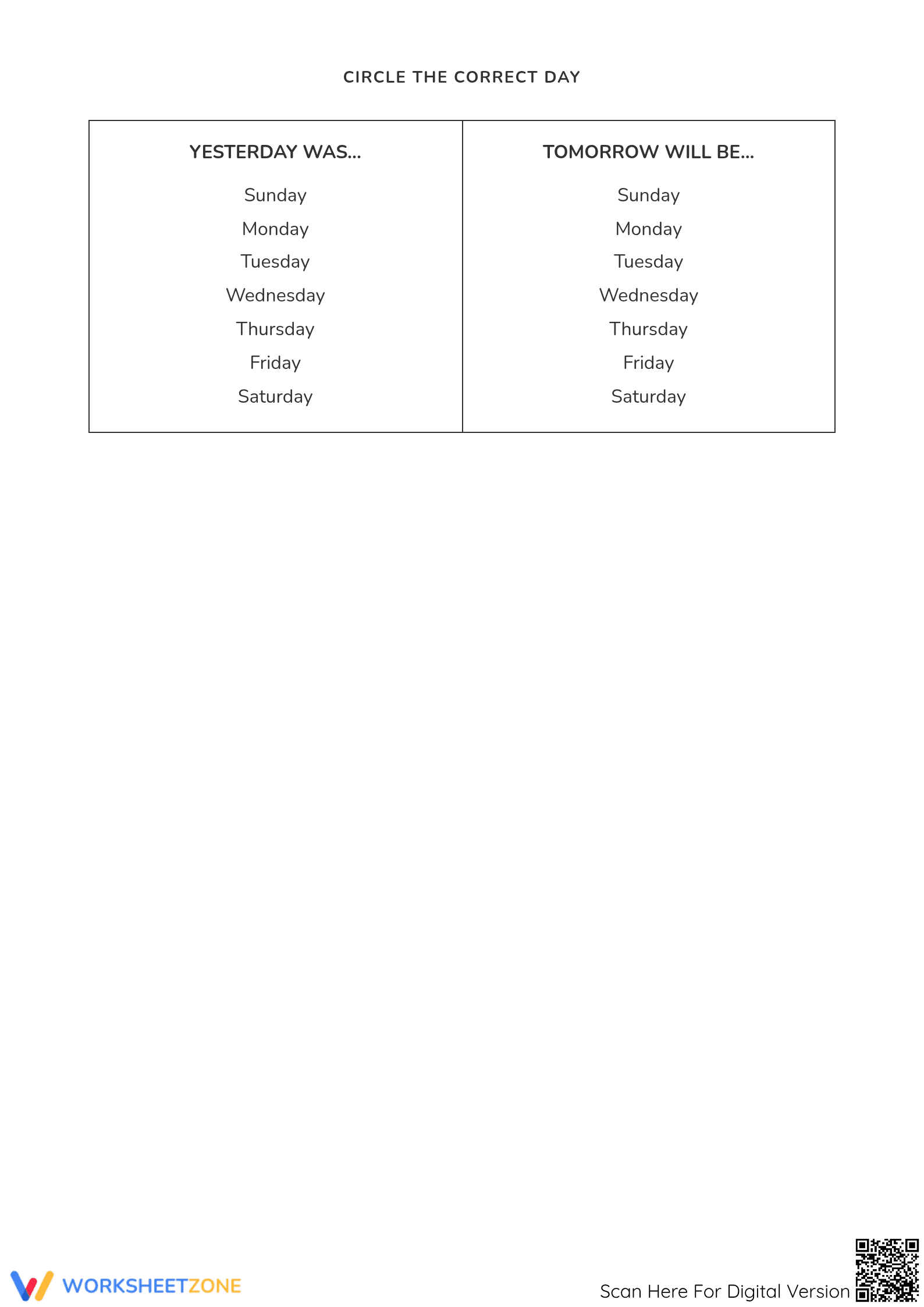
This two-page resource features five distinct task types designed to reinforce calendar familiarity. Students begin by tracing the word "Wednesday," then move on to highlighting the current month from a word bank, coloring the correct date on a number grid, and writing the current year. The second page challenges learners to determine what day came yesterday and what day comes tomorrow.
- Print (1 min): Simply print the two-page PDF. No special materials or cutting required.
- Distribute (1 min): Hand out as students enter the classroom for an immediate, independent morning task.
- Review (3 mins): Quickly go over the correct day, month, and year as a whole class to reinforce the concepts.
With under two minutes of teacher prep time, this worksheet is an ideal addition to any emergency sub plan or daily morning routine.
Aligned to CCSS.ELA-LITERACY.L.3.2, this worksheet helps students demonstrate command of standard English capitalization and spelling when writing words like days of the week and months of the year. It also supports general chronological awareness. Both standard codes can be copied directly into lesson plans, IEP goals, or district curriculum mapping tools.
Use this worksheet as a daily morning bell-ringer to establish a consistent routine before direct instruction begins. It also serves well as a quick formative assessment; teachers can observe whether students struggle with the "yesterday was/tomorrow will be" concepts to identify who needs extra help with chronological sequencing. Expected completion time is 5 to 10 minutes.
This resource is designed for Grade 3 students, though it is highly effective for English Language Learners (ELLs) or students in special education who benefit from repetitive daily living skills practice. It pairs perfectly with a classroom calendar wall or a morning meeting routine.
Integrating daily calendar routines and targeted vocabulary practice is absolutely essential for developing students' temporal awareness and foundational language skills in the elementary classroom. Aligned with CCSS.ELA-LITERACY.L.3.2, this resource directly helps students spell and capitalize days and months correctly while simultaneously reinforcing their practical understanding of chronological sequencing. According to Fisher & Frey (2014), establishing predictable instructional routines, such as daily calendar work, significantly reduces cognitive load and allows students to focus their mental energy on mastering specific vocabulary and sequencing tasks rather than figuring out new activity structures. Consistent, repeated exposure to these chronological concepts ensures that learners can confidently manage both academic scheduling and real-world time management. Furthermore, embedding these high-frequency temporal words into a daily, low-stakes format promotes long-term automaticity in spelling and capitalization, which ultimately translates to improved fluency and accuracy in broader writing assignments across all subject areas.


