How to Teach 3rd Grade Context Clues That Actually Stick
What 3rd Grade Context Clues Worksheets Actually Teach
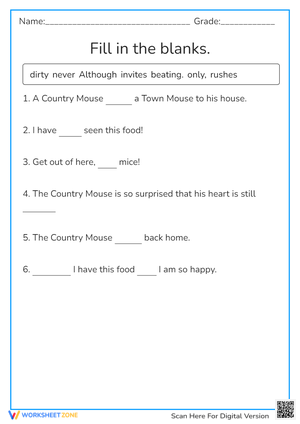
Context clues sit at the center of third-grade vocabulary work because this is the year students are expected to figure out unfamiliar words without stopping to ask. Good context clues worksheets give your readers structured, repeatable practice inferring word meaning from the sentence around a word—exactly the skill Common Core names for this grade. Instead of guessing or skipping, students learn to slow down, reread, and use the words they already know to unlock the ones they don't.
The standard behind this work is CCSS.ELA-Literacy.L.3.4.a, which directs third graders to use sentence-level context as a clue to the meaning of a word or phrase. That single line does a lot of instructional heavy lifting. It tells you the grain size—the sentence, not the whole passage—the strategy of using context as evidence, and the outcome of arriving at a workable meaning. A worksheet built around short, self-contained sentences maps almost perfectly onto that expectation, which is why this format stays useful for both core instruction and targeted practice.
The Six Context Clue Types Your Third Graders Need
Not every clue looks the same, and third graders benefit from having names for what they're doing. Naming the clue type turns a vague 'figure it out' into a concrete move a student can practice and repeat on the next unfamiliar word.
Reading Rockets identifies six common types of context clues—definition, synonym, antonym, example, inference, and general context—and notes that direct instruction in these strategies especially benefits struggling readers, who often skip unfamiliar words rather than using the surrounding sentence to reason toward meaning.
Here is how each type looks in grade 3 language:
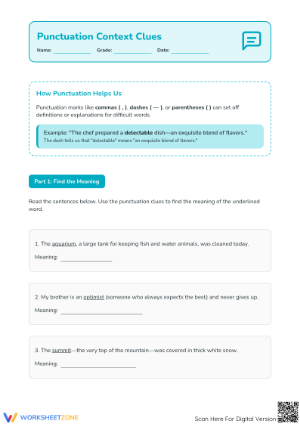
- Definition: the sentence explains the word directly, as in 'The nocturnal owl hunts at night, when it is dark.'
- Synonym: a nearby word means about the same thing—'She was furious, so angry that she stomped away.'
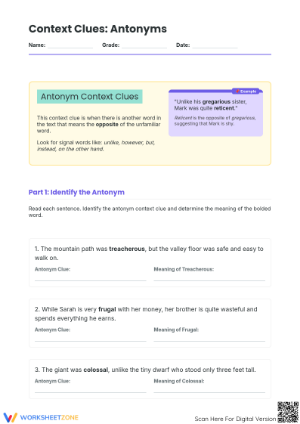
- Antonym: a contrast signals the opposite—'The trail was not narrow but wide enough for three kids.'
- Example: listed cases hint at meaning—'Citrus fruits like oranges, lemons, and limes taste sour.'
- Inference: the reader combines clues—'He grabbed his umbrella because the sky looked stormy.'
- General context: the whole sentence points the reader toward one reasonable guess.
When a worksheet sorts practice by type, you can see exactly which move a student hasn't mastered yet, and that diagnostic value matters far more than the number of items completed.
Sequencing Worksheets for Gradual Release
The fastest way to waste a good worksheet is to hand it out cold. Context clue strategies stick when you model them first, then share the work, then step back. A gradual-release sequence keeps the thinking where it belongs at each stage instead of dumping it all on the student at once.
Start with modeled practice: put one sentence under the document camera and think aloud through the clue, pointing to the exact words that gave the meaning away. Move to guided practice, where the class works two or three items together and you press for evidence with 'What word told you that?' Only then assign independent practice, and reserve a short worksheet for that final, low-support stage. You can even print the same sentence set at three difficulty levels and use them across the three stages, so the target words stay constant while the scaffolding gradually fades.
Common Mistakes That Keep Clues From Sticking
A few predictable habits undercut even strong worksheets. The first is treating the answer as the goal: students write a definition, feel done, and never point to the clue that justified it. The fix is a routine that requires evidence—underline the clue words before writing the meaning, every single time.
The second mistake is running every clue type together before any one of them is secure. Third graders do better when you isolate one type, build fluency with it, and only then mix types on a review page. And watch for sentences where the words around the target are harder than the target itself; if the context is too difficult, the strategy can't work, so keep early practice sentences readable for the group in front of you.
Classroom Implementation
To fit this into a real week, tie worksheet practice to words students are already meeting in read-alouds and content-area texts. The Iowa Reading Research Center notes that most new vocabulary is learned incidentally through wide reading, so explicit context-clue practice should complement independent reading rather than replace it. The worksheet supplies the deliberate reps; the class novel and the science text supply the volume.
A simple rotation works well: introduce a clue type on Monday with modeled sentences, run guided practice midweek, assign an independent worksheet on Thursday, and use Friday to revisit any target words that showed up in the week's reading. Keep sessions short. Five well-chosen sentences with real discussion beat a full page completed in silence, because the goal is transferable strategy, not a finished packet.
Turning Worksheet Responses Into Formative Data
The most underused feature of a context clues worksheet is the wrong answer. When a student misses an item, the miss usually points to a specific clue type they can't yet use, and that is information you can act on by tomorrow morning.
A 2018 efficacy study published in Middle School Journal found that explicitly teaching context clue strategies produces measurable gains in students' vocabulary development, but the effect depends on multiple exposures to each target word across varied contexts rather than single-pass completion. The practical takeaway for third grade is precise: sort your worksheet items by clue type, track which type each student misses, and reteach that one type with three or four fresh sentences over the following days. A student who nails synonym clues but fails every antonym item doesn't need more worksheets in general—they need targeted antonym exposure, and your item-level data points straight at it.
Frequently Asked Questions
1. How does context clues practice align with 3rd grade Common Core standards?
It maps directly to CCSS.ELA-Literacy.L.3.4.a, which asks third graders to use sentence-level context as a clue to the meaning of a word or phrase. Sentence-based worksheets give students repeated practice at exactly that grain size, and related grade 3 standards on affixes and root words round out the vocabulary strand.
2. What are the main types of context clues 3rd graders should learn?
Reading Rockets names six: definition, synonym, antonym, example, inference, and general context. Teaching each type by name gives students a concrete move to reach for instead of a vague reminder to use context, which makes the strategy far easier to transfer to real reading.
3. How often should teachers assign context clues worksheets?
Short, frequent practice beats occasional long packets. A few focused sentences several times a week, tied to words from your read-alouds and content texts, gives the multiple exposures that vocabulary growth requires without turning practice into busywork.
4. How can context clues worksheets support small-group reading intervention?
Use one clue type per session with four or five students, and have them underline the clue and explain their thinking aloud before writing a meaning. The structured, repeatable format builds the lookback habit that below-level readers most often lack.
5. How should teachers differentiate context clues practice for struggling readers?
Narrow the focus to a single clue type, use shorter sentences with familiar surrounding words, and add discussion so students hear the reasoning modeled aloud. Item-level results from each worksheet tell you which clue type to reteach next.
Clear All