


























Views
Downloads

Grade 1 Days of the Week — Printable No-Prep Worksheet
Paste this activity's link or code into your existing LMS (Google Classroom, Canvas, Teams, Schoology, Moodle, etc.).
Students can open and work on the activity right away, with no student login required.
You'll still be able to track student progress and results from your teacher account.
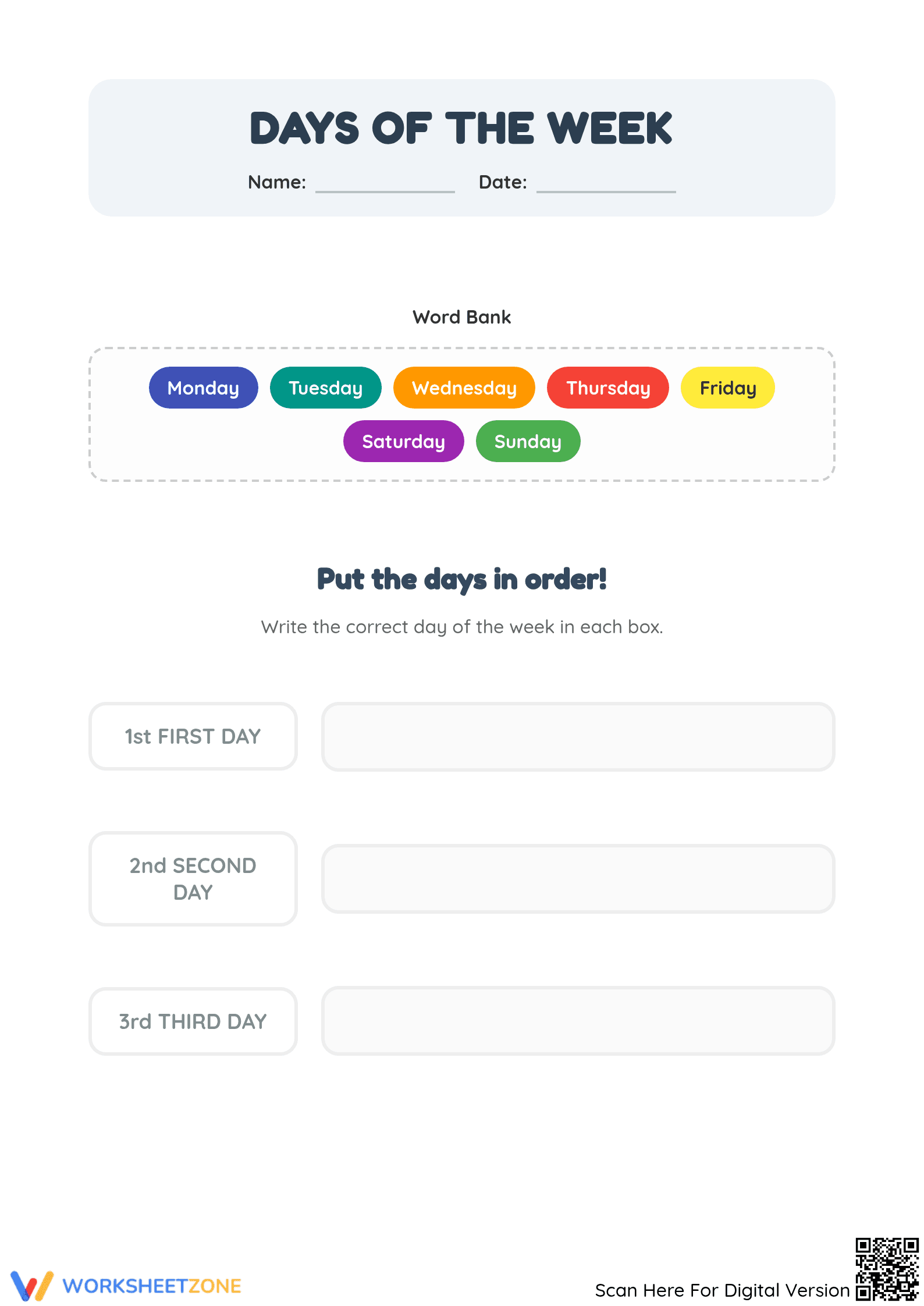
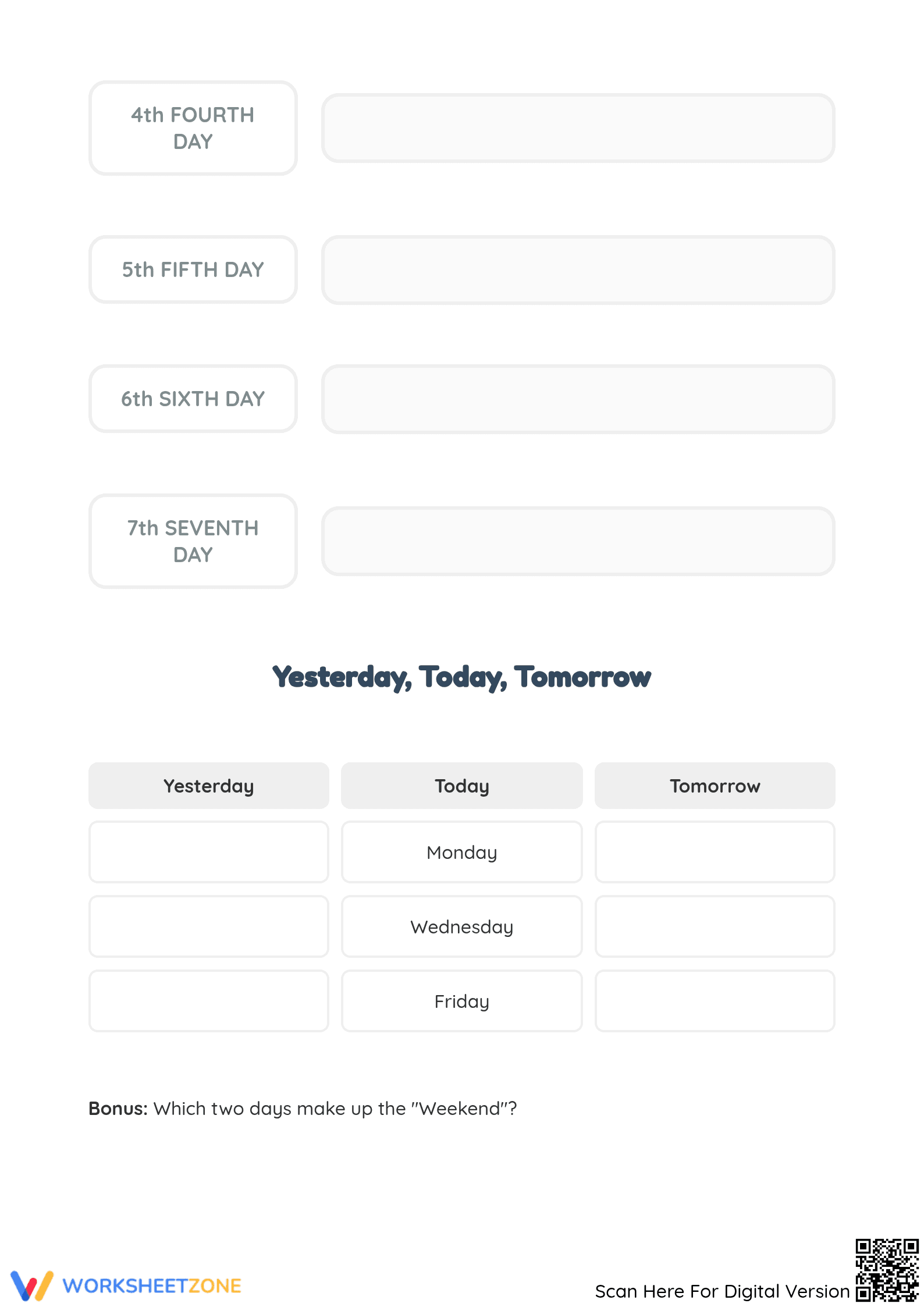
This ready-to-use worksheet helps early learners master the days of the week and understand basic chronological concepts. Students will practice sequencing the seven days correctly and identifying the relationship between yesterday, today, and tomorrow, building essential vocabulary and foundational time-management skills for daily classroom routines.
At a Glance
- Grade: 1 · Subject: ELA
- Standard:
CCSS.ELA-LITERACY.L.1.5— Understand word relationships and nuances in word meanings- Skill Focus: Ordering days of the week
- Format: 2 pages · 14 problems · Answer key included · PDF
- Best For: Morning work or independent practice
- Time: 10–15 minutes
This two-page resource features a word bank to support early readers across 14 tasks. Students first write the days in numerical order. The second page introduces a "Yesterday, Today, Tomorrow" chart where learners fill in missing days based on a starting point. A bonus question asks students to identify the weekend. An answer key is provided.
This resource is designed for a smooth, zero-prep workflow:
- Print (1 minute): Simply download the PDF and print double-sided to save paper. The layout is clean and uses minimal ink.
- Distribute (1 minute): Hand out to students during morning meeting or literacy centers. The color-coded word bank makes it highly accessible.
- Review (2 minutes): Use the included answer key to quickly check student work or project it on the board for self-correction.
With total prep time under two minutes, this is perfect for any sub plan.
This activity aligns with CCSS.ELA-LITERACY.L.1.5, requiring students to demonstrate an understanding of word relationships and nuances in word meanings. By categorizing and sequencing time-based vocabulary (yesterday, today, tomorrow), learners build the foundational language skills necessary for narrative writing and reading comprehension. Both standard codes can be copied directly into lesson plans, IEP goals, or district curriculum mapping tools.
Deploy this worksheet as a morning work activity to reinforce daily calendar routines before direct instruction begins. It also serves perfectly as an independent literacy center task while the teacher works with small groups. As a formative assessment tip, observe whether students rely heavily on the word bank or if they can mentally sequence the days when completing the "Yesterday, Today, Tomorrow" chart. Most first graders will complete this assignment within 10 to 15 minutes.
This resource is primarily designed for first-grade students mastering calendar concepts, but it also serves as an excellent review for second graders who need extra reinforcement. The inclusion of a word bank provides built-in differentiation, supporting English Language Learners and students who struggle with spelling. Pair this worksheet with a daily classroom calendar routine or a read-aloud book about the days of the week to maximize engagement and retention.
Mastering time-related vocabulary is a critical milestone in early childhood cognitive development. According to a recent ScienceDirect TpT Analysis, explicit instruction in sequencing and chronological terms significantly improves reading comprehension and narrative structuring in primary grades. When students practice skills aligned with CCSS.ELA-LITERACY.L.1.5 to understand word relationships and nuances in word meanings, they build the mental frameworks required to process complex texts later on. Activities that require learners to map concepts like yesterday, today, and tomorrow foster both linguistic and logical growth. By integrating these foundational vocabulary exercises into daily routines, educators provide the repetition necessary for long-term retention. This structured approach ensures that young learners can confidently articulate temporal relationships, setting a strong foundation for future academic success across all core subjects.


