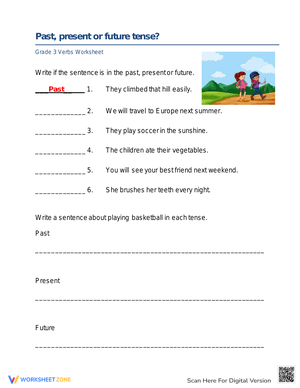
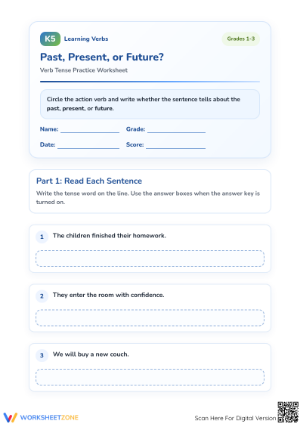
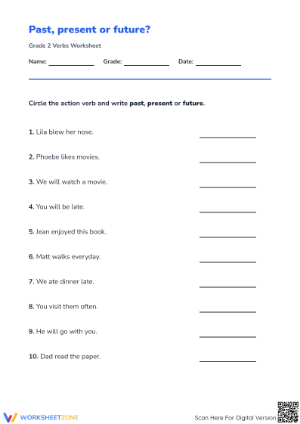
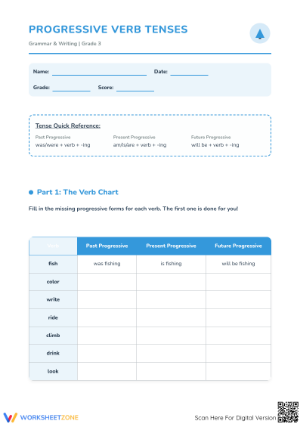
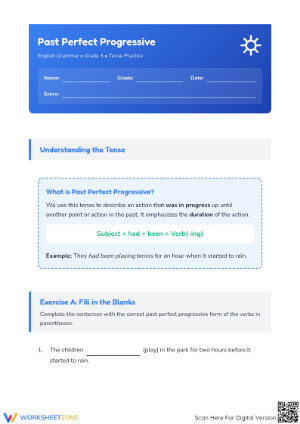
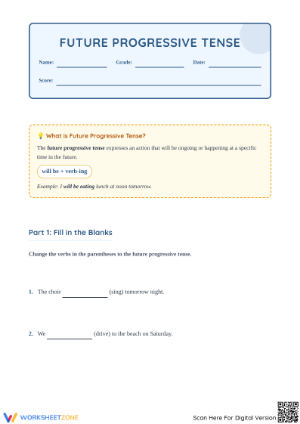
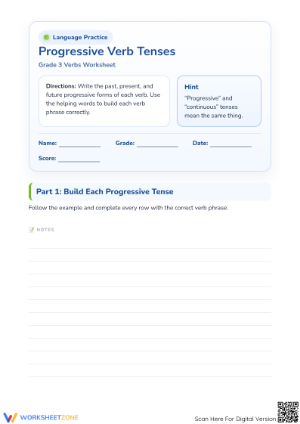
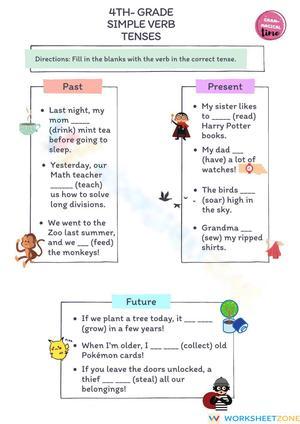
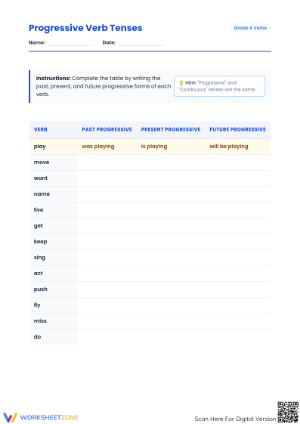
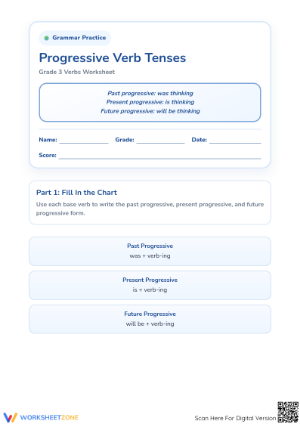
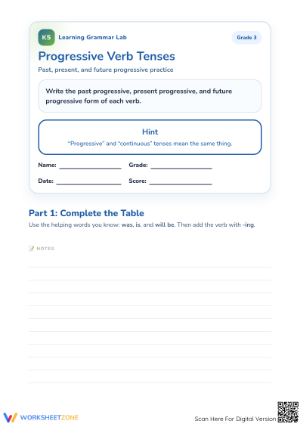
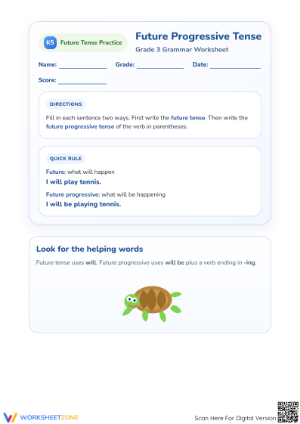
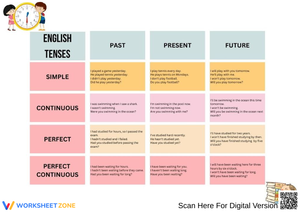
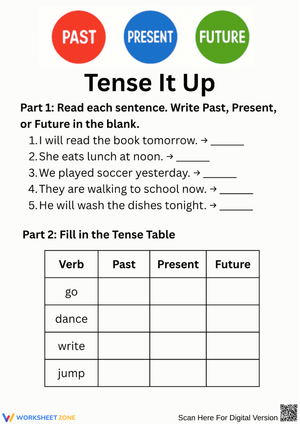
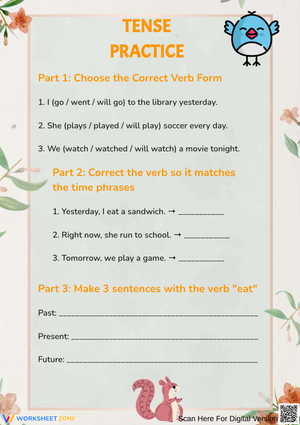
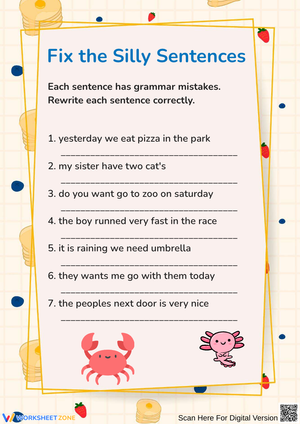
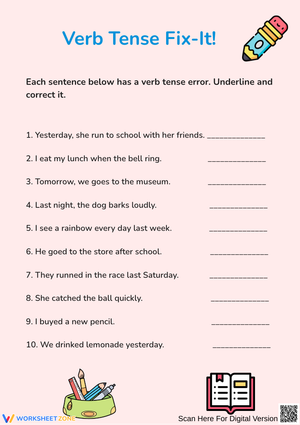
These 3rd grade verb tenses printable worksheets give teachers a clean way to address one of the trickier grammar transitions in elementary school: moving students from casually using past, present, and future in speech to forming those tenses correctly on the page. The set covers simple present, regular and irregular past, and future, along with tense-consistency exercises in short paragraph contexts. Each worksheet stands alone, so teachers can assign what the class needs without working through a fixed sequence.
Skills the Set Builds
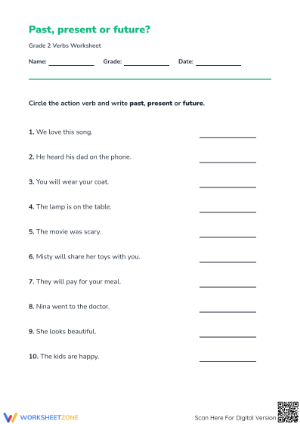
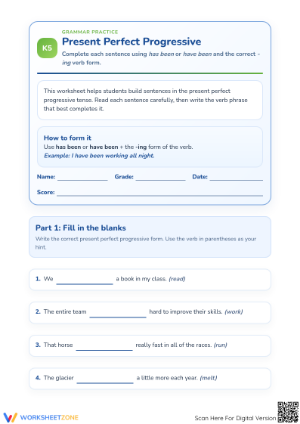
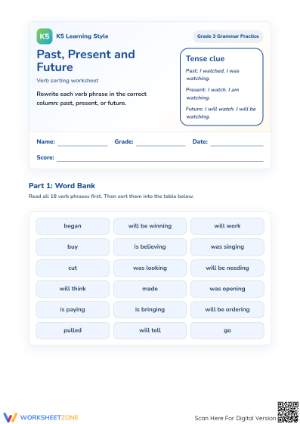
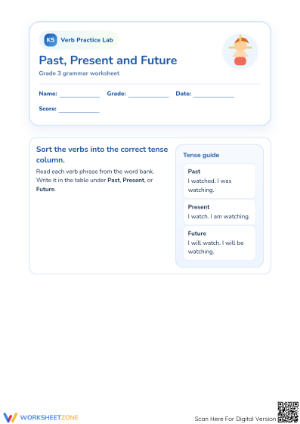
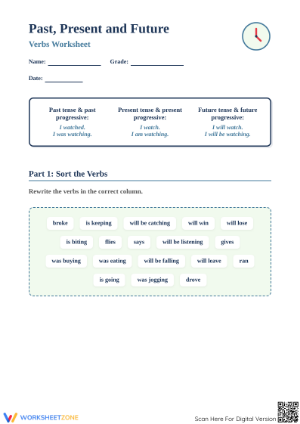
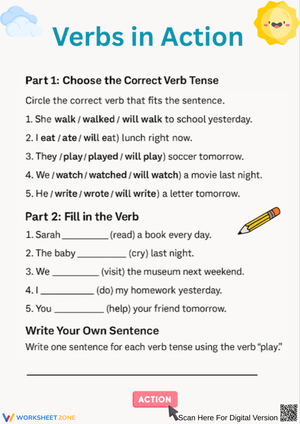
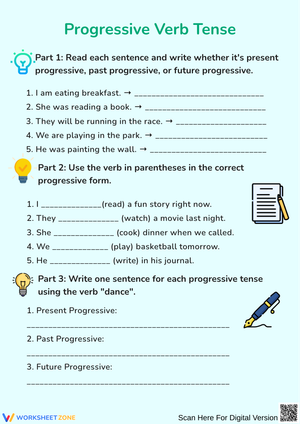
The worksheets move through the simple tenses using varied task types so students aren't completing the same exercise repeatedly. Early worksheets ask students to identify and sort verbs by tense — a lower-stakes starting point before any rewriting happens. Later worksheets require students to rewrite full sentences, shift the tense of a short passage, or proofread a paragraph for tense errors. Irregular verbs get their own dedicated practice: matching present forms to past, completing sentences with the correct irregular past tense, and producing correct spellings from scratch rather than selecting from a multiple-choice list.
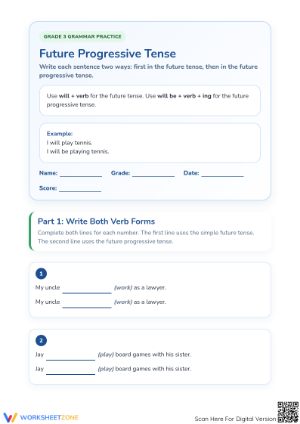
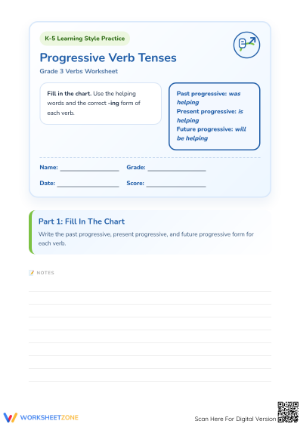
Present tense exercises include subject-verb agreement work, because third-person singular forms — "she runs," "he carries" — cause a different category of error than past tense does. Future tense practice pairs verb forms with time-signal words like "next week" or "by Friday" so students attach the grammar to real-world temporal meaning, not just a rule about adding "will."
Mistakes Students Make That These Worksheets Help You Catch
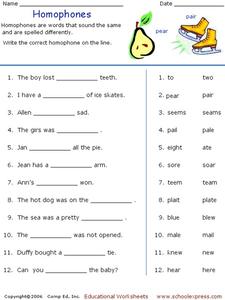
The most predictable error in third-grade verb tense work is over-regularization of irregular past forms. Students who have just internalized "add -ed for past tense" will write "runned," "eated," and "goed" with complete confidence, because they've applied the rule correctly — to a verb that ignores it. This isn't carelessness; it's the logic of overgeneralization, and it persists longer than most teachers expect. The irregular verb worksheets give students repeated exposure to the correct forms in sentences they have to complete, which moves those forms out of conscious rule-checking and into automatic recall faster than any single lesson will.
A second persistent error is the mid-narrative tense shift. A student writes, "She walked to the door and opens it," switching from past to present without noticing, because she's tracking the story's logic rather than the grammatical frame around it. The tense-consistency proofreading worksheets present short passages with embedded shifts and ask students to find and correct them — which builds exactly the rereading habit that catches these errors during revision. A third issue worth noting is the spelling layer: when students add "-ed" to verbs like "stop" or "hope," the required consonant doubling or silent-e drop produces forms like "stoped" and "hopeing" that look like tense errors but are actually spelling interference. The worksheets that ask students to write the past form from scratch, rather than select it, address both problems in one task.
Working These Worksheets Into Your Teaching Week
The most efficient approach is short, repeated practice rather than a single block of grammar time. A five-minute morning warm-up — sentence completion while attendance is taken — gives students low-pressure exposure before the instructional day starts. Because the worksheets are standalone, teachers can rotate focuses each week: simple present after introducing the concept, irregular past the following week, tense-consistency proofreading before students begin a narrative writing unit.
3rd grade verb tenses printable worksheets also work well as exit tickets in the last six or seven minutes before students leave for specials. A three-sentence task asking students to rewrite sentences in a specified tense gives teachers an immediate read on who has it and who doesn't — without the grading weight of a full quiz. For literacy centers, the irregular verb matching worksheets run well as partner activities; two students checking each other's answers tends to generate more productive discussion about the correct forms than silent independent work does.
Standard Alignment
These worksheets directly address two Language standards from the Common Core State Standards for English Language Arts — Grade 3. Standard L.3.1.e requires students to form and use simple verb tenses, which is the focus of the present, past, and future practice throughout the set. Standard L.3.1.d addresses forming and using regular and irregular verbs, covering the portion of the set focused on irregular past forms and the rewriting tasks that ask students to produce — not just recognize — the correct form. In classroom terms, L.3.1.d tends to come first in the fall when students are building base knowledge of verb behavior, and L.3.1.e is reinforced continuously through writing workshop as students revise their own drafts for tense consistency.
Differentiating These Worksheets Across Learner Levels
Students who struggle with the grammar layer often do better when the worksheet removes the memory burden of irregular forms. Teachers can write a reference box of irregular verb pairs — go/went, eat/ate, run/ran, bring/brought — directly on the worksheet before copying, or attach it on a sticky note. That change keeps the task focused on tense selection rather than recall, which is the actual skill being practiced. It's worth noting that some students freeze on proofreading tasks when the passage is unfamiliar, because they spend their working memory parsing the content rather than attending to the grammar. Using a passage about a shared classroom experience — a recent field trip, a book the class has read — removes that obstacle.
For students who move through the basic tasks quickly, the rewriting worksheets extend naturally: ask them to write a second version of the same sentences in an additional tense, or to write a short original paragraph and deliberately rewrite it in a different tense. 3rd grade verb tenses printable worksheets that focus on tense consistency in paragraphs are especially well-suited to this group because the proofreading task has more nuance than a simple identification exercise — there's genuine analytical work involved in deciding which tense a passage is committed to and whether each verb upholds it.
Frequently Asked Questions
Do these worksheets address irregular verbs separately, or are they mixed in with regular verb practice?
Both. Some worksheets focus exclusively on irregular past tense forms — matching, sentence completion, and producing the correct spelling from memory. Others mix regular and irregular verbs within the same exercises, which is closer to what students actually encounter when revising their own writing.
Where in a verb tenses unit do these worksheets fit best?
The identification and sorting worksheets work best right after initial instruction, before students are expected to produce tenses independently. The sentence-rewriting worksheets belong in the middle of a unit, once some direct teaching has already happened. The tense-consistency proofreading worksheets make the most sense near the end of a unit, or at the start of a narrative writing unit when students are actively making tense choices in their own drafts.
How do these worksheets connect to writing instruction rather than functioning as a separate grammar track?
The tense-consistency exercises are the strongest bridge between the two. When students proofread a paragraph for unintentional tense shifts, they're doing the same cognitive work required during writing workshop revision. Running a tense-consistency worksheet the day before a revision lesson on the same skill primes students to notice the error pattern when they return to their own drafts. 3rd grade verb tenses printable worksheets used this way become preparation for writing rather than a detour from it.












 Interactive Worksheet Maker
 Quiz Maker
 Word Search Maker
 Crossword Puzzle Maker
 Word Scramble Generator
 Sentence Scramble Generator
 Handwriting Worksheet Generator
 Name Tracing Generator
 Fill In The Blank Generator