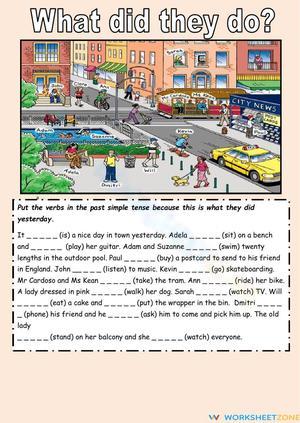
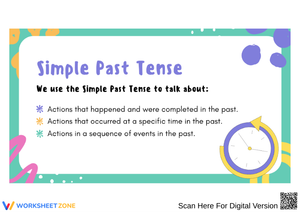
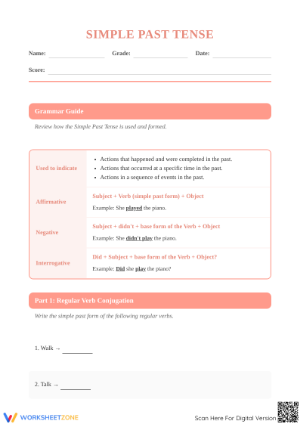
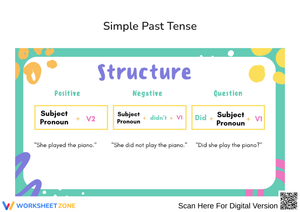
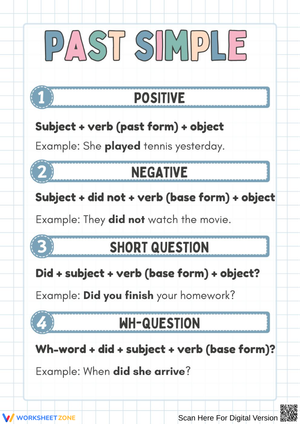
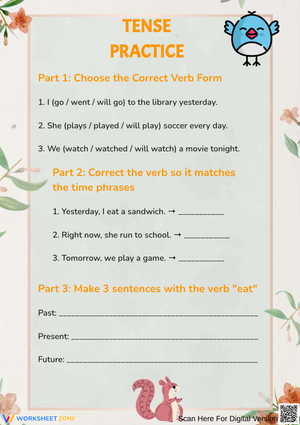
These simple past tense worksheets for 3rd grade give teachers a ready set of printable exercises covering both regular and irregular verb conjugation — the two pillars of CCSS.ELA-LITERACY.L.3.1.D. The set moves from controlled sentence-level tasks into paragraph editing, so students build toward the verb consistency their narrative writing actually requires.
What Each Worksheet Targets
Regular verbs take up significant ground in the set. Most third graders know the base rule — add -ed — but three spelling variations create genuine trouble, and each gets its own focused practice. Words ending in a silent e require only a d (love → loved). Words ending in a consonant followed by a y require swapping the y for an i before adding -ed (carry → carried). Single-syllable words ending in one vowel and one consonant require doubling the final consonant (stop → stopped). Students sort verbs into these categories, rewrite present-tense sentences in past tense, and complete fill-in-the-blank exercises within each worksheet before encountering a mixed review in the later ones.
Irregular verbs get their own dedicated worksheets. High-frequency forms — went, saw, ate, caught, brought, wrote, ran, gave — appear across multiple task formats: matching the base form to its past form, completing sentences, and correcting deliberate errors embedded in short paragraphs. The variety of formats matters because these words stick through repeated exposure in different contexts, not through a single encounter.
Standard Alignment
CCSS.ELA-LITERACY.L.3.1.D requires third graders to form and use regular and irregular verbs accurately. In classroom terms, this standard sits at the intersection of grammar and writing instruction — it is not a standalone language skill but a prerequisite for the narrative writing units most third-grade teams run in the fall and winter. The progression is deliberate: students who built basic verb awareness in second grade now apply that knowledge with spelling precision and contextual accuracy. These worksheets address both layers — the mechanical spelling rules and the writing-embedded application — without conflating them before students are ready to handle both at once.
Errors That Keep Showing Up in Student Work
Overgeneralization is the first and most persistent problem. Students who have just learned that verbs take -ed in the past will write goed, eated, and runned — sometimes for weeks after direct instruction. This isn't carelessness; it is the brain applying a newly learned rule too broadly, which is a predictable stage in language acquisition. The irregular verb worksheets are especially useful here because they force students to slow down on exactly the words where overgeneralization tends to surface.
The double-consonant rule generates its own category of errors. Students who can recite the rule — CVC words double the final consonant — still write stoped instead of stopped in connected writing, because applying a spelling rule under the cognitive load of composing a full sentence is harder than applying it in isolation. A separate error worth watching: some students produce loveed — they know an ending is needed but don't recognize the silent e as already providing one. The worksheets flag these words explicitly rather than leaving students to work out the pattern on their own.
Building These Worksheets Into Your Instructional Week
The most reliable entry point is the mini-lesson-to-guided-practice sequence. Introduce the spelling rule or irregular verb group during a 10-minute direct instruction segment, then distribute the corresponding worksheet while students are still close enough for you to circulate and catch early mistakes. Working through the first two or three items together before releasing students to independent work surfaces the most common misunderstandings before they get repeated across an entire exercise.
For literacy center rotations, most of these worksheets fit into dry-erase pockets for reuse — practical for a center students visit more than once a week. The sentence-rewriting exercises also work well as morning work; students can complete them in the first 8 minutes after attendance without needing verbal directions. Reserve the paragraph-editing worksheet for the session immediately before a narrative writing assignment. Students who have just corrected tense errors in a model paragraph catch more of their own when they sit down to draft.
Reaching Different Learners With the Same Set
Students who are below grade level in language often freeze on the irregular verb exercises because the words don't follow predictable patterns. Pairing each worksheet with a reference card — the three spelling rules in plain language on one side, a list of common irregular verb pairs on the other — removes the memory bottleneck so students can direct their attention toward the verb task itself. This isn't reducing rigor; it removes the wrong barrier. The simple past tense worksheets for 3rd grade address the same grade-level skills whether or not that reference support is present — the card changes what students have to hold in working memory, not what they are practicing.
For students working above grade level, each worksheet serves as a starting point rather than a stopping point. After completing the exercises, those students write three original sentences using verbs from that worksheet — two in correct past tense, and one where they deliberately introduce a tense shift and label why it disrupts the reader. That last item builds the metalinguistic awareness stronger writers need when they revise their own narratives.
Frequently Asked Questions
What does CCSS.ELA-LITERACY.L.3.1.D actually require students to do?
The standard calls for third graders to form and use regular and irregular verbs accurately. In practice, this means students should produce correctly spelled past tense forms in their own writing — not just recognize correct forms on a multiple-choice test. That distinction shapes how you use the worksheets: sentence completion and paragraph editing tasks align more directly with this standard than recognition-only activities.
My students keep writing "goed" and "eated" even after I've taught this. What helps?
Repeated, varied exposure is the mechanism that overrides overgeneralization over time. Students need to see and write the correct irregular forms — went, ate — across enough different contexts that the correct version becomes more automatic than the overgeneralized one. Distributing the irregular verb worksheets across multiple weeks rather than clustering them in a single unit gives students the spaced practice that builds lasting retention. A classroom anchor chart with high-frequency irregular pairs (go/went, eat/ate, run/ran) also reduces errors during independent writing, when retrieval demand is highest.
Are these worksheets appropriate to send home as homework?
The simple past tense worksheets for 3rd grade work well as homework once the underlying rule has been introduced in class — the task formats are clear enough that families don't need to re-teach the concept. The sentence-rewriting and fill-in-the-blank exercises are the best candidates for home use. The paragraph-editing exercises are better kept in school, where you can debrief errors with the whole class the following day. Sending home an editing task without that conversation leaves students without feedback on the judgment calls involved in tense correction.
How do these worksheets connect to what students write in their journals?
The paragraph editing exercises are the direct bridge. Students who correct tense errors in a model paragraph practice the same skill they need during the revision stage of their own writing — maintaining consistent past tense throughout a narrative. After those exercises, naming the transfer explicitly helps: "Today you fixed someone else's story. Now open your draft and check your own verbs the same way." That verbal link between the isolated task and authentic writing is what makes the grammar practice stick. The simple past tense worksheets for 3rd grade support that connection, but the teacher's transfer move is what completes it.












 Interactive Worksheet Maker
 Quiz Maker
 Word Search Maker
 Crossword Puzzle Maker
 Word Scramble Generator
 Sentence Scramble Generator
 Handwriting Worksheet Generator
 Name Tracing Generator
 Fill In The Blank Generator