


























Views
Downloads



Progressive Verb Tenses Worksheet | Printable Grade 3
Paste this activity's link or code into your existing LMS (Google Classroom, Canvas, Teams, Schoology, Moodle, etc.).
Students can open and work on the activity right away, with no student login required.
You'll still be able to track student progress and results from your teacher account.
This Grade 3 English Language Arts worksheet focuses on the mastery of progressive verb tenses. Students learn to form and use past, present, and future progressive forms by combining helping verbs with the -ing form of action verbs. This resource provides a clear structure for practicing 36 different verb combinations.
At a Glance
- Grade: 3 · Subject: English Language Arts
- Standard:
CCSS.ELA-LITERACY.L.3.1.E— Form and use the simple and progressive past, present, and future verb tenses.- Skill Focus: Progressive Verb Tense Formation
- Format: 2 pages · 36 problems · Answer key included · PDF
- Best For: Grammar centers and independent practice sessions
- Time: 15–20 minutes
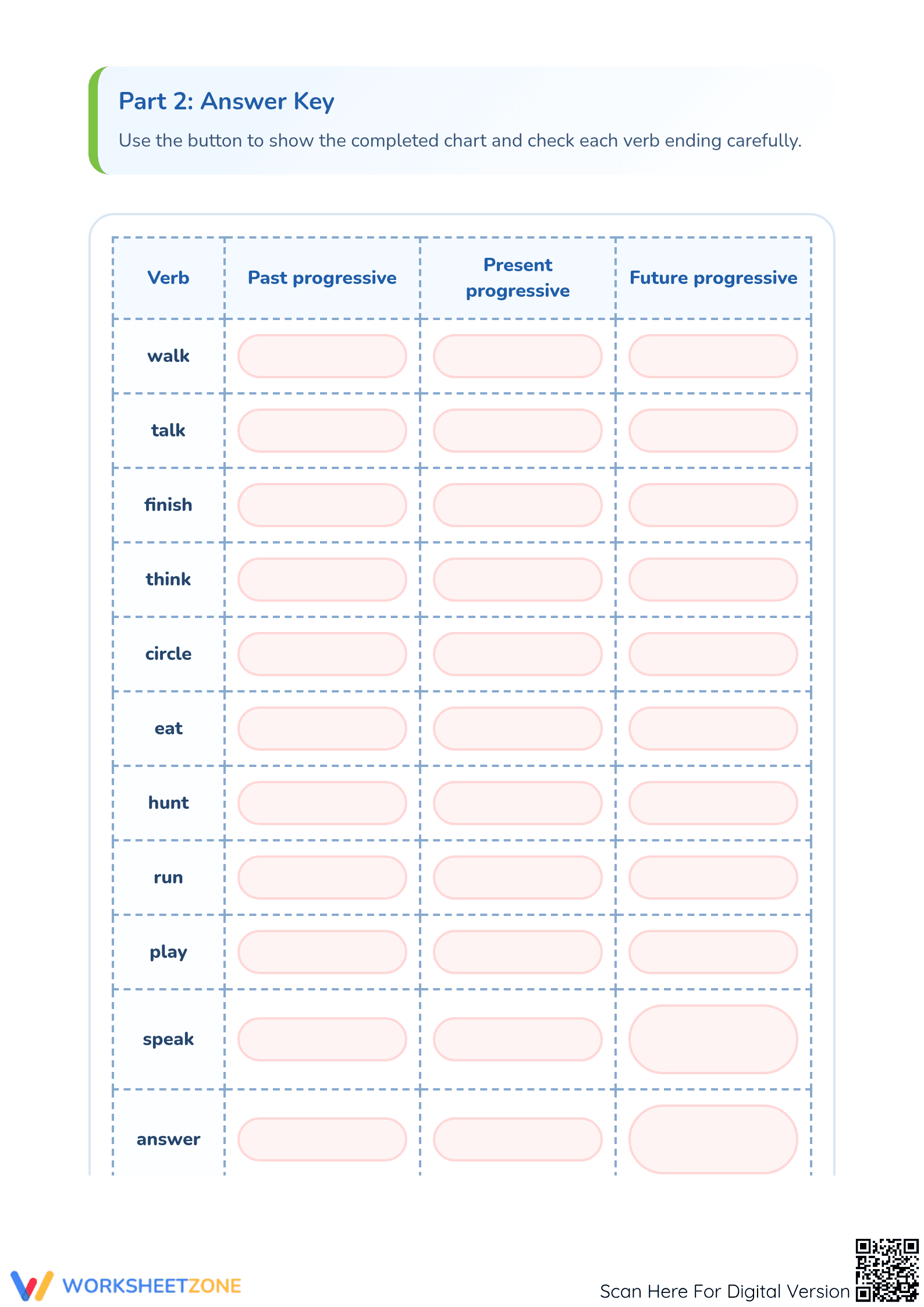
The worksheet features a comprehensive 12-row chart where students convert base verbs—such as walk, talk, and finish—into their progressive counterparts. Each row requires three entries: the past progressive (was/were), present progressive (is/am/are), and future progressive (will be). A clear example box provides a visual reference, and a full answer key is included.
Skill Progression
- Guided Practice: The introductory header defines the three progressive forms with clear color-coded examples, acting as a permanent anchor for the duration of the task.
- Supported Practice: The 12 verbs selected are high-frequency words, allowing students to focus on the tense-forming mechanics rather than vocabulary decoding.
- Independent Practice: With 36 total response slots, students engage in high-repetition practice that builds muscle memory for auxiliary verb agreement and suffix addition.
This structure ensures that learners move from understanding the rule to applying it fluently across all three temporal domains using a gradual-release model.
Standards Alignment
This resource is directly aligned to `CCSS.ELA-LITERACY.L.3.1.E`. This standard requires students to "Form and use the simple and progressive (e.g., I was walking; I am walking; I will be walking) verb tenses." By focusing specifically on the progressive aspect, this worksheet addresses the core mechanics of the standard. This standard code can be copied directly into lesson plans or IEP goals.
How to Use It
Use this worksheet during the guided practice phase of a grammar lesson on verb aspects. After introducing the concept of actions in progress, have students complete the first three rows together to check for understanding. It also serves as an excellent formative assessment tool; teachers can observe if students correctly select auxiliary verbs while maintaining correct spelling. Expect completion in 15-20 minutes.
Who It's For
Designed for third-grade students mastering grammar nuances, this worksheet is also effective for ESL learners who need structured practice with auxiliary patterns. It pairs naturally with a short narrative text or a picture prompt where students must describe what characters are doing in a scene.
Grammar mastery, specifically verb tense consistency, is a foundational pillar of Grade 3 literacy. Research from EdReports 2024 highlights that systematic practice with progressive verb tenses—was walking, is walking, will be walking—enables students to convey complex temporal relationships in their writing. This worksheet aligns with CCSS.ELA-LITERACY.L.3.1.E by providing high-frequency verb practice across past, present, and future forms. By mastering the inflectional endings and auxiliary verb combinations, learners build the syntactic stamina required for narrative fluency. Educational frameworks emphasize that repeated exposure to these structures during the transitional third-grade year prevents tense shifting errors common in early elementary compositions. This resource serves as a structured bridge between simple tense recognition and advanced paragraph construction, ensuring that students can accurately reflect actions in progress across any timeline. Teachers can leverage this data-driven approach to monitor individual progress and provide targeted intervention where auxiliary verb agreement remains a challenge for specific learners.


