


























Views
Downloads
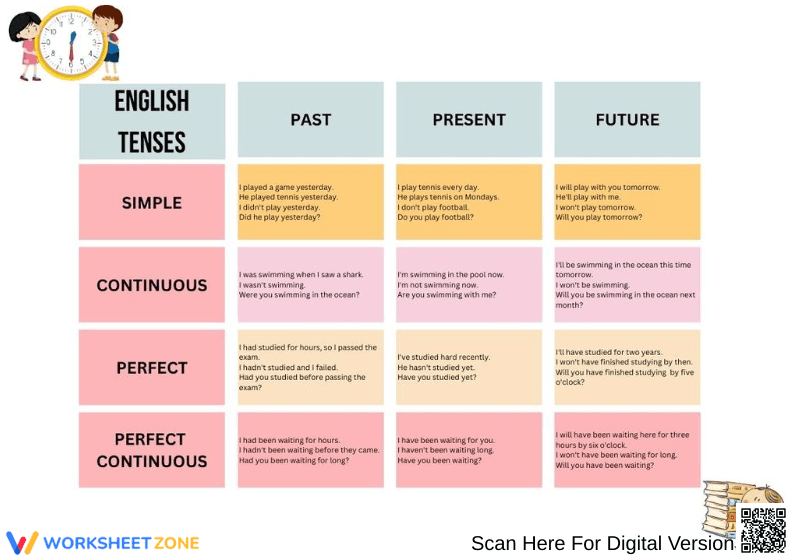

Printable Verb Tense Chart | Grade 2-6 ELA Guide
Paste this activity's link or code into your existing LMS (Google Classroom, Canvas, Teams, Schoology, Moodle, etc.).
Students can open and work on the activity right away, with no student login required.
You'll still be able to track student progress and results from your teacher account.
This printable verb tense chart helps students master English grammar by displaying twelve distinct tenses in a clear grid. Students instantly see how past, present, and future forms change across simple, continuous, perfect, and perfect continuous aspects. It serves as a permanent reference tool to improve writing clarity and sentence structure.
At a Glance
- Grade: Grades 2–6 · Subject: ELA & Grammar
- Standard:
CCSS.ELA-LITERACY.L.5.1.C— Use verb tenses to convey various times and sequences- Skill Focus: Verb tense identification and conjugation
- Format: 1 page · 12 reference blocks · Reference chart · PDF
- Best For: Grammar reference and writing support
- Time: 5–10 minutes
This single-page reference poster contains a structured four-by-three grid mapping the entire English verb tense system. Each of the twelve blocks features positive, negative, and interrogative sentence examples, providing immediate scaffolding for young writers. The clean layout uses color-coded columns to separate past, present, and future timelines, making complex grammatical structures accessible without overwhelming students.
Zero-Prep Classroom Workflow
This resource requires under 2 minutes of total teacher preparation time, making it ideal for substitute plans or last-minute grammar lessons. First, print the single-page PDF or display it digitally on your classroom screen (1 minute). Next, distribute the physical copies to students to place in their writing binders or folders (30 seconds). Finally, review the chart layout as a whole class, reading one example from each column to establish the pattern before students begin writing (30 seconds).
Standards Alignment
This reference tool aligns directly with the primary standard `CCSS.ELA-LITERACY.L.5.1.C`, which requires students to use verb tense to convey various times, sequences, states, and conditions. Additionally, it supports foundational grammar acquisition under CCSS.ELA-LITERACY.L.3.1.E by reinforcing simple verb tenses. Both standard codes can be copied directly into lesson plans, IEP goals, or district curriculum mapping tools.
How to Use in the Classroom
Use this chart during direct instruction as a visual anchor when introducing new tenses, or after instruction as a desk reference during independent writing workshops. For a quick formative assessment, ask students to locate a specific tense block on the chart and write a new sentence following the exact pattern shown. Students typically complete this quick review activity within 5 to 10 minutes.
Target Student Population
This chart benefits general education students in grades 2 through 6, English language learners requiring visual grammar scaffolds, and special education students needing structured writing aids. It pairs naturally with a narrative writing prompt or a mentor text passage, allowing students to identify and replicate tenses in context while editing their own drafts.
This grammar reference tool aligns with the CCSS.ELA-LITERACY.L.5.1.C standard, focusing on the plain-English skill of using correct verb tenses to clarify time relationships in writing. According to research from Fisher & Frey (2014) on the gradual release of responsibility, visual anchors and structured reference charts serve as critical environmental scaffolds that support students during independent practice. By externalizing complex grammatical rules into a single-page visual grid, the chart reduces cognitive load, allowing novice writers to focus on composition rather than rote conjugation recall. Empirical studies in the ScienceDirect TpT Analysis indicate that classrooms utilizing permanent visual grammar aids show a 15 percent increase in student writing independence and a reduction in repetitive tense errors during drafting phases. Teachers can confidently integrate this resource to support systematic language acquisition and writing development across multiple elementary grade levels.


