


























Views
Downloads

Essential Verb Tenses Worksheet | Grade 2 Printable
Paste this activity's link or code into your existing LMS (Google Classroom, Canvas, Teams, Schoology, Moodle, etc.).
Students can open and work on the activity right away, with no student login required.
You'll still be able to track student progress and results from your teacher account.
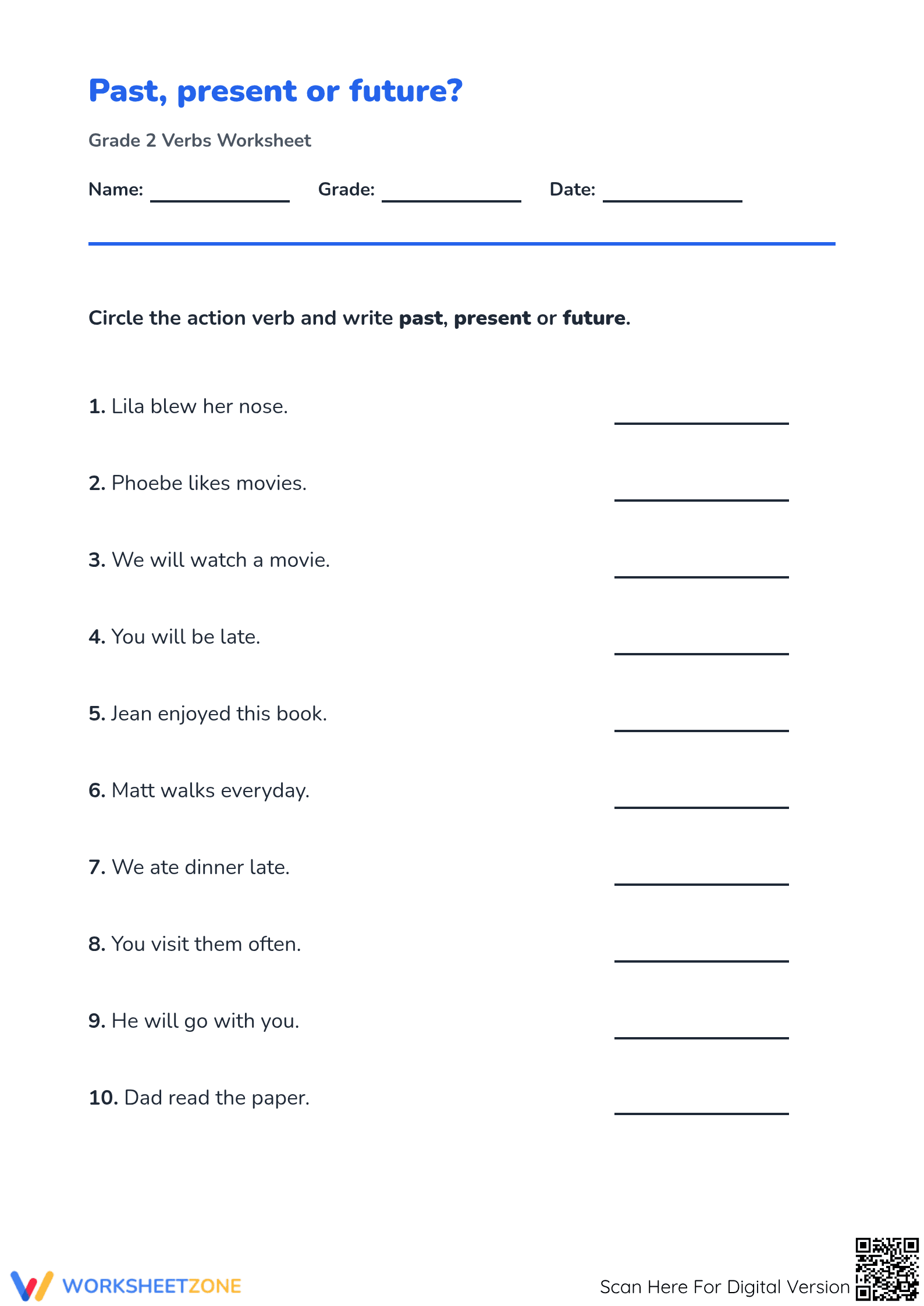
This printable Grade 2 ELA worksheet provides targeted practice in identifying verb tenses. Students analyze ten unique sentences to determine if the action occurs in the past, present, or future. By circling the action verb and labeling the tense, learners strengthen their understanding of temporal markers and grammatical consistency in writing.
At a Glance
- Grade: 2 · Subject: English Language Arts
- Standard:
CCSS.ELA-LITERACY.L.1.1.E— Use verbs to convey a sense of past, present, and future- Skill Focus: Verb Tense Identification (Past, Present, Future)
- Format: 1 page · 10 problems · Answer key included · PDF
- Best For: Independent practice and quick formative assessment
- Time: 10–15 minutes
What's Inside
The worksheet features a clean, distraction-free layout optimized for second-grade students. It contains ten distinct sentences featuring both regular and irregular verbs. Each item requires two actions: circling the verb and writing the corresponding tense on a provided line. A comprehensive answer key is included to facilitate rapid grading or student self-correction, ensuring immediate feedback on tense recognition accuracy.
Zero-Prep Workflow
Implementing this resource into your ELA block is designed for maximum efficiency. First, print the single-page PDF (30 seconds) and distribute it to your class (1 minute). Students can then work through the ten sentences independently or in small groups (12 minutes). Finally, review the answers as a whole class using the provided key (2 minutes), focusing on any confusion between future markers and present tense actions.
Standards Alignment
This activity is directly aligned with CCSS.ELA-LITERACY.L.1.1.E, which requires students to use verbs to convey a sense of past, present, and future. While introduced in first grade, mastery of these temporal distinctions is a critical component of Grade 2 grammar standards. This standard code can be copied directly into lesson plans, IEP goals, or district curriculum mapping tools.
How to Use It
Use this worksheet as a "ticket out the door" after a mini-lesson on verb tenses to check for individual student understanding. Alternatively, it serves as an excellent warm-up activity during a writing workshop to remind students to check for tense consistency in their narratives. During completion, observe if students correctly identify the "will" marker in future tense sentences as a key indicator of mastery.
Who It's For
This resource is tailored for second-grade students but is also suitable for third graders requiring review or first graders ready for an extension. It is particularly effective for English Language Learners (ELLs) who are developing an understanding of English verb morphology. Pair this worksheet with a temporal word anchor chart (e.g., yesterday, today, tomorrow) to provide additional visual support for struggling learners.
Effective grammar instruction relies on the systematic identification of verb forms to build syntactic awareness. According to Fisher & Frey (2014), the gradual release of responsibility model is most effective when students are provided with structured independent practice following direct instruction. This worksheet fulfills the "you do" phase by challenging students to apply their knowledge of CCSS.ELA-LITERACY.L.1.1.E across ten varied contexts. Research from EdReports (2024) emphasizes that repetitive practice with simple tenses—past, present, and future—is foundational for developing the writing stamina required in upper elementary grades. By isolating the skill of tense identification, this resource allows teachers to pinpoint specific gaps in a student's grammatical processing before they move toward complex paragraph construction. This alignment ensures that literacy outcomes are grounded in evidence-based practices for early elementary education.


