


























Views
Downloads


Printable Progressive Verb Tenses 2 Worksheet | Grade 3 ELA
Paste this activity's link or code into your existing LMS (Google Classroom, Canvas, Teams, Schoology, Moodle, etc.).
Students can open and work on the activity right away, with no student login required.
You'll still be able to track student progress and results from your teacher account.
Effectively teach Grade 3 students how to form and use progressive verb tenses across past, present, and future contexts. This three-page worksheet facilitates mastery through structured conjugation and sentence-level application. Students move from basic identification to complex tense transformation, ensuring deep understanding of ongoing actions in standard English grammar.
At a Glance
- Grade: 3 · Subject: English Language Arts
- Standard:
CCSS.ELA-LITERACY.L.3.1— Use various verb tenses to convey specific times and sequences of actions- Skill Focus: Progressive Verb Tenses (Past, Present, Future)
- Format: 3 pages · 22 items · Answer key included · PDF
- Best For: Grammar reinforcement and verb tense mastery
- Time: 25–35 minutes
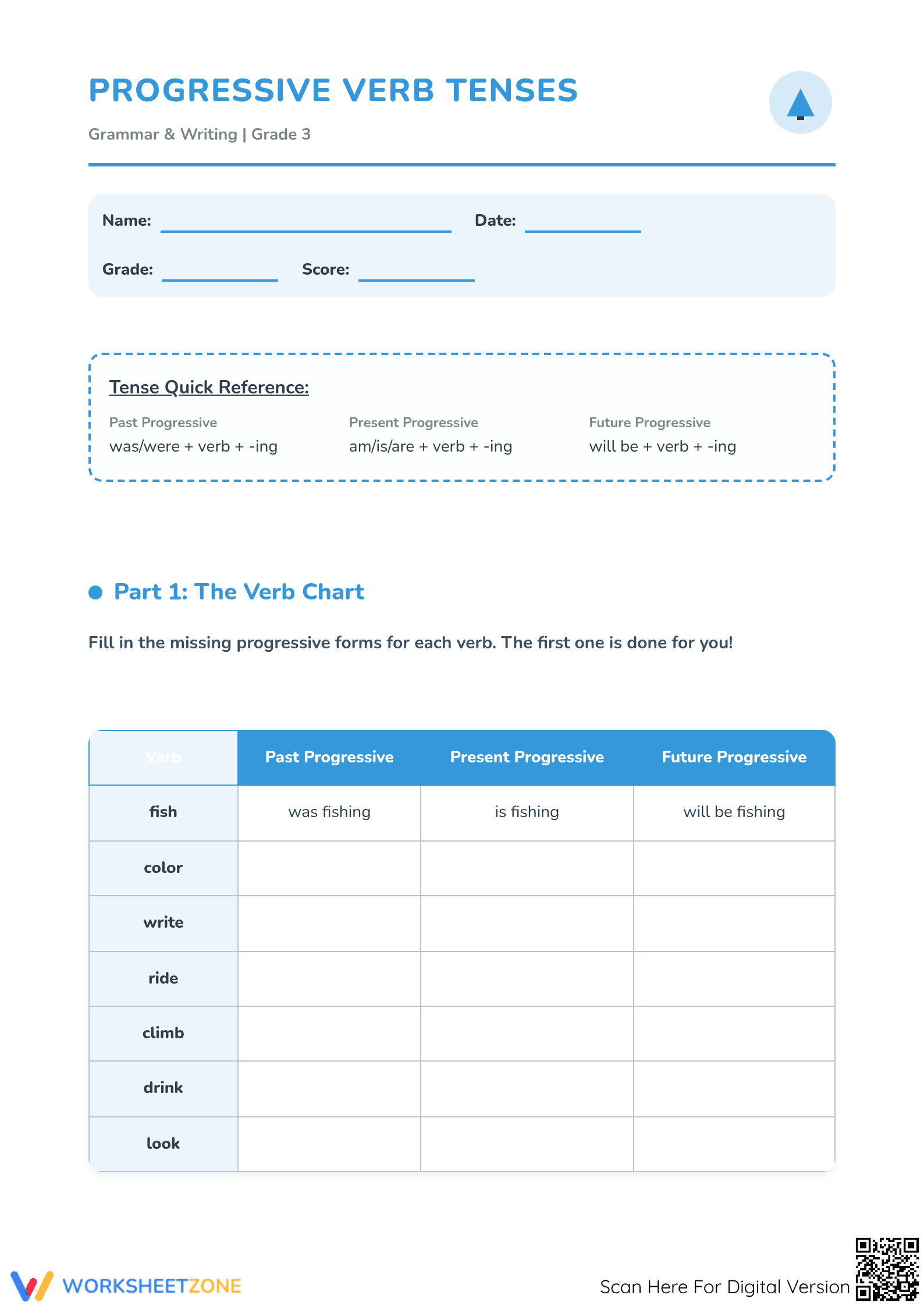
This three-page PDF provides a multi-modal approach to grammar. It includes a tense quick-reference guide, a comprehensive 12-verb conjugation chart (Part 1), five context-driven sentence completion exercises (Part 2), and five challenging tense transformation tasks (Part 3). A full answer key is included to support rapid grading and immediate student feedback.
Skill Progression
- Guided Practice: Part 1 uses a verb chart where students fill in 33 cells for past, present, and future progressive forms using a provided reference guide for scaffolding.
- Supported Practice: Part 2 moves to sentence-level application with 5 fill-in-the-blank items that require selecting the correct tense based on context and parenthetical cues.
- Independent Practice: Part 3 demands mastery as students rewrite 5 complete sentences into specific new progressive tenses, demonstrating an ability to manipulate verb structures independently.
The worksheet utilizes the "I Do, We Do, You Do" model of gradual release, ensuring students build confidence before tackling transformation tasks.
Standards Alignment
This resource aligns with CCSS.ELA-LITERACY.L.3.1, focusing on the student's ability to demonstrate command of standard English grammar and usage when writing. While specifically targeting progressive forms—often introduced as a bridge to Grade 4 mastery—it fulfills the requirement for understanding complex action sequences. This standard code can be copied directly into lesson plans or IEP goals.
How to Use It
Use this worksheet during the "We Do" or "You Do" phase of a grammar lesson. It is ideal for independent desk work or as a formative assessment after teaching the auxiliary verb formula (is/am/are + -ing). Teachers should observe students during the chart completion; if they struggle, provide verbal modeling before they attempt the transformations in Part 3. Expected completion time ranges from 25 to 35 minutes.
Who It's For
Designed for Grade 3 general education students, this resource is excellent for ESL/ELL learners needing practice with English auxiliary verbs and progressive suffixes. It pairs naturally with a short reading passage where students highlight ongoing actions. For differentiation, have struggling learners use the "Tense Quick Reference" box as a constant visual anchor during the transformation tasks.
Research by Fisher & Frey (2014) emphasizes the importance of the gradual release of responsibility in literacy instruction, particularly when students are acquiring complex grammatical structures like the progressive verb tense. By moving from the highly structured environment of a conjugation chart to the more cognitively demanding task of sentence transformation, this worksheet aligns with evidence-based practices for cognitive scaffolding. The inclusion of immediate feedback through an answer key further supports the self-correction loops necessary for grammar mastery in early elementary years. This specific resource targets the transition from simple to progressive tenses, a critical milestone for developing writing fluency as identified in national ELA frameworks. Educators can cite this document as a standards-aligned instrument (CCSS.ELA-LITERACY.L.3.1) designed to build the syntactic complexity required for narrative and informational writing tasks in Grade 3 and beyond.


