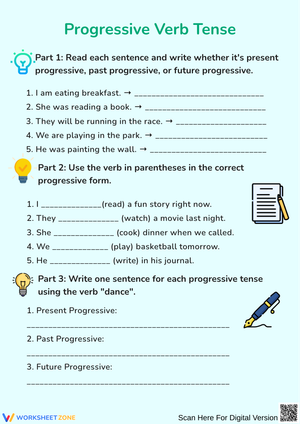
These present continuous tense printable worksheets for 3rd grade give teachers a focused set of resources for one of the trickier grammar milestones at this level — getting students to correctly form, use, and spell ongoing-action sentences. Third graders often know intuitively that "she running" sounds wrong, but explaining why requires them to internalize two separate skills at once: selecting the right helping verb and applying spelling changes to the base verb before adding -ing. The set addresses both directly.
The Specific Skills Each Worksheet Targets
The worksheets divide the tense into its component parts before combining them. Across the set, students practice:
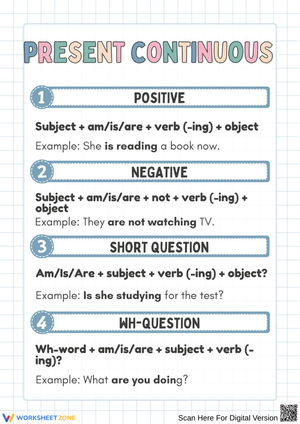
- Choosing the correct helping verb — am, is, or are — based on the subject
- Adding -ing to base verbs that follow the standard rule ("talk" → "talking," "play" → "playing")
- Applying the silent-e drop rule ("dance" → "dancing," "make" → "making")
- Applying the consonant-doubling rule for short one-syllable verbs ("sit" → "sitting," "run" → "running")
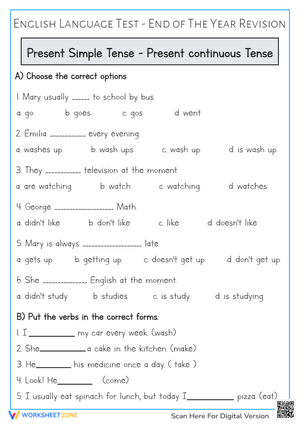
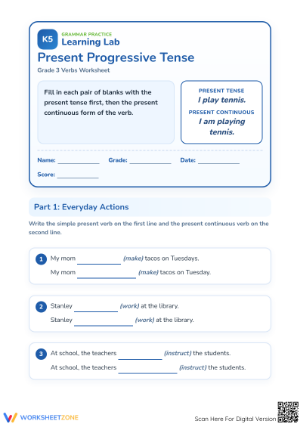
- Converting simple present sentences into present continuous form
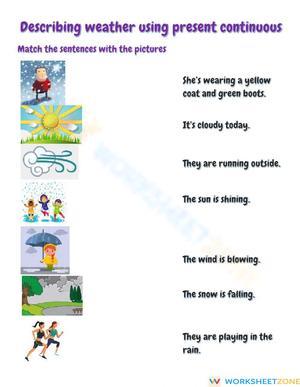
- Writing original sentences from picture prompts showing ongoing actions
The helping verb and the -ing suffix are both obligatory — a sentence missing either one is incorrect — but students regularly get one right while mishandling the other. Worksheets that treat the two skills separately before combining them give students a cleaner path to control over the full structure.
Spelling Changes That Trip Up Third Graders
The -ing suffix looks simple until students meet the silent-e drop and consonant-doubling rules. Writing "makeing" is not careless; it reflects a partially internalized phonics rule being applied in the wrong direction. Students who have learned that silent e keeps the preceding vowel long resist dropping it — they are applying what they already know, just in the wrong context. Similarly, "runing" comes from a real gap: the student has not yet connected consonant doubling to short-vowel preservation.
These present continuous tense printable worksheets for 3rd grade isolate each rule in targeted exercises before blending them. One worksheet asks students to sort base verbs into two groups — "double the consonant" or "drop the e" — before writing the -ing form of each. Another presents a set of present continuous sentences, some with spelling errors and some without, and asks students to mark and rewrite the mistakes. Separating the two rules first lowers the cognitive demand and makes the combined practice that follows more productive.
How to Build These Worksheets Into Your Lesson Planning
The most effective sequence is a live activity before independent written practice, not a cold start on the page. Spend ten to fifteen minutes having students physically act out verbs while classmates narrate: "Darius is hopping. The teacher is writing." Once students have heard and produced the structure several times out loud, the written exercises feel like confirmation rather than guesswork.
The sentence-transformation worksheets work well as Monday warm-ups after morning meeting — five minutes converting "The dog barks" to "The dog is barking" brings grammar back into focus without front-loading the week. The picture-prompt worksheets fit the final eight minutes of a lesson block when early finishers need something purposeful. Worth noting: the transformation exercises can frustrate students who have not yet secured basic subject-verb agreement. Those students need a visible helping-verb reference chart before independent practice becomes useful to them, not after they have already written three wrong answers.
Student Errors Worth Watching For and Addressing Early
The most persistent error is defaulting to "is" regardless of subject. Students write "we is running" and "they is eating" because "is" sounds close enough to right at this age. A classroom anchor chart that pairs each pronoun with its helping verb — "I → am," "he/she/it → is," "we/you/they → are" — posted during independent practice does more sustained work than marking corrections on individual papers. Having students circle the subject before selecting the helping verb catches the majority of agreement errors without requiring teacher intervention on every sentence.
A second pattern involves verbs that describe states rather than actions. Eight-year-olds write "I am wanting a snack" and "She is knowing the answer" because they have internalized "right now = -ing verb" as a universal rule. The term stative verb is unnecessary at this grade, but a direct correction with a plain explanation holds: "Feeling and thinking words usually don't take -ing." A short class list of the most common ones — "want," "know," "like," "love," "need," "understand" — posted in the room gives students a concrete reference when they are uncertain.
Present continuous tense printable worksheets for 3rd grade that include error-correction exercises — where students identify what is wrong and rewrite the sentence — are particularly useful for catching both patterns at once. Students who can spot "She are dancing" and "He is makeing a cake" in the same exercise are working two separate grammar checks simultaneously, which reflects how proofreading actually operates in real writing.
Standard Alignment
The worksheets address CCSS.ELA-LITERACY.L.3.1.E, which calls for students to form and use simple verb tenses. While the standard references simple tenses explicitly, third-grade instruction regularly extends to progressive forms because students need to distinguish habitual action from ongoing action — a contrast that becomes consequential in both narrative and informational writing at this grade. A student describing a science observation needs to know whether "the ice melts" (ongoing process) or "the ice is melting" (right now, as I watch) better fits what they are recording. Building that precision in third grade sets up the more formal progressive tense work expected in grades 4 and 5.
Adjusting the Set for a Range of Learners
For students who are still uncertain which helping verb to use, adding a printed word bank at the top of each worksheet shifts the focus entirely to -ing spelling — one skill at a time rather than two. That one adjustment does not change the content of the exercise; it changes where the student's attention goes. Students who need more support with subject-verb agreement get the most from the worksheet after reviewing the anchor chart, not before they have internalized that reference.
Advanced writers who handle the mechanics without difficulty benefit more from the picture-prompt and open-response exercises than from fill-in tasks. Push those students toward multi-sentence descriptions — "The girl is pouring the water. The younger kids are watching her" — and ask them to explain their helping-verb choice in one sentence. Making a rule explicit in writing is a stronger comprehension check than a correct answer alone.
Frequently Asked Questions
How do I explain the difference between simple present and present continuous to eight-year-olds?
Anchor the distinction in time words rather than grammar definitions. Simple present belongs to "always," "every day," and "usually" — things that are true as routine. Present continuous belongs to "right now" and "at this moment." Put those time markers on the board and have students practice choosing which one fits a given sentence. A student who immediately recognizes that "I eat my lunch right now" sounds wrong — and self-corrects to "I am eating my lunch right now" — has already grasped the core distinction. The time-marker sort takes about five minutes and does more practical work than a formal definition would.
What spelling errors appear most often when students complete these worksheets?
"Makeing," "danceing," and "runing" are the three that show up most consistently in student work. The silent-e errors come from students applying a phonics rule in the wrong context — they know silent e matters, but have not yet learned that -ing makes it unnecessary. The missing doubled consonant in "runing" is a separate gap: the student has not connected consonant doubling to short-vowel preservation. Catching these patterns early in worksheet practice, before they settle into daily writing habits, is exactly where these present continuous tense printable worksheets for 3rd grade do their most useful work.
Do I need to formally teach stative verbs at this grade level?
The concept is worth addressing; the terminology is not required. Third graders do not need to know the word "stative," but they benefit from knowing that certain verbs — particularly those describing feelings, thoughts, and states of being — sound wrong with -ing attached. A short class list of the most common ones ("know," "want," "like," "love," "understand," "need") gives students a concrete reference when they are unsure. Most eight-year-olds, once shown a few side-by-side examples, recognize that "I am needing a pencil" sounds off even if they cannot explain why.












 Interactive Worksheet Maker
 Quiz Maker
 Word Search Maker
 Crossword Puzzle Maker
 Word Scramble Generator
 Sentence Scramble Generator
 Handwriting Worksheet Generator
 Name Tracing Generator
 Fill In The Blank Generator