


























Views
Downloads


Future Progressive Tense Worksheet | Grade 3 Essential
Paste this activity's link or code into your existing LMS (Google Classroom, Canvas, Teams, Schoology, Moodle, etc.).
Students can open and work on the activity right away, with no student login required.
You'll still be able to track student progress and results from your teacher account.
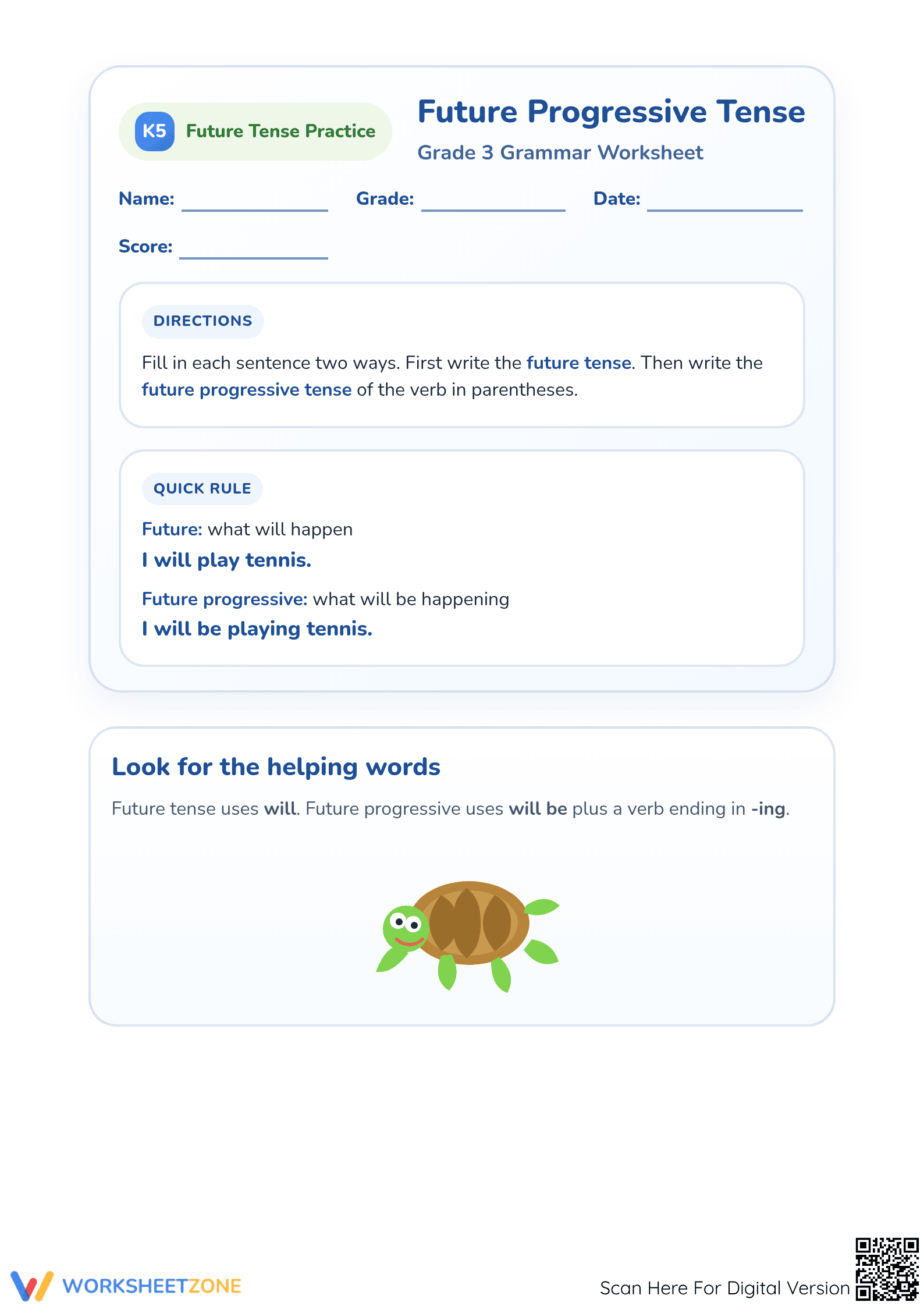
This Grade 3 future progressive tense worksheet helps students master the distinction between simple future and future progressive verb forms. By practicing 10 structured sentence pairs, learners develop the grammatical precision needed for clear writing and speaking. Students will successfully identify helping words and apply correct verb endings to indicate ongoing future actions.
At a Glance
- Grade: 3 · Subject: ELA
- Standard:
CCSS.ELA-LITERACY.L.3.1.E— Form and use simple and progressive verb tenses correctly- Skill Focus: Future Progressive Tense
- Format: 3 pages · 10 problems · Answer key included · PDF
- Best For: Independent practice or grammar centers
- Time: 15–20 minutes
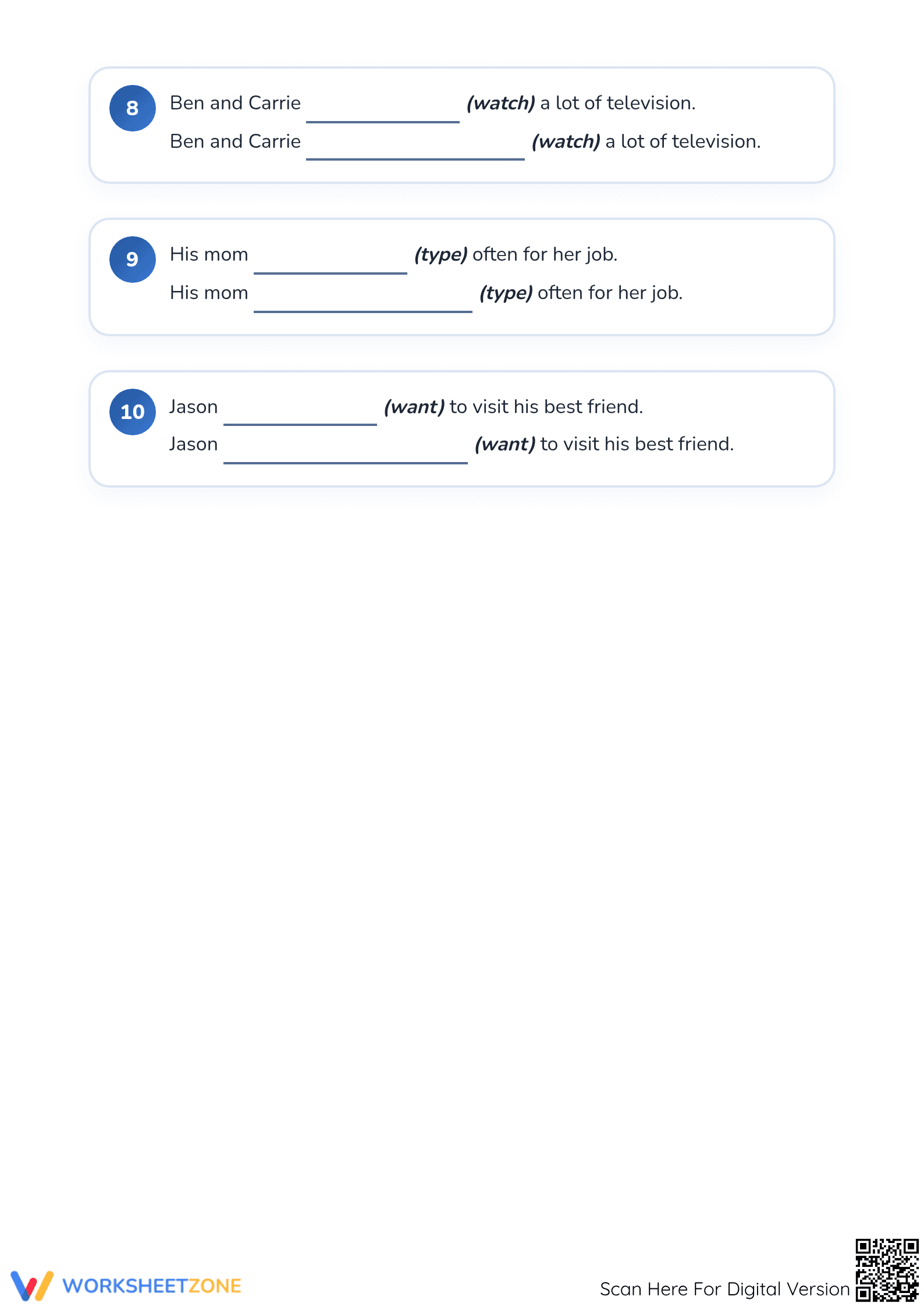
This comprehensive 3-page PDF includes a dedicated instructional header with a "Quick Rule" box and a visual "Helping Words" guide. The main activity consists of 10 sentence-completion tasks where students must provide two variations for every verb: the simple future and the future progressive. A full answer key is provided for immediate feedback or self-grading.
The zero-prep workflow is designed for maximum efficiency in busy classrooms. First, print the three-page set (30 seconds). Next, distribute to students; the built-in "Quick Rule" section acts as a mini-lesson, allowing students to begin immediately without a lengthy lecture (1 minute). Finally, use the included answer key for rapid review or peer-grading (2 minutes). This resource is an ideal grab-and-go option for substitute folders.
This resource aligns with `CCSS.ELA-LITERACY.L.3.1.E`, which requires students to form and use the simple (e.g., I will walk) and progressive (e.g., I will be walking) verb tenses. By contrasting these two forms side-by-side, students gain a deeper understanding of how temporal markers change sentence meaning. Both standard codes can be copied directly into lesson plans, IEP goals, or district curriculum mapping tools.
Use this worksheet as a formative assessment after introducing the concept of "will be" + "-ing" verbs. It works exceptionally well during the independent practice phase of a lesson. Teachers should observe if students remember to include both the helping verb "be" and the "-ing" suffix. Completion typically takes 15 to 20 minutes depending on writing speed.
This practice is tailored for third-grade students but serves as an excellent scaffold for English Language Learners (ELLs) who struggle with auxiliary verb placement. It pairs naturally with a mentor text focused on future plans or a classroom anchor chart detailing verb tense timelines.
According to the RAND AIRS 2024 report, structured grammar practice that utilizes explicit rules and side-by-side comparisons significantly improves student retention of complex verb structures. This worksheet applies these principles by requiring students to generate both simple future and future progressive forms for the same verb, reinforcing the specific function of the CCSS.ELA-LITERACY.L.3.1.E standard. By isolating the "will be" + "-ing" construction, the resource reduces cognitive load and allows Grade 3 learners to focus on the morphological changes required for progressive tenses. Research from Fisher & Frey (2014) suggests that such scaffolded independent practice is vital for moving students toward linguistic mastery. This 10-task set provides the necessary repetition to ensure students can accurately communicate ongoing future actions in their own writing and academic discussions.


