


























Views
Downloads


Progressive Verb Tenses Worksheet | Grade 3 Essential
Paste this activity's link or code into your existing LMS (Google Classroom, Canvas, Teams, Schoology, Moodle, etc.).
Students can open and work on the activity right away, with no student login required.
You'll still be able to track student progress and results from your teacher account.
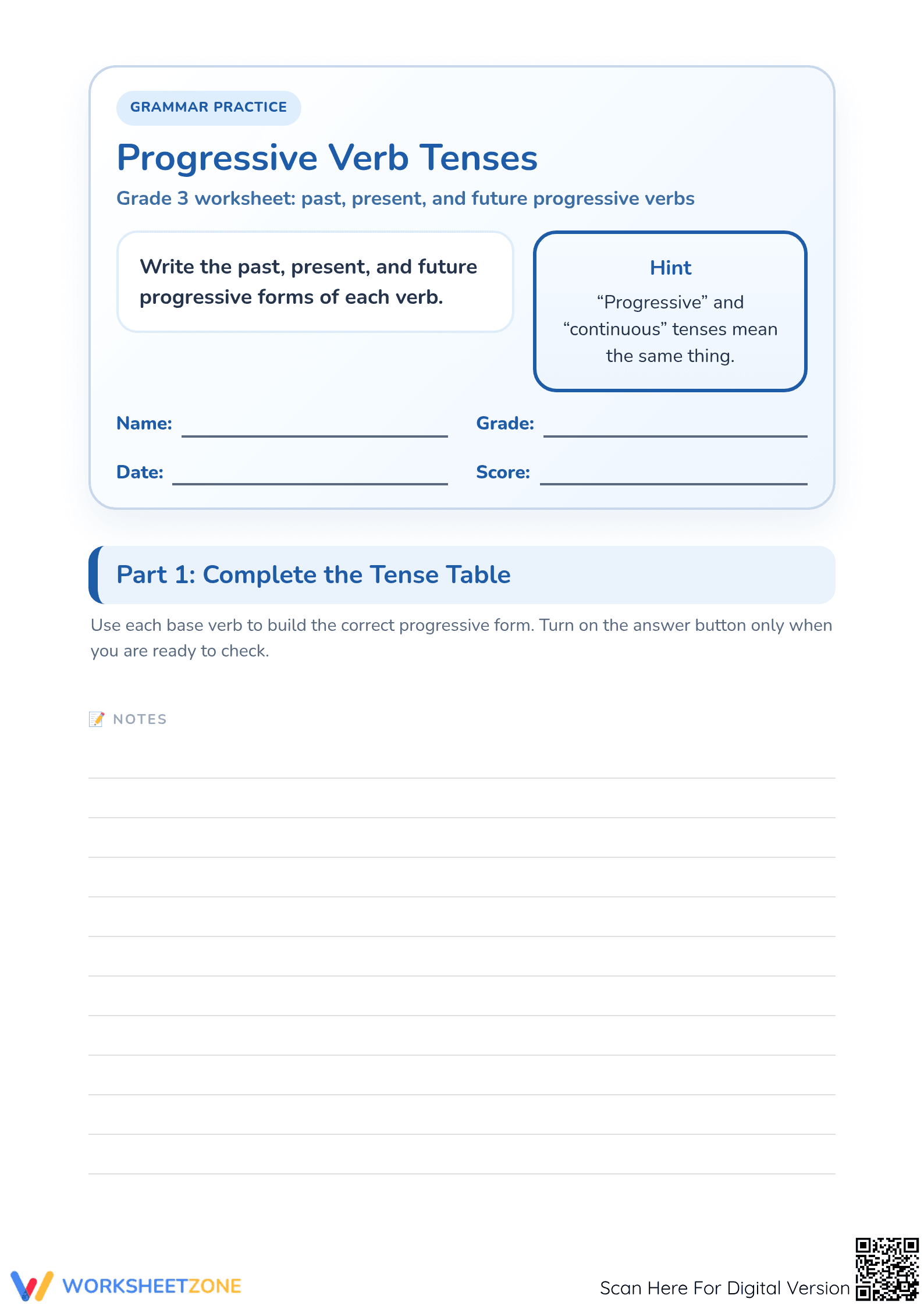
This Grade 3 grammar worksheet helps students master progressive verb tenses by transforming 13 common base verbs into their past, present, and future forms. By focusing on the "ing" suffix and auxiliary verbs, learners develop the linguistic precision needed for descriptive writing and accurate storytelling. It provides a clear, structured path to verb tense mastery.
At a Glance
- Grade: Grade 3 · Subject: ELA
- Standard:
CCSS.ELA-LITERACY.L.3.1.E— Form and use past, present, and future verb tenses accurately- Skill Focus: Progressive Verb Tenses
- Format: 3 pages · 39 problems · Answer key included · PDF
- Best For: Independent grammar practice and morning work
- Time: 15–20 minutes
What's Inside: The resource includes a comprehensive three-page PDF. The first page features a student notes section for recording rules, while the second page contains a 13-row verb table. Students work with verbs like "run," "swim," and "forget," filling in 39 total cells. A full answer key is provided on the final page to facilitate quick grading or student self-correction.
Zero-Prep Workflow: This resource is designed for immediate classroom implementation. First, print the three-page PDF (30 seconds). Next, distribute the verb table to students for independent or small-group work (1 minute). Finally, use the included answer check page to review spelling changes and auxiliary verb usage with the whole class (5 minutes). Total teacher preparation time is under two minutes.
Standards Alignment: The primary focus is CCSS.ELA-LITERACY.L.3.1.E, which requires students to form and use various verb tenses. This worksheet specifically targets the progressive (continuous) aspect, helping students understand how "was," "is," and "will be" change the temporal context of an action. Both standard codes can be copied directly into lesson plans, IEP goals, or district curriculum mapping tools.
How to Use It: Use this worksheet during the "You Do" phase of a gradual release lesson on verb aspects. It serves as an excellent formative assessment to identify students struggling with spelling shifts, such as doubling consonants in "running." Expected completion time is 15 to 20 minutes, making it ideal for literacy centers or a focused homework assignment.
Who It's For: This practice is tailored for third-grade students but remains highly effective for English Language Learners (ELLs) who need explicit practice with auxiliary verbs. It pairs naturally with a mentor text focused on action or a classroom anchor chart detailing the "ing" spelling rules for various verb endings.
Research from Fisher & Frey (2014) emphasizes that the gradual release of responsibility is most effective when students engage in high-volume, focused practice of discrete linguistic skills like verb conjugation. This worksheet provides 39 specific opportunities for students to apply the rules of progressive tenses, reinforcing the connection between auxiliary verbs and the "ing" participle. By aligning with CCSS.ELA-LITERACY.L.3.1.E, the resource ensures that Grade 3 learners move beyond simple tense recognition toward active production of complex verb forms. This type of structured repetition is essential for developing the automaticity required for fluent writing and reading comprehension. According to recent NAEP data, students who demonstrate mastery over verb aspects in early elementary grades show significantly higher proficiency in narrative writing tasks. This resource offers the exact type of scaffolded, standards-based practice necessary to bridge the gap between basic grammar knowledge and sophisticated language application in the classroom.


