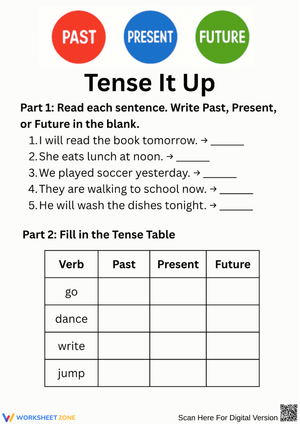
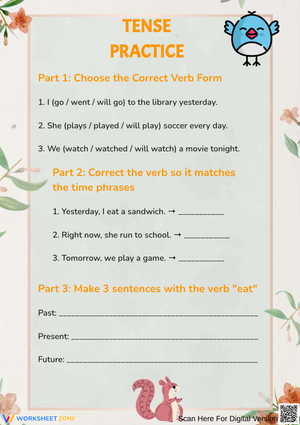
Present simple tense printable worksheets for 3rd grade give teachers a focused set of resources for what is, in many classrooms, the first genuinely thorny grammar challenge of the year: explaining why "she run" is wrong when "they run" is right. Each worksheet targets a specific layer of this tense — from signal word placement and habitual action sentences to the spelling rules for third-person singular verbs and the mechanics of negative constructions using do and does.
What the Set Covers
The worksheets move through the three main contexts where present simple appears: habitual actions ("my dog barks at the mail carrier every day"), general truths and facts ("water freezes at 32 degrees Fahrenheit"), and fixed scheduled events ("school starts at 7:45"). Students identify signal words — always, usually, often, sometimes, never — and practice placing them correctly in a sentence, which sharpens both grammatical awareness and feel for adverbial frequency.
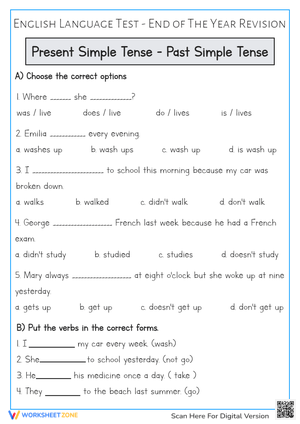
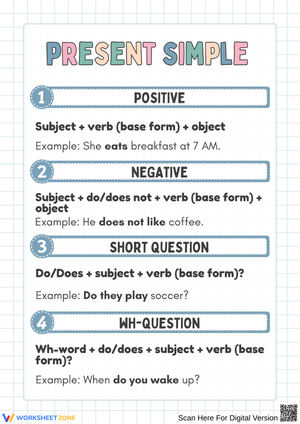
Later exercises shift into sentence transformation: students rewrite affirmative statements as yes/no questions or negative sentences, which means working with do and does as auxiliary verbs. This adds real complexity. In a positive sentence, third-person singular subjects carry the -s on the main verb ("she likes"), but in a negative or question form, does carries that grammatical weight and the main verb returns to its base form ("Does she like?"). Worksheets present both forms together so students see that shift in context rather than as two separate rules to memorize in isolation.
The Third-Person Singular — Where Things Concentrate
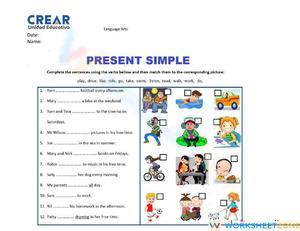
The -s inflection for he, she, and it is where most conjugation errors surface in 3rd-grade writing. Students who follow the general subject pattern — I run, you run, we run, they run — encounter the third-person form as an exception they have to learn rather than a natural extension of what they already know. Several worksheets isolate this rule specifically, presenting sentence blanks that require choosing between a base form and an inflected form before any additional complexity is introduced.
The spelling side of the rule adds its own layer of difficulty. Most verbs take a clean -s, but the exceptions are predictable once students see them as categories:
- Verbs ending in -ch, -sh, -s, -x, or -z take -es: watches, washes, fixes
- Verbs ending in a consonant followed by -y drop the -y and add -ies: carries, flies, studies
- Verbs ending in a vowel followed by -y simply take -s: plays, enjoys
Students who write "studys" or "flys" in their independent work are not guessing randomly — they are applying the standard -s rule without knowing where the spelling exceptions begin. These worksheets make those category boundaries explicit through spelling drills that ask students to sort verbs before applying the correct ending.
Frequent Student Errors Worth Watching For
The most consistent error pattern in 3rd-grade writing involves the interaction between the -s rule and the auxiliary verb system. Students who have internalized both rules separately will often write "Does she runs fast?" — the does is correct, but the -s stays on the main verb because the third-person rule feels unconditional. A sentence transformation exercise where students start from "She runs fast" and must produce "Does she run fast?" surfaces this confusion within a single question, making it visible and addressable before it becomes a dug-in habit.
A second reliable error involves to be and to have. These irregular verbs do not follow the standard -s addition, and students regularly apply regular conjugation by analogy — writing "he haves" by extending "he has" the same way they extend "he talks" from "he talk." Sorting activities in the set separate these irregular verbs from regular ones so students recognize the distinction as a category rather than trying to unlearn a single incorrect form one correction at a time.
Working These Into Your Lesson Plan
These worksheets work cleanly as Monday warm-ups — five minutes at the start of literacy block to reactivate verb tense awareness before students move into writing. Because each worksheet focuses on one piece of the present simple system, they also function well as exit tickets: one worksheet at the end of a grammar mini-lesson tells you, in about eight minutes, which students understood the day's point and which need another pass before moving forward.
Present simple tense printable worksheets for 3rd grade also hold up well in peer-editing structures. After students complete a transformation exercise, swapping papers and checking each other's subject-verb agreement builds a proofreading instinct — a habit worth establishing before 4th grade, when the volume of written output increases sharply and informal grammar review becomes harder to fit in the schedule. For small group instruction, the third-person spelling worksheets in particular let a teacher sit with four or five students working through the -y rule together while the rest of the class works independently.
Standard Alignment
These worksheets address CCSS.ELA-LITERACY.L.3.1.E, which requires students to form and use the simple verb tenses correctly. In most 3rd-grade pacing guides, this standard lands mid-year — after parts of speech review but before the instructional focus shifts to complex sentences and multi-paragraph writing. That placement matters: present simple verb agreement has to be stable before students move into past tense narratives and future tense planning in their own writing. These worksheets do foundation work at the right point in that sequence, not as a standalone grammar unit disconnected from the writing curriculum.
Differentiating These Worksheets for a Range of Learners
For students who need additional support — English Language Learners especially, who are building vocabulary and grammar knowledge at the same time — the most practical adjustment is a two-column reference chart at the top of each worksheet showing the base form beside the third-person singular form: study / studies, watch / watches, play / plays. This reduces working memory demand enough that students can focus on the grammatical decision rather than the spelling. Once the pattern is reliable in that supported context, remove the chart and see what holds.
Present simple tense printable worksheets for 3rd grade can be extended for students who have already internalized the basic rules. Removing the word bank from transformation exercises, or asking students to compose two original sentences using a target verb in both its affirmative and negative forms, reveals the true depth of their understanding — and the gaps that appear at this level are usually more specific and more interesting to address than basic subject-verb agreement errors. For students significantly below grade level, starting with side-by-side first-person and third-person parallel sentences — "I play / she plays," "we watch / he watches" — before moving into full worksheet exercises gives them enough repetition with the core contrast to make the subsequent practice land rather than frustrate.
Frequently Asked Questions
Do the worksheets cover irregular verbs, or only regular conjugation?
The set includes targeted work on to be (am, is, are) and to have (have, has), the two irregular present simple forms 3rd graders most frequently misapply. Sorting activities separate these from regular verb conjugation so students build accurate mental categories rather than treating each irregular form as a separate memorization task stacked on top of the regular rules.
How do these work alongside present continuous instruction?
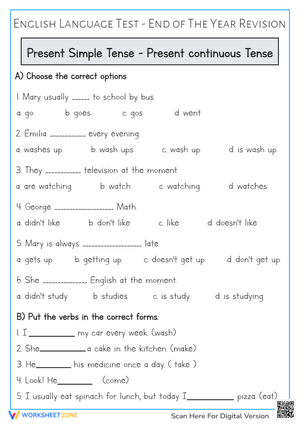
Several exercises pair present simple and present continuous sentences side by side, asking students to identify which tense fits the context. The contrast between "I eat lunch at noon every day" and "I am eating lunch right now" makes the functional difference concrete rather than abstract — far more effective than teaching the two tenses weeks apart with no comparison moment built in.
How often should these worksheets be used during the week?
Short, frequent sessions — three or four times a week for eight to ten minutes — produce more durable retention than one long grammar block per week. Spaced retrieval practice, where students return to the same concepts at intervals rather than covering them in a single concentrated lesson, moves the rules from temporary recall into automatic knowledge. One worksheet per session is generally the right scope; two in a row tends to reduce the attentional quality students bring to the second one.
Are these appropriate for ELL students at the 3rd-grade level?
Present simple tense printable worksheets for 3rd grade work well for ELL students when paired with the reference chart support described above. The sentence frame exercises — where students supply the correct verb form to complete a partially written sentence — are particularly accessible because they limit the production demand while keeping the grammatical decision intact. For students reading below a 2nd-grade level, reading the prompts aloud before independent work time keeps the exercise focused on grammar rather than decoding.












 Interactive Worksheet Maker
 Quiz Maker
 Word Search Maker
 Crossword Puzzle Maker
 Word Scramble Generator
 Sentence Scramble Generator
 Handwriting Worksheet Generator
 Name Tracing Generator
 Fill In The Blank Generator