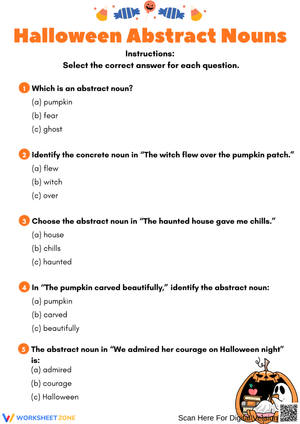
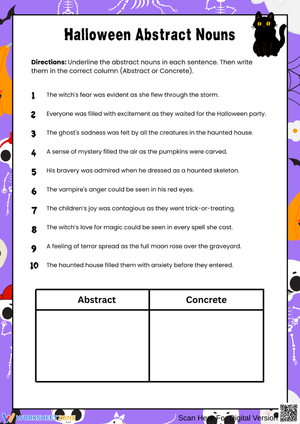
These 3rd grade abstract nouns worksheets target the specific gap third graders hit when they can name a concrete noun confidently but struggle to explain why bravery qualifies as a noun when nobody can hand it to them. Each worksheet moves students from first recognition to active production — sorting abstract nouns against concrete ones, building new abstract nouns through suffix patterns, and using them correctly in original sentences.
The Specific Skills Covered Across the Set
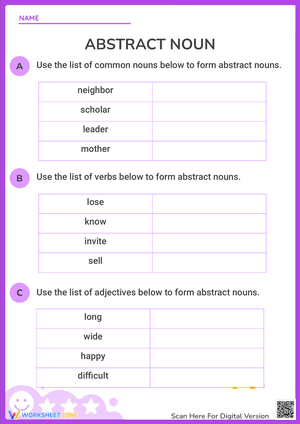
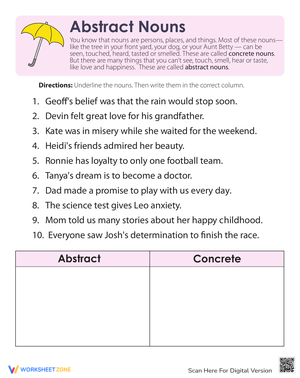
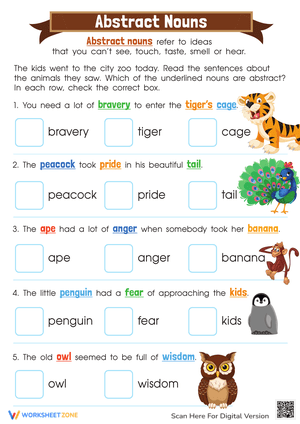
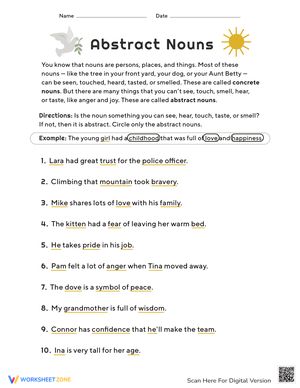
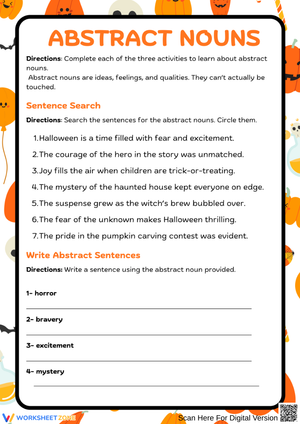
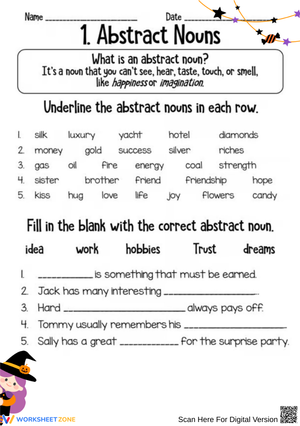
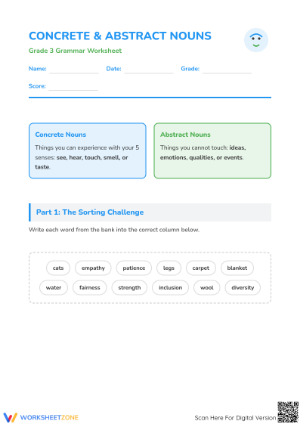
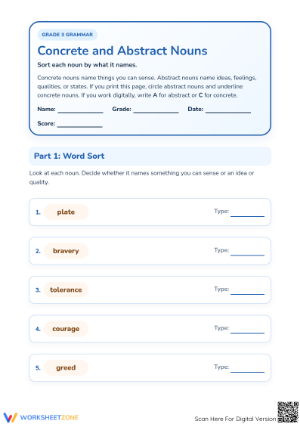
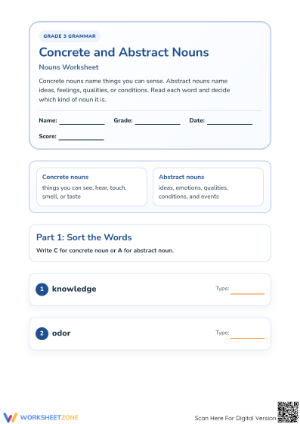
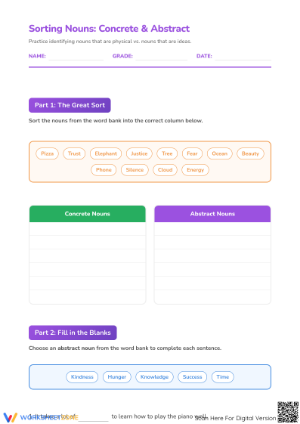
The worksheets address abstract noun instruction at several points of depth. Students begin by applying the Five Senses Test — asking whether a word can be seen, heard, smelled, tasted, or touched — to mixed lists of concrete and abstract nouns. From there, each worksheet shifts to suffix-based word building: students take base adjectives or verbs and construct abstract nouns using -ness (as in sadness), -tion (as in education), -ship (as in friendship), and -ment (as in excitement). A third layer asks students to rewrite sentences by swapping an adjective for its abstract noun equivalent — turning "She was kind to everyone" into a sentence that uses kindness as a subject or object in a complete thought.
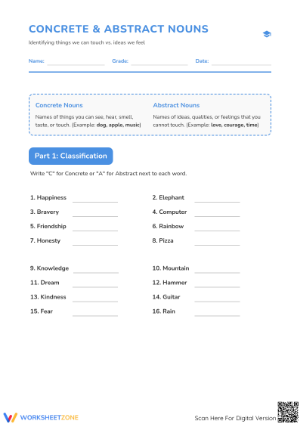
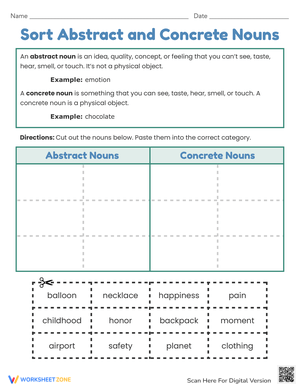
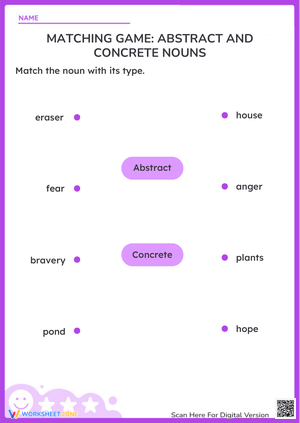
- Sorting nouns as concrete or abstract using the Five Senses Test
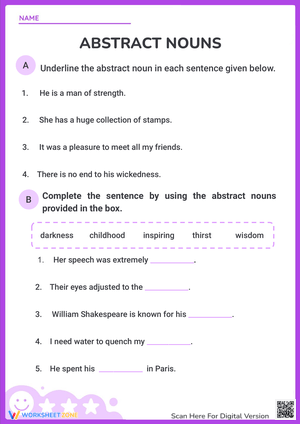
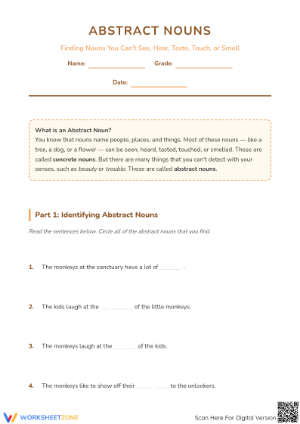
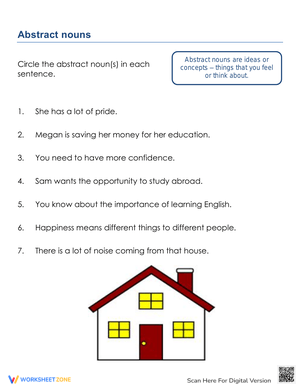
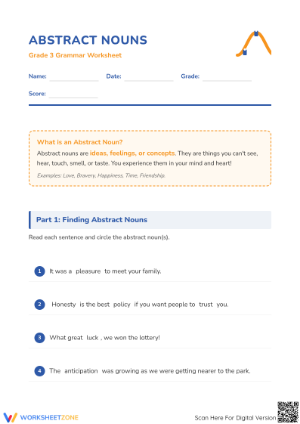
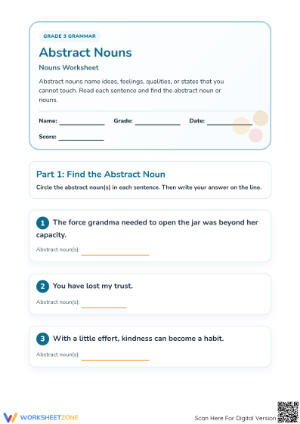
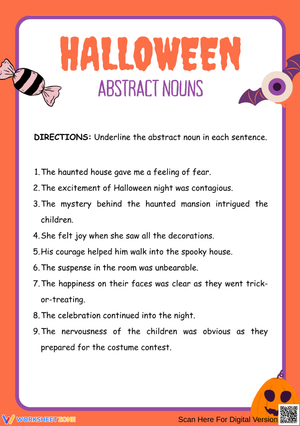
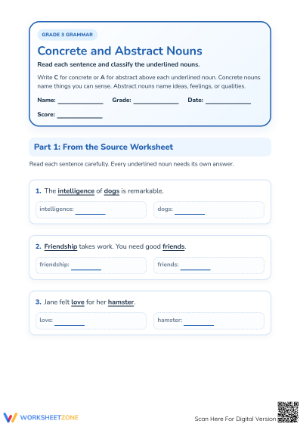
- Identifying abstract nouns in grade-level sentences and short passages
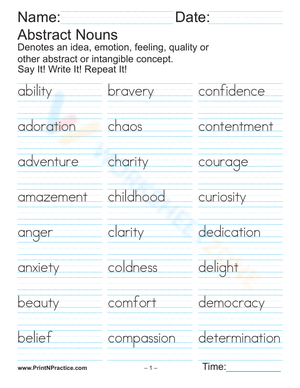
- Building abstract nouns from base words using common suffixes
- Rewriting sentences to shift from adjective form to abstract noun form
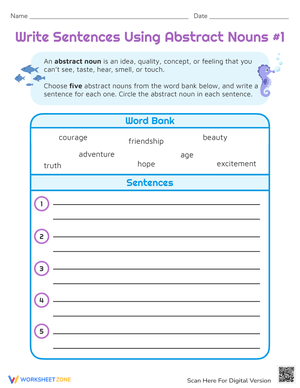
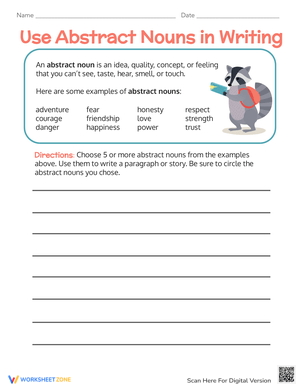
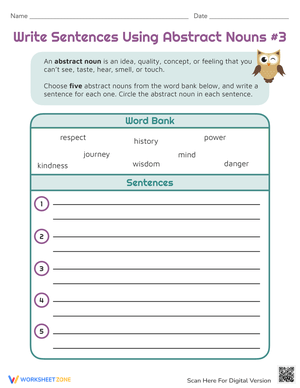
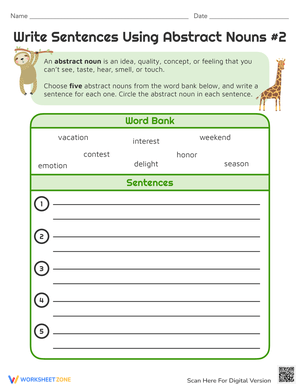
- Completing original sentences with student-generated abstract nouns
Mistakes Students Make That These Worksheets Help Surface
The most persistent error isn't misidentifying obvious words — students rarely call dog abstract. The trouble comes with borderline cases. Time trips students up consistently: they can't touch it, so they mark it abstract, then push back when you point to the clock on the wall. ("That's not time — that's a clock.") They're not entirely wrong, and that productive disagreement is worth having as a class. It forces students to articulate their reasoning rather than just sort cards on instinct.
Suffix work introduces a different error pattern. Once students learn that -ness signals abstract nouns, they overapply the rule. Witness ends in -ness but names a person — clearly concrete. Business behaves the same way. Students who treat suffix patterns as a guaranteed identification test stop thinking about what the word actually names. Introducing these counterexamples early keeps the suffix lessons from becoming a shortcut that quietly undermines the concept you're trying to build.
Building These Worksheets Into Your Lesson Sequence
These work well as Monday warm-ups during the week a class moves from noun basics into abstract nouns. Ten minutes at the start of a lesson — a sorting worksheet passed out face-down until students are settled — keeps the concept visible without eating into writing time. The suffix-focused worksheets fit naturally into a word study block or literacy center rotation, and students can work through them independently once the concept has been introduced whole-group.
Where the set pays off most is the writing connection. Run the sentence-rewriting exercises directly before a personal narrative or character study assignment. Students who have just practiced turning brave into bravery as a noun in a sentence reach for that move more readily in their own writing. That transfer doesn't happen automatically — the timing matters. A 3rd grade abstract nouns worksheets set works as a bridge resource, not just grammar for grammar's sake, when it's placed deliberately before a writing task rather than treated as a standalone unit.
Standard Alignment
These worksheets address CCSS.ELA-Literacy.L.3.1.C, which requires third graders to form and use abstract nouns. In classroom terms, this standard sits in the Language strand and typically lands mid-year, after students have established fluency with plural and possessive nouns. The standard demands both identification and production — students need to recognize abstract nouns in text and use them correctly in their own compositions. Each worksheet in this set addresses one or both of those requirements directly, which keeps instruction aligned to the standard's scope without drifting into adjacent skills.
Adjusting the Worksheets for Students at Different Points in the Learning Curve
For students still working to distinguish concrete from abstract nouns, the sorting worksheets work well when paired with a reference card listing reliable anchor examples — friendship, anger, trust, honesty, freedom. Having those anchors available while working through new words gives students something concrete to compare against without requiring a teacher at their elbow for every decision. This is especially useful during center rotations when your attention is split across groups.
For students ready for more challenge, the sentence-rewriting exercises extend naturally: instead of rewriting a provided sentence, students write two original sentences — one using the adjective form, one using the abstract noun — then explain in writing what changed. English language learners often benefit from an explicit connection to parallel suffix patterns in their home language. Spanish-dominant students, for instance, already use -dad in Spanish (as in lealtad for loyalty) — mapping that onto English -ty and -ness gives those students a productive point of entry rather than treating abstract noun formation as an arbitrary English-only rule. A focused 3rd grade abstract nouns worksheets set makes those adaptations manageable because the exercises are discrete enough to modify or extend without restructuring a full lesson.
Frequently Asked Questions
What definition works best when introducing abstract nouns to 8- and 9-year-olds?
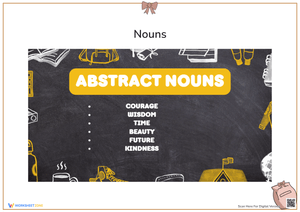
The most classroom-functional definition is: a noun that names something you cannot experience with any of your five senses. Students internalize this faster than definitions built around words like "intangible" or "concept." Pair it with four or five anchor examples — joy, courage, honesty, friendship, time — that students return to throughout the unit whenever a new word creates uncertainty.
Why does CCSS L.3.1.C appear in 3rd grade rather than 2nd?
Third graders are at a developmental stage where abstract thinking begins to solidify. Concrete operational reasoning still dominates, but students this age can increasingly hold an idea in mind without a physical referent in front of them. Placing abstract noun instruction at grade 3 matches the cognitive window when the concept is challenging but achievable — earlier, it demands a level of sustained adult support that whole-group instruction cannot consistently provide.
Can one word function as both a concrete and an abstract noun?
Yes — context determines the classification in some cases. Heart names an organ (concrete) but represents emotion or courage in figurative language (abstract). For third grade instruction, keeping examples clean and unambiguous matters more than exploring edge cases. Save context-dependent words for students who have the core concept firmly in place and are ready for genuine nuance rather than confusion.
Where does this resource fit within a full grammar sequence?
Abstract noun instruction lands most effectively after students are confident with basic noun categories — common, proper, plural, possessive. It serves as a bridge between noun mechanics and the vocabulary work students tackle in preparation for more demanding reading and writing. Bringing a 3rd grade abstract nouns worksheets set into that transition point gives teachers a targeted resource that extends noun knowledge without requiring students to set aside the grammar foundation they already have.












 Interactive Worksheet Maker
 Quiz Maker
 Word Search Maker
 Crossword Puzzle Maker
 Word Scramble Generator
 Sentence Scramble Generator
 Handwriting Worksheet Generator
 Name Tracing Generator
 Fill In The Blank Generator