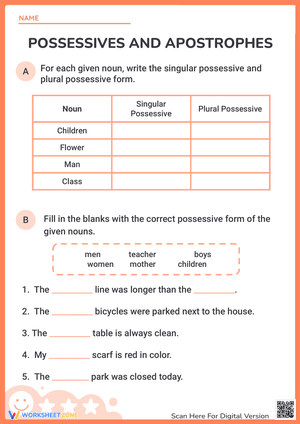
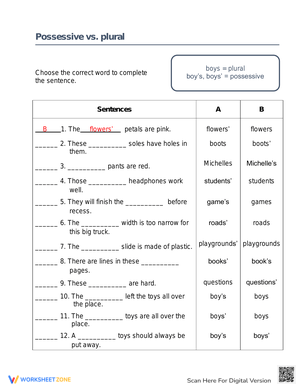
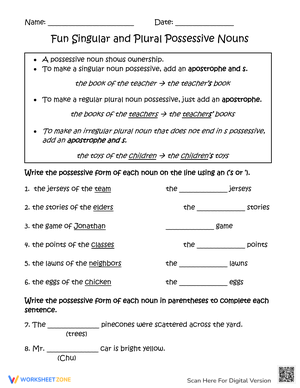
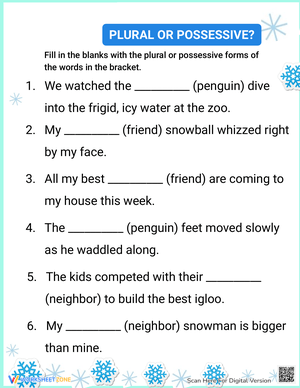
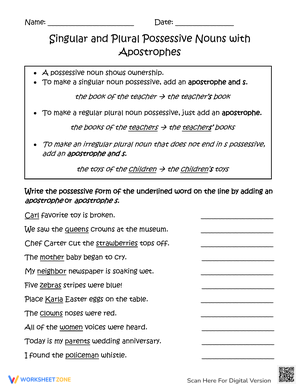
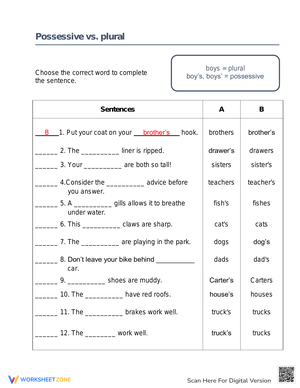
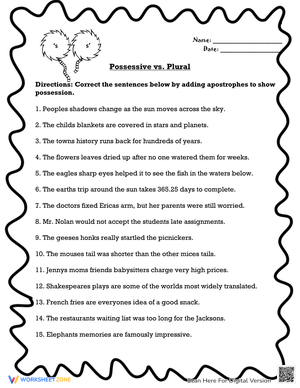
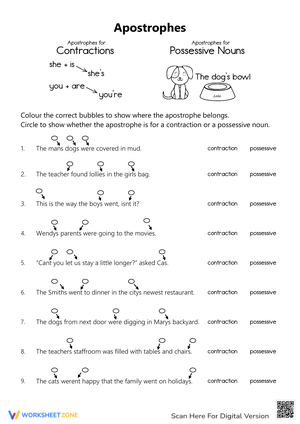
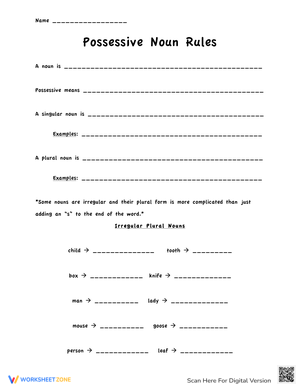
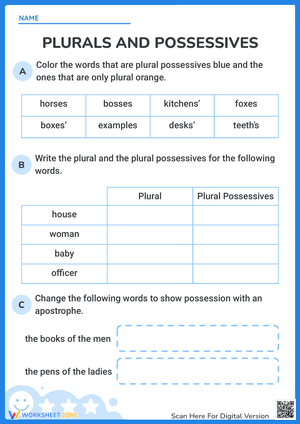
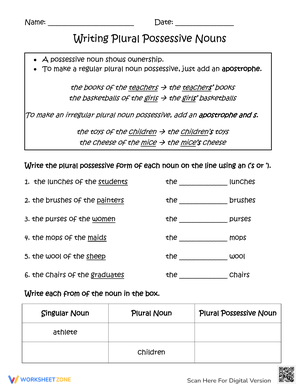
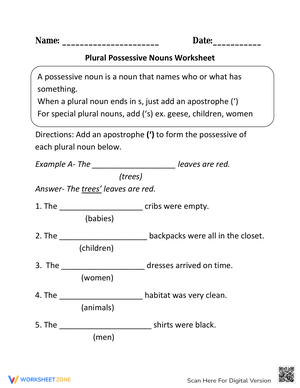
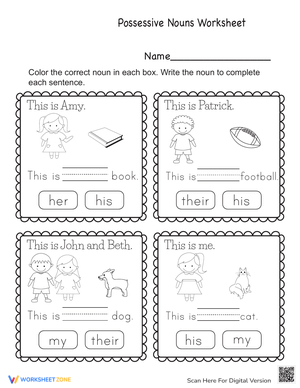
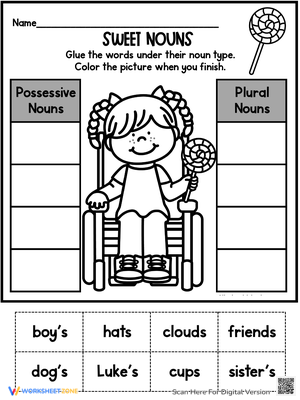
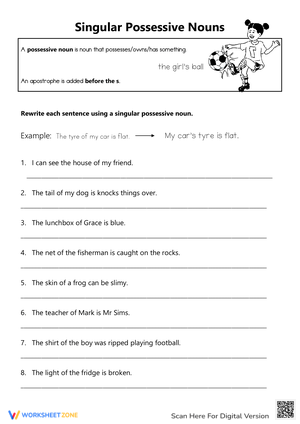
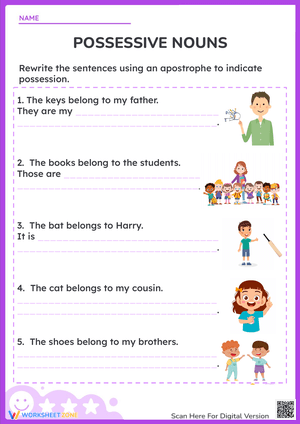
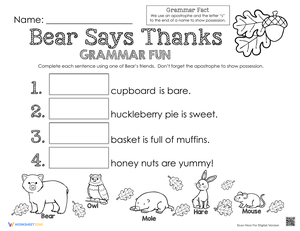
These 3rd grade possesive nouns worksheets give teachers a ready-made set of targeted practice for one of the trickiest grammar turning points in elementary school — the point where ownership enters the noun unit and the apostrophe arrives with it. Each worksheet focuses on one distinct possessive construction, so students aren't asked to sort out singular, regular plural, and irregular plural forms simultaneously before any of those patterns have settled. The set builds from singular possessives outward, following the progression that actually holds up in a classroom.
The Specific Skills Each Worksheet Targets
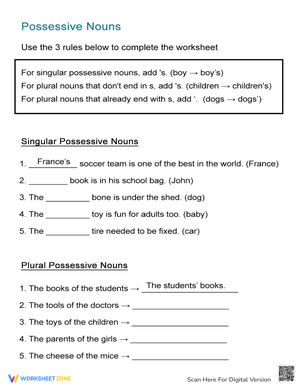
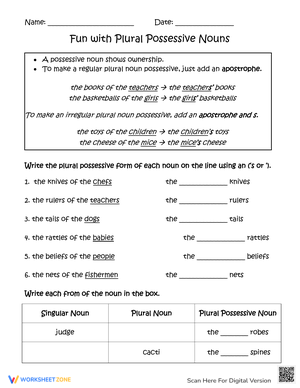
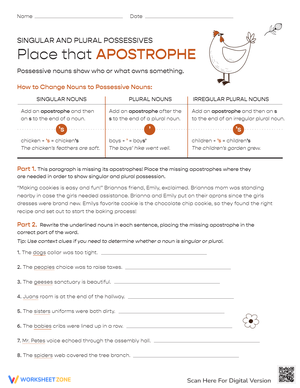
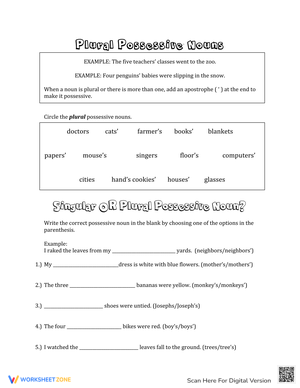
The three constructions third graders need to produce — and routinely confuse — each receive dedicated practice before students encounter mixed exercises. Singular possessives come first: students rewrite phrases like "the notebook of the teacher" as "the teacher's notebook," placing the apostrophe before the -s on a single owner. Regular plural possessives come next, covering nouns that already end in -s, where the apostrophe moves to the end — "the students' project," never "the students's project." Finally, irregular plural possessives address words like "children," "geese," and "mice," which form their plural without an -s and therefore follow the singular pattern: "the children's playground," "the geese's habitat."
Each worksheet uses a phrase-rewriting format — "the collar of the dog" becomes "the dog's collar" — because this structure forces students to locate the owner, identify what's owned, and reconstruct the phrase. Fill-in-the-blank items where the answer is already partially formed don't require that same deliberate decision-making, and the difference shows in how quickly students transfer the skill to their own writing.
Errors That Show Up Before the Rule Finally Sticks
The hard part isn't placing the apostrophe — it's deciding whether one belongs at all. Students who write "dogs" correctly in a sentence about multiple animals will switch to "dog's" the moment any relationship appears between that noun and something else on the page. The apostrophe becomes a reflex rather than a deliberate punctuation choice. A student who has otherwise been solid on this topic will still produce "The teacher's are grading papers" — reading teacher-plus-activity as a sign of ownership and dropping in the apostrophe before asking what the teacher actually owns in that sentence.
The most reliable fix is the ownership pause: before placing any apostrophe, the student asks, "What does this noun own right now?" If nothing in the sentence belongs to it, the word is just a plural. This one mental check catches a large share of the extra apostrophes that fill third-grade writing at the start of this unit. Several worksheets include items built to look like possessives but aren't — plural subjects performing actions, not owning things — so students practice the distinction rather than just the placement itself.
Irregular plurals create a separate error pattern. When students see "children," they recognize it as plural and try to apply plural rules, writing "childrens'" — as though the word needs both a plural marker and a possessive one. The clarification that cuts through this: "children" is already the complete plural of "child" and takes no additional -s, so its possessive follows the exact same rule as a singular noun. Once students hear it framed that way, "children's" settles quickly.
How to Build These Worksheets Into Your Lesson Plans
The phrase-rewriting exercises fit naturally as the independent practice segment of a direct-instruction lesson — after modeling two or three examples at the board, students work through a worksheet while the teacher circulates and notes errors. The five minutes before students leave for a special or recess is a reliable window for a short exit-ticket worksheet: six or seven rewrite items tell you which students are ready to move forward and which need another look before the next lesson.
For collaborative work, cut the rewrite prompts apart and place them at stations around the room. Students carry a recording sheet and work through each station in pairs, discussing which form is correct before writing it down. The conversation between partners — "wait, is this one dog's or dogs'?" — does more to consolidate the rule than the same items completed silently at a desk. This format also surfaces disagreements that whole-class instruction tends to smooth over.
Monday morning is a natural home for the mixed-practice worksheets. Using one as the first activity of the grammar week, after a weekend away from the concept, reveals what students have actually retained versus what they were imitating at the end of the previous week. That spaced-retrieval check is more informative than a warm-up given the day after instruction.
Standard Alignment
These worksheets address CCSS ELA standard L.3.2.D, which requires third graders to form and use possessive nouns. The standard sits inside Strand 2 — conventions of standard English — meaning the target is production, not recognition. A student who can circle the correct possessive in a multiple-choice item has not yet fully met this standard; a student who rewrites a phrase to show ownership, places the apostrophe correctly, and applies that construction in original writing has. A 3rd grade possesive nouns worksheets that covers all three construction types — singular, regular plural, and irregular plural — gives teachers the full scope of practice L.3.2.D calls for without pulling materials from multiple sources.
Adjusting the Set for Different Student Levels
Students who are still uncertain about what a noun is benefit from a brief grounding step before the possessive rule lands: working through a short list of familiar nouns — animals, classroom objects, family members — and identifying the owner and owned item in each phrase before touching the apostrophe. This ten-minute preparation prevents the confusion that comes from introducing two concepts at once and removes the stumbling block that makes some students appear to misunderstand possessives when they're really just uncertain about noun identification.
Students who have the singular form well in hand can move from rewriting exercises to original sentence generation. Asking a student to write three sentences — one each using "children's," "geese's," and "oxen's" — shifts the work from constrained practice to open composition. That move from rewriting to generating is where the skill becomes genuinely transferable to their drafts and essays.
Frequently Asked Questions
Why do third graders have such a hard time distinguishing plurals from possessives?
Both forms frequently end in -s, which is the root of the confusion. Students learn to add -s to form plurals and then encounter an apostrophe-plus-s pattern that looks nearly identical. Until they understand that these two constructions serve entirely different purposes — one marks quantity, the other marks ownership — the apostrophe feels arbitrary. The sorting exercises included in the 3rd grade possesive nouns worksheets address this directly by requiring students to classify noun forms before writing them, making the conceptual distinction before the mechanical one.
When in the unit should irregular plural possessives be introduced?
After students are solid on singular possessives — usually after two or three focused practice sessions. Jumping to "children's" before "the teacher's book" has settled tends to create cognitive overload rather than productive challenge. Irregular forms work well as a third-week focus or as a reach activity for students who are ready while their classmates continue working with regular plurals.
Can completed worksheets serve as assessment evidence?
Completed worksheets make useful formative assessment records when the teacher reads the error pattern rather than just tallying the score. A student who misses every plural possessive but gets every singular correct has a different instructional need than one who misses items without a clear pattern. Keeping two or three completed worksheets per student across the unit gives a clearer picture of growth — and provides concrete examples for parent conferences — than a single end-of-unit quiz. The 3rd grade possesive nouns worksheets format supports this use because each worksheet targets a narrow enough skill that the errors cluster meaningfully rather than blurring together.
How many worksheet sessions are typically needed before students apply possessives correctly in their own writing?
Most students need three to five sessions before the rule is stable enough to appear in original writing without a prompt. The clearest sign that a student is ready isn't a perfect worksheet score — it's when they catch their own apostrophe errors during revision without being told to look for them. Once that self-correction habit appears, the structured practice has done its job.












 Interactive Worksheet Maker
 Quiz Maker
 Word Search Maker
 Crossword Puzzle Maker
 Word Scramble Generator
 Sentence Scramble Generator
 Handwriting Worksheet Generator
 Name Tracing Generator
 Fill In The Blank Generator